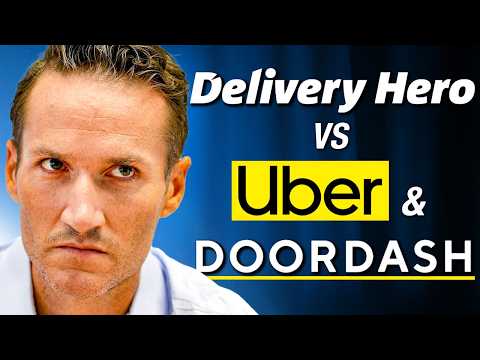
Niklas Östberg, Founder @ Delivery Hero: Competing with Uber and Doordash in a Capital Arms Race
Niklas Östberg (guest), Harry Stebbings (host)
In this episode of The Twenty Minute VC, featuring Niklas Östberg and Harry Stebbings, Niklas Östberg, Founder @ Delivery Hero: Competing with Uber and Doordash in a Capital Arms Race explores delivery Hero’s Niklas Östberg on Greed, Resilience, and Sustainable Scale Niklas Östberg, CEO and co‑founder of Delivery Hero, reflects on building a global food and quick‑commerce giant, the dangers of overconfidence, and how capital market cycles reshaped his thinking on risk and valuation.
Delivery Hero’s Niklas Östberg on Greed, Resilience, and Sustainable Scale
Niklas Östberg, CEO and co‑founder of Delivery Hero, reflects on building a global food and quick‑commerce giant, the dangers of overconfidence, and how capital market cycles reshaped his thinking on risk and valuation.
He explains why they chose debt over equity at the peak, how stock price collapse exposed that decision, and why disciplined cohort economics and sustainable unit economics matter more than rapid, subsidized growth.
Östberg argues most performance is driven by internal execution, not competition, and details contrarian bets like selling their German home market, doubling down on logistics and quick commerce, and aggressive M&A of small local players.
He also discusses maintaining speed at scale, authentic leadership, retaining founders post‑acquisition, and his nuanced views on regulation, Europe’s startup ecosystem, and the real long‑term impact of AI and automation on the industry.
Key Takeaways
Avoid greed-fueled capital decisions; over-raising debt can be fatal when cycles turn.
Delivery Hero chose debt over equity at a €30–35B valuation because they felt “unstoppable” and feared dilution on the way to a perceived €100B outcome; when the stock dropped 50%+, equity became inaccessible and debt became a heavy constraint.
Get the full analysis with uListen AI
Sustainable cohorts and unit economics matter more than explosive top-line growth.
Östberg repeatedly points to cohort behavior as “gravity”: discount-driven spikes (e. ...
Get the full analysis with uListen AI
Great leaders must be willing to be contrarian when their judgment is strong.
He cites doubling down on logistics in 2015, heavy investment in quick commerce, and selling their German home market as deeply unpopular but ultimately value-creating moves that improved customer experience and sharpened global execution.
Get the full analysis with uListen AI
Execution and culture drive outcomes far more than competitor behavior or balance sheets.
He estimates performance as “80% our execution, 20% competition,” arguing that even powerful rivals like Uber Eats and DoorDash are constrained by the same return thresholds and cannot sustainably overspend if your service is strong.
Get the full analysis with uListen AI
Speed at scale requires radical simplification, clear ownership, and local accountability.
Östberg emphasizes splitting goals to the smallest accountable units (e. ...
Get the full analysis with uListen AI
Founder retention post-M&A hinges on trust, autonomy, and treating them as co-founders of the group.
Instead of top‑down orders, he focuses on sharing data, convincing rather than overruling, and giving acquired founders broad influence across Delivery Hero, which keeps high-caliber entrepreneurs like Glovo’s Oscar engaged long-term.
Get the full analysis with uListen AI
Regulation can tilt the playing field against European companies if applied asymmetrically.
He argues Europe’s heavy compliance stack (GDPR, sustainability reporting, etc. ...
Get the full analysis with uListen AI
Notable Quotes
“We thought that we were unbeatable, unstoppable… We got greedy.”
— Niklas Östberg
“In the end, cohorts are almost like gravity. They always work.”
— Niklas Östberg
“Great leaders follow their beliefs. When they do, people follow them.”
— Niklas Östberg
“I saw it as 80% competition, 20% our own execution. I’ve learned it’s 80% our own execution and 20% competition.”
— Niklas Östberg
“Complexity is a killer of speed.”
— Niklas Östberg
Questions Answered in This Episode
How should founders decide between raising equity and raising debt when markets are euphoric, and what early warning signs indicate they’re crossing into “greed” territory?
Niklas Östberg, CEO and co‑founder of Delivery Hero, reflects on building a global food and quick‑commerce giant, the dangers of overconfidence, and how capital market cycles reshaped his thinking on risk and valuation.
Get the full analysis with uListen AI
What concrete metrics and cohort patterns should marketplace businesses track to distinguish between healthy growth and subsidy-driven illusions?
He explains why they chose debt over equity at the peak, how stock price collapse exposed that decision, and why disciplined cohort economics and sustainable unit economics matter more than rapid, subsidized growth.
Get the full analysis with uListen AI
How can leaders know when to remain stubbornly contrarian versus when to accept that changing data should change their minds?
Östberg argues most performance is driven by internal execution, not competition, and details contrarian bets like selling their German home market, doubling down on logistics and quick commerce, and aggressive M&A of small local players.
Get the full analysis with uListen AI
What organizational structures and incentives best preserve speed and founder-like ownership in very large, multi-country companies?
He also discusses maintaining speed at scale, authentic leadership, retaining founders post‑acquisition, and his nuanced views on regulation, Europe’s startup ecosystem, and the real long‑term impact of AI and automation on the industry.
Get the full analysis with uListen AI
How can European regulators encourage innovation and protect workers and consumers without unintentionally handicapping local tech champions against US and Chinese rivals?
Get the full analysis with uListen AI
Transcript Preview
If you take our Thailand business, we scaled from couple of thousand orders a day up to 400,000 orders a day in less than a year. But it was not sustainable.
Niklas Rosberg, the CEO and co-founder of Delivery Hero, the largest delivery platform in the world.
We thought that we were unbeatable, unstoppable. Therefore, we felt there was a clear path to being a $100 billion company, so why would we have wanted to dilute on $30 billion? We got greedy. Stock fell 5%, then 10 or 15%, and then shortly after more than 50%. Then it was truly too late. Great leaders follow their beliefs. When they do, people follow them. What public market often does is that it values things one or two year forward. And of course, it compares with other companies. We were definitely overvalued, and we are probably undervalued today.
Do you see DoorDash and Uber Eats as your biggest competitors today? Ready to go? (instrumental music) Niklas, this is such a joy for me to do. I mean, when we look at Delivery Hero today, it is one of the generational defining companies of Europe. So thank you so much for joining me today.
Ah, thank you very much. Very kind of you.
Now, I heard from some of your friends that you are the most resilient person they've ever met, and I heard stories of spraining ankles and cycling 100 kilometers the next day. I think that a lot goes back to our earlier years. Where do you get this unwavering determination and resilience from, do you think?
I think some of it comes back to my, my childhood. I was a cross-country skier. Uh, and for anyone who's not a cross-country skier, it's, it's exhausting. You, you, you train every day. You go out in the dark, two hours interval training in the dark forest of Sweden. That's kind of how a regular day looked like, and I think you build some resilience there. Uh, it's, it's... So I think that came from there. But I think the other thing that also builds resilience is if you feel like you have a purpose and you actually do something where you add value. Um, and I think over the years, I've also learned to focus on what I can impact rather than all the other things. And I, I know that is hard. But I, I really tried to stop caring for what other people think or pleasing others. Uh, so that helps. And then I would say, yeah, having a team around that, that is supportive, um, that, that also helps a lot. But, but it probably comes down to those things. But the skiing definitely makes a difference.
Can I ask? One of my biggest weaknesses is I care far too much about what other people think. Does success help in terms of reducing the importance of others' opinions?
It probably builds a certain confidence that what you're doing i-i-is right, t-that you got something right. It probably also helped that, uh, when you have success, you also get a lot of positive rea- uh, uh, kind of encouragement or people being supportive, and they're... They celebrate success. It's also very easy to, to... And you have to be careful that you don't... that it doesn't, uh, take you off your... I mean, your feet off the ground. Um, but, but I do think that some level of success is probably helpful as well.
Install uListen to search the full transcript and get AI-powered insights
Get Full TranscriptGet more from every podcast
AI summaries, searchable transcripts, and fact-checking. Free forever.
Add to Chrome