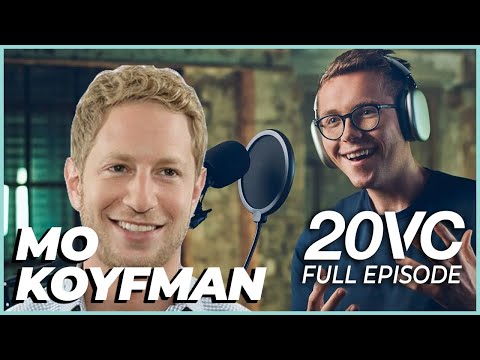
Mo Koyfman: The Secret to Winning in Venture; Why Small Funds Outperform Large Funds | 20VC #915
Mo Koyfman (guest), Harry Stebbings (host)
In this episode of The Twenty Minute VC, featuring Mo Koyfman and Harry Stebbings, Mo Koyfman: The Secret to Winning in Venture; Why Small Funds Outperform Large Funds | 20VC #915 explores mo Koyfman Reveals Why Small, Focused Venture Funds Outperform Giants Mo Koyfman, founder of Shine Capital and former Spark Capital partner, explains how his background, career at IAC and Spark, and deep love for early-stage company building led him to start his own New York–based firm.
Mo Koyfman Reveals Why Small, Focused Venture Funds Outperform Giants
Mo Koyfman, founder of Shine Capital and former Spark Capital partner, explains how his background, career at IAC and Spark, and deep love for early-stage company building led him to start his own New York–based firm.
He argues that small, constrained funds typically outperform large early-stage funds because constraints enforce discipline in deal count, check size, and follow-ons, while large pools of capital encourage undisciplined investing.
Koyfman details Shine’s approach to structure (clear leadership, meritocracy), portfolio construction (concentrated, ownership-focused), and reserves (“deserves,” not automatic pro rata), emphasizing rigorous decision-making and honest communication with founders.
He contrasts boutique early-stage investors with multistage megafunds, urging founders to choose investors for whom their company truly matters, and predicts a shakeout of “tourist” capital as excess money leaves the ecosystem.
Key Takeaways
Smaller, constrained early-stage funds often produce better returns.
Koyfman argues that when fund size is limited, managers are forced to be selective about deal count, check size, and follow-ons, avoiding the “YOLO” mentality that plagues overcapitalized early-stage funds.
Get the full analysis with uListen AI
Fund structure and governance materially impact decision quality.
He prefers an investment-firm model with clear leadership, defined roles, and meritocracy over broad partnerships, which can complicate investment and personnel decisions and dilute accountability.
Get the full analysis with uListen AI
Treat reserves as “deserves,” not entitlements.
Shine does not pre-allocate reserves deal-by-deal; instead, it keeps a fund-level reserve pool and allocates follow-on capital to companies that truly earn it, reducing the tendency to throw good money after bad.
Get the full analysis with uListen AI
Ownership still matters—if you’re a picker, not an indexer.
Because Shine does 10–12 deals a year and leads/co-leads, it targets double-digit ownership (often around 10–12%) so that winners can materially move the fund, in contrast to high-volume, low-ownership indexing strategies.
Get the full analysis with uListen AI
Honest, sometimes painful feedback is ultimately a gift to founders.
Koyfman maintains that telling founders when a business is unlikely to work—and advising either a hard pivot or an orderly wind-down—can save them years of wasted effort and increase the odds of future backing.
Get the full analysis with uListen AI
The investor’s relative stake and context drive how much they’ll care.
He cautions founders that in megafunds, an early-stage check is often insignificant to the firm and that the partner may not stay; boutique investors whose funds are smaller and more concentrated are structurally more invested in each outcome.
Get the full analysis with uListen AI
Too much capital creates bad habits in startups and VC.
Koyfman believes the recent glut of funding led to overfunded companies, loss of focus and discipline, and weak returns, and expects a shakeout of tourist investors and a healthier, more rational environment ahead.
Get the full analysis with uListen AI
Notable Quotes
“Larger early-stage funds always lead to lesser returns over time.”
— Mo Koyfman
“I live my life by a very simple moniker: strong opinions, weakly held.”
— Mo Koyfman
“They’re not reserves, they’re deserves.”
— Mo Koyfman (via Todd Dagres)
“The more an investment matters to an investor, the better investor they will be for you.”
— Mo Koyfman
“The best thing you can do for an entrepreneur who is working on a business that you know is not going to work is to tell them, in the nicest way possible, why.”
— Mo Koyfman
Questions Answered in This Episode
How should an early-stage founder evaluate whether to take money from a focused boutique firm like Shine versus a large multistage fund?
Mo Koyfman, founder of Shine Capital and former Spark Capital partner, explains how his background, career at IAC and Spark, and deep love for early-stage company building led him to start his own New York–based firm.
Get the full analysis with uListen AI
In practice, how does Shine decide which companies truly “deserve” follow-on capital when the performance signals are still ambiguous?
He argues that small, constrained funds typically outperform large early-stage funds because constraints enforce discipline in deal count, check size, and follow-ons, while large pools of capital encourage undisciplined investing.
Get the full analysis with uListen AI
What specific characteristics in a founder most reliably predict to Koyfman that he has misjudged them in past failed investments?
Koyfman details Shine’s approach to structure (clear leadership, meritocracy), portfolio construction (concentrated, ownership-focused), and reserves (“deserves,” not automatic pro rata), emphasizing rigorous decision-making and honest communication with founders.
Get the full analysis with uListen AI
How can small and mid-sized funds remain collaborative syndicate partners when competing with increasingly aggressive megafunds for allocation?
He contrasts boutique early-stage investors with multistage megafunds, urging founders to choose investors for whom their company truly matters, and predicts a shakeout of “tourist” capital as excess money leaves the ecosystem.
Get the full analysis with uListen AI
If excessive capital has created bad habits, what concrete governance or structural changes should founders adopt to rebuild discipline and focus?
Get the full analysis with uListen AI
Transcript Preview
(instrumental music plays) Three, two, one, zero. You have now arrived at your destination.
Mo, this is such a joy to do. I've been looking forward to this for a long time. I've wanted to have you on the show for a long time, so thank you so much for joining me today.
It's absolutely my pleasure, and as I was just saying to you, I haven't really done much press, um, not that this is press per se, um, since I started Shine, and, uh, when you reached out, I thought this would be a great opportunity to share some of my current thinking. So thank you again for doing it.
Not at all, but it is a fantastic opportunity. And I want to start with a little bit of context. And so talk to me, how did you make your way into the world of venture that I clearly love so much, having done 3,000 episodes? And then how did you come to found Shine most recently?
Yeah. You know, honestly, it was an accident. Uh, if, if you would have asked me about venture capital when I was in college, I, I literally wouldn't have known what it was or barely knew what it was, and I'm dating myself here, but that is the truth. Um, as my old boss, Barry Diller, liked to say, I just put one dumb foot in front of the other.
(laughs)
Um, to be honest, my family background has a lot to do, uh, with where I am today. Uh, my father is an immigrant from the former Soviet Union who came to America when he was 35. He didn't speak a word of English and he didn't have a penny in his pocket. All he had was his intelligence, his education, he was an electrical and mechanical engineer by trade, and his determination. He was helped by a Jewish refugee organization called HIAS and spent his first few months in the US learning English, after which he started as a draftsman at an engineering firm in Manhattan where he met his eventual business partner. Six years later, they started their own engineering firm and they grew it over the next 30 years to be one of the preeminent MEP shops in the city. MEP stood for mechanical, electrical, plumbing, but since they've added telecommunications because obviously that is a core part of infrastructure for commercial real estate today. My mother on the other hand, was the child of immigrants and grew up in Brooklyn. Uh, they didn't have much, but she got a good education and she was embraced by a warm, loving family and community. She moved to Israel after college where most of our family now lives, and met my dad on a trip back to New York where, in her words, she got stuck. My mom, interestingly enough, is an OG software engineer.
(laughs)
She learned to code before she moved to Israel, figuring it would be more useful than her Hebrew teaching degree.
Install uListen to search the full transcript and get AI-powered insights
Get Full TranscriptGet more from every podcast
AI summaries, searchable transcripts, and fact-checking. Free forever.
Add to Chrome