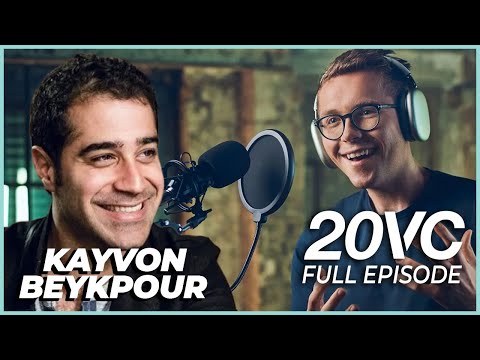
Kayvon Beykpour: How to Structure and Manage the Best Product Reviews | 20VC #894
Kayvon Beykpour (guest), Harry Stebbings (host)
In this episode of The Twenty Minute VC, featuring Kayvon Beykpour and Harry Stebbings, Kayvon Beykpour: How to Structure and Manage the Best Product Reviews | 20VC #894 explores kayvon Beykpour Reveals How Great Product Reviews Drive Iconic Products Kayvon Beykpour, co‑founder of Periscope and former Twitter Head of Consumer Product, discusses how storytelling, conviction, and structure underpin great product building and product reviews.
Kayvon Beykpour Reveals How Great Product Reviews Drive Iconic Products
Kayvon Beykpour, co‑founder of Periscope and former Twitter Head of Consumer Product, discusses how storytelling, conviction, and structure underpin great product building and product reviews.
He explains the importance of framing products as dreams rather than mere features, and how to balance art (intuition, emotion, narrative) with science (data, experimentation, process) in product management.
Beykpour details when and how to hire your first PM, how to run effective product reviews, and how leaders should give feedback without turning every opinion into a mandate.
He shares candid lessons from Periscope—especially around defaults, ephemerality vs permanence, and ignoring early naysayers—while highlighting exemplary product strategies at Adobe and SpaceX.
Key Takeaways
Turn product mechanics into a compelling dream through storytelling.
Don’t just describe what your product does; describe what it means (e. ...
Get the full analysis with uListen AI
Treat product as both art and science, with art often underweighted.
Data, roadmaps, and processes are essential, but the products people love are built with deep emotion and conviction. ...
Get the full analysis with uListen AI
Hire your first PM when you’re only reacting and losing alignment.
Signals include constantly firefighting instead of proactively shaping the product, and growing communication ‘lossiness’ where no one is clear on priorities. ...
Get the full analysis with uListen AI
Interview PMs through real stories, not canned questions or labels.
Use open-ended prompts (“hardest problem you solved,” “product you love/hate and why”) to surface how candidates think, handle ambiguity, resolve conflict, and wear multiple hats—critical traits for early-stage environments.
Get the full analysis with uListen AI
Structure product reviews to serve both teams and leadership.
Kayvon runs weekly reviews with clear archetypes (early hypothesis, pre‑launch, post‑launch), a cross-functional leadership panel, and a short debrief that distills discussion into a few written bullets so teams aren’t overwhelmed or confused.
Get the full analysis with uListen AI
Separate feedback from mandates and be explicit about the difference.
Leaders must repeatedly clarify that most comments in product reviews are input, not orders, and teams should feel empowered to disagree when they have conviction. ...
Get the full analysis with uListen AI
Defaults shape behavior; design them around the primary use case.
Periscope’s shift from ephemeral streams to permanent-by-default archives, driven by rare ‘iconic moment’ use cases, hurt the core hangout/ephemeral use case. ...
Get the full analysis with uListen AI
Notable Quotes
“Being able to interpolate between the mechanics of a product and the dream of a product is really important.”
— Kayvon Beykpour
“I cannot think of a single product that I love that wasn’t built with a high degree of emotion involved.”
— Kayvon Beykpour
“You have to be really good at knowing when other people thinking your idea is terrible should be ignored, but not so much that you’re lying to yourself.”
— Kayvon Beykpour
“Assume everything you hear from leadership at product reviews is just feedback and input, not a directive, unless explicitly stated otherwise.”
— Kayvon Beykpour
“We made the defaults conform to the exception rather than the rule, and I think that was one of the downfalls of Periscope.”
— Kayvon Beykpour
Questions Answered in This Episode
How can early-stage founders practically cultivate the ‘art’ side of product—storytelling and emotion—when they’re under intense pressure to chase metrics?
Kayvon Beykpour, co‑founder of Periscope and former Twitter Head of Consumer Product, discusses how storytelling, conviction, and structure underpin great product building and product reviews.
Get the full analysis with uListen AI
What mechanisms can teams use to safely push back on leadership’s strong opinions in product reviews without fear of career risk?
He explains the importance of framing products as dreams rather than mere features, and how to balance art (intuition, emotion, narrative) with science (data, experimentation, process) in product management.
Get the full analysis with uListen AI
How do you decide which small subset of overwhelming customer feedback should actually change your roadmap, especially in a large-scale consumer product?
Beykpour details when and how to hire your first PM, how to run effective product reviews, and how leaders should give feedback without turning every opinion into a mandate.
Get the full analysis with uListen AI
In hindsight, how would you have designed Periscope’s ephemerality and defaults differently to serve both everyday hangouts and rare ‘historic moment’ broadcasts?
He shares candid lessons from Periscope—especially around defaults, ephemerality vs permanence, and ignoring early naysayers—while highlighting exemplary product strategies at Adobe and SpaceX.
Get the full analysis with uListen AI
What specific habits or rituals can product leaders adopt to avoid waiting too long to correct a bad hire on their team?
Get the full analysis with uListen AI
Transcript Preview
(beeping) Three, two, one, zero. (ding) You have now arrived at your destination.
Kayvon, this is such a joy for me to do. I've been so looking forward to this one. I've been a fan from afar for a while, and then when Scott Belsky said, "Kayvon is the best, you have to have him on," I jumped at the chance. So thank you so much for joining me today.
Thanks for having me. Great to meet you, Harry.
It is so great to me. But I wanna start with actually the story of you and Scott that we just touched on before. So tell me, how did you and Scott first engage around Periscope? And talk to me about that first encounter in those early days of Periscope.
Yeah. So, um, I was actually introduced to Scott by, um, an investor who we had pitched on Periscope. Um, and this is before we'd even built the product. We had mock-ups, we had prototypes, we had basically a fundraising deck, and this was at the time, I think we had t- like it was just me and my co-founder. Maybe we had, like, one or two other people that we were already working with, um, on, on the early team. But this was, like, pre-the app existing, um, and we were doing fundraising 'cause we wanted to hire a team. And, um, basically, like, everyone said no, um, but a few people were interested. And one of the VCs who we had pitched, um, who ended up saying no, by the way, was like, "Eh, this isn't really for me, but I've been talking to this guy, Scott Belsky, who had, like, shared an idea similar to this back in the day. Let me put you in touch with him because maybe you two can, can hit it off." Um, which I'm so grateful for that introduction because I ended up, um, talking to Scott probably a week later, and we just, it, like, it was instant chemistry. First of all, he had been thinking about this idea. And, uh, you know, at the time, we sort of were imagining, um ... What we wanted to build with Periscope was, like, the closest thing to teleportation, you know? Like, we didn't actually know how to build, like, the Star, Star Trek manifestation of, um, you know, you know, uh, beaming people anywhere, um, though that would be really, really cool. Like, we're just not that smart. So we were like, what's the easiest way we can build the most analogous version of this with the technology we have today? And that's when sort of, like, live streaming entered the picture. And Scott, for whatever reason, gi- you know, he's brilliant in his own way, and had been, uh, very successful building Behance and all that. This idea had been sort of stuck in his mind for, for a long time as well. So I think we instantly hit it off for the shared love we had for this, for this dream. Um, and in that first conversation, I can't tell you how refreshing it was, having spent weeks trying to fundraise and getting, you know, striking out left and right. Scott was like, "I'm in. I wanna support you guys." Um, he wrote us, uh, he wrote us, like, a th- uh, well, I don't wanna share how much the check was. But he wrote us a substantially sized check and, and was like, "I wanna be on the team and help you guys make this come to life." Um, and from then on, you know, Scott was just part of our, he was part of our team. He was, like, just an incredible resource for us to, um, you know, keep iterating on this dream and turning it into a reality eventually.
Install uListen to search the full transcript and get AI-powered insights
Get Full TranscriptGet more from every podcast
AI summaries, searchable transcripts, and fact-checking. Free forever.
Add to Chrome