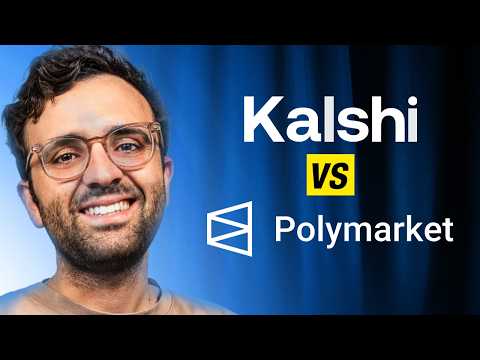
Kalshi CEO Tarek Mansour on Raising $1BN, CNN and CNBC Deals & the Polymarket Feud
Tarek Mansour (guest), Harry Stebbings (host)
In this episode of The Twenty Minute VC, featuring Tarek Mansour and Harry Stebbings, Kalshi CEO Tarek Mansour on Raising $1BN, CNN and CNBC Deals & the Polymarket Feud explores kalshi CEO on $1B Raise, Polymarket Rivalry, and Regulated Bets Kalshi CEO Tarek Mansour explains why the company raised $1B at an $11B valuation despite already being profitable, framing it as fuel to build a global, regulated prediction-market brand and to meet capital requirements as volume scales.
Kalshi CEO on $1B Raise, Polymarket Rivalry, and Regulated Bets
Kalshi CEO Tarek Mansour explains why the company raised $1B at an $11B valuation despite already being profitable, framing it as fuel to build a global, regulated prediction-market brand and to meet capital requirements as volume scales.
He describes a structural consumer shift from passively consuming news and culture to actively predicting outcomes, positioning Kalshi as a new kind of financial market that feels intuitive and accessible to mainstream users.
Mansour dives into Kalshi’s intense rivalry with Polymarket, their regulatory battles with the U.S. government, and landmark media partnerships with CNN and CNBC that embed prediction markets directly into news coverage.
He also reflects on leadership doubts, the dangers of over-capitalization, hard lessons from FTX and SBF, and his evolving philosophy on product versus marketing, hiring, investor relationships, and founder resilience.
Key Takeaways
A massive TAM plus a visible behavior shift justifies aggressive capital deployment.
Mansour argues the $1B raise is less about survival and more about seizing a rare inflection point: consumers are moving from passively consuming news/sports/culture to actively predicting outcomes, and prediction-market traders are emerging as a new economic class.
Get the full analysis with uListen AI
Regulation-first in financial services can be a durable competitive moat.
By spending years to get federally regulated and even suing the government over election markets, Kalshi deliberately chose the slower, compliant path—avoiding the FTX-style shortcut and now benefiting from legitimacy, longevity, and mainstream partnerships that unregulated players can’t easily access.
Get the full analysis with uListen AI
Rivalries can be accelerants, not distractions, if channeled correctly.
Mansour frames the Kalshi–Polymarket feud as analogous to Messi–Ronaldo or Brady–Manning: the competition forces both sides to sharpen product, marketing, and regulatory strategy, ultimately expanding the entire prediction-market category for users.
Get the full analysis with uListen AI
Product excellence alone is insufficient; brand and marketing must be built in parallel.
He admits Kalshi was too product-centric for too long, wrongly assuming that if the product was great growth would follow; his updated view is that product and marketing are twin muscles that must be developed together, not sequentially.
Get the full analysis with uListen AI
Prediction markets are positioned as information systems, not gambling venues.
Mansour stresses that Kalshi is a neutral exchange, not a house: users trade against each other, Kalshi earns a fee regardless of win/loss, and most users are there to learn and monitor probabilities, not to trade aggressively—making it closer to financial markets and news than to casinos.
Get the full analysis with uListen AI
Long-term founder reputation hinges on doing right by early backers and partners.
He consciously protected early investors’ pro rata even when top-tier funds wanted to squeeze them, viewing company-building as an infinite game where trust, fairness, and consistent behavior compound into better talent, capital, and partnership opportunities.
Get the full analysis with uListen AI
Scaling from 100 to many hundreds of employees requires trading some chaos for process.
Mansour acknowledges that Kalshi’s culture is flat, scrappy, and product-obsessed to the point of chaos; his current leadership challenge is adding structure and repeatable processes without sacrificing speed of shipping and growth.
Get the full analysis with uListen AI
Notable Quotes
“What happened with Kalshi in the election was a bit of a ChatGPT moment for our industry.”
— Tarek Mansour
“An industry truly becomes an industry when there's a rivalry.”
— Tarek Mansour
“You truly can will something into existence.”
— Tarek Mansour
“We were seen as the safe, boring losers because we were committed to being regulated first.”
— Tarek Mansour
“Most people that come through your door should probably not be at your company.”
— Tarek Mansour
Questions Answered in This Episode
If prediction markets become deeply integrated into news and politics, how might they influence public opinion and political behavior over time?
Kalshi CEO Tarek Mansour explains why the company raised $1B at an $11B valuation despite already being profitable, framing it as fuel to build a global, regulated prediction-market brand and to meet capital requirements as volume scales.
Get the full analysis with uListen AI
Where is the ethical line for markets on wars, pandemics, or geopolitical crises, and who should decide which events are too sensitive to list?
He describes a structural consumer shift from passively consuming news and culture to actively predicting outcomes, positioning Kalshi as a new kind of financial market that feels intuitive and accessible to mainstream users.
Get the full analysis with uListen AI
How can Kalshi prevent a future where the same kind of asymmetric-information professionals that dominate Wall Street also dominate prediction markets?
Mansour dives into Kalshi’s intense rivalry with Polymarket, their regulatory battles with the U. ...
Get the full analysis with uListen AI
At what scale or product milestone should a startup deliberately trade speed for organizational structure and process, and how does a founder know they’ve waited too long?
He also reflects on leadership doubts, the dangers of over-capitalization, hard lessons from FTX and SBF, and his evolving philosophy on product versus marketing, hiring, investor relationships, and founder resilience.
Get the full analysis with uListen AI
Could a fully prediction-market-native media network eventually displace legacy players like CNN and CNBC, or will partnerships always be strategically superior to owning the whole stack?
Get the full analysis with uListen AI
Transcript Preview
Kind of what happened with Kalshi in the election was a bit of a ChatGPT moment for our industry.
Kalshi is one of the fastest-growing companies on the planet. In the last week, they announced a $1 billion raise at an $11 billion valuation. Dave, Tariq joins me for his only interview following these announcements.
An industry truly becomes an industry when there's a rivalry. Without Polymarket, we wouldn't have pushed our marketing and pushed our product as hard.
Did you ever cross paths with SBF? And what did you learn from observing FDI since implosion? Ready to go? (instrumental music plays) Tariq, dude, it is so fucking good to have you on the show. I mean, holy cow, what a rampage Kalshi's been on, my friend. Thank you so much for coming back.
Thanks for having me. Super excited.
Now, dude, I got to start on the main thing. A billion dollars. Uh, the first thing I have to ask, why does Kalshi need a billion dollars?
That's a good question. But what we've realized in the last, um, I would say six to nine months, given the sort of acceleration of what we've seen, um, is I think the opportunity ahe- ahead of us is may- maybe even bigger than we had all possibly imagined. There's a few symptoms of that. So, one, I don't know if you know this, Harry, but, um, Kalshi this year, um, is at- at this scale at least, you know, I think the fasted growing company in America outside of AI. I think Anthropic is growing faster, and I'm not sure about Metacore and Cursor, but we're, you know, growing at that sort of, uh, at that- that pace, at that rate. Um, and number two, what we're seeing, which is even more important, the- the qualitative, uh, thing that we're seeing is there's a- there's a real and rare shift in consumer behavior. You know, people are kind of turning from, like, passive watchers of events or news or- or sports or other things that they engage with in real life to active participants. You know? That- that natural behavior of wanting to predict the future or debating about something is turning into activity on Kalshi. That is rare. Like, when you see this shift in consumer behavior, I mean, you've seen it in Airbnb with the hosts and- and Uber with riders, when, you know, we're seeing a new class of people, in this case prediction market traders, becoming a thing, that's indicative of a very, very massive opportunity ahead of us. And, you know, when you have a massive opportunity ahead of you, you- you want to go big, you want to bet big, and so we're- we're really scaling up for that opportunity here.
Totally get you. What does a billion dollars get for you that you couldn't do without?
I think one... So, okay, we are at a point right now where, so we're growing incredibly fast, um, we are also profitable right now, um, you know, and, um... So it's a good question. I think the next phase is how do we build a global brand? How do we build a brand that people know, they talk about, they associate with, um, and how we put the story of the company and the story of the brand out there? Um, and so there's a lot of marketing that's coming. Obviously scaling the team. So, we're still 100 people. And number two is, we're a financial market, we're a financial, uh, company, and so as the volumes increase, as liquidity increases, uh, y- you know, as a regulated f- like, we're a federally regulated comp- uh, financial exchange. It's a little bit like a bank or some of the kind of regulated clearing houses you hear about. You have re- reserve requirements, and added capital on the balance sheet, think of it a little bit as a safety cushion. S- things that adds sort of, um, uh, uh, it enables us to do things in- in- in, like faster. Like, more capital enables you to do things faster in financial services, and that's usually a good thing.
Install uListen to search the full transcript and get AI-powered insights
Get Full TranscriptGet more from every podcast
AI summaries, searchable transcripts, and fact-checking. Free forever.
Add to Chrome