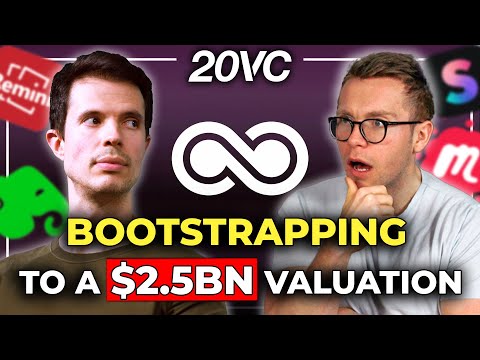
Luca Ferrari: Scaling to 500M Downloads, $360M in Reported 2023 Sales and a $2.55BN Valuation |E1127
Luca Ferrari (guest), Harry Stebbings (host)
In this episode of The Twenty Minute VC, featuring Luca Ferrari and Harry Stebbings, Luca Ferrari: Scaling to 500M Downloads, $360M in Reported 2023 Sales and a $2.55BN Valuation |E1127 explores luca Ferrari on Humility, Acquisitions, and Building Bending Spoons’ Empire Luca Ferrari, co-founder and CEO of Bending Spoons, explains how a failed first startup led him to invert the classic startup playbook: instead of building new products to find product-market fit, Bending Spoons acquires products that already have it and then radically improves them.
Luca Ferrari on Humility, Acquisitions, and Building Bending Spoons’ Empire
Luca Ferrari, co-founder and CEO of Bending Spoons, explains how a failed first startup led him to invert the classic startup playbook: instead of building new products to find product-market fit, Bending Spoons acquires products that already have it and then radically improves them.
He outlines their hybrid model—part deep product/engineering company, part long-term capital allocator—used to grow apps like Evernote and others to massive scale while mostly self-funding through cash flows and debt.
Ferrari emphasizes intellectual humility, rigorous capital allocation, and large margins of safety, openly sharing where they mispriced deals, overestimated user acquisition, or took too little risk for fear of disappointing others.
He also dives into talent strategy and culture: selecting for raw talent and motivation over experience, supporting remote work while valuing in-person collaboration, and obsessing over building one of the most admired companies of all time.
Key Takeaways
Invert the classic startup playbook: buy product-market fit, then rebuild.
After their first startup failed from building the wrong product, Bending Spoons chose to acquire products with existing users/brand and then completely rework code, UX, monetization, and growth—using an operator-led approach more akin to a tech company than pure PE.
Get the full analysis with uListen AI
Price acquisitions via discounted long-term cash flows, not exit multiples.
Because they buy to hold indefinitely rather than flip, Bending Spoons models the future free cash flows they can reasonably influence, discounts them, and sets a max price—accepting that the projection is noisy and demanding a large margin of safety.
Get the full analysis with uListen AI
Assume you are more biased and less smart than you feel.
Ferrari stresses that overconfidence is the root of major capital allocation errors; he deliberately downgrades his own forecasts, especially on new ideas, and bakes in pessimism to counter natural optimism about his own projects.
Get the full analysis with uListen AI
User acquisition is the hardest metric to forecast—treat it cautiously.
Their biggest mispricings came from overestimating future user growth; Ferrari notes UA depends on many external, uncontrollable variables and is far less fixable than monetization or product improvements, so assumptions here must be conservative.
Get the full analysis with uListen AI
Hire for talent and motivation; treat experience as secondary.
Bending Spoons optimizes for raw problem-solving ability and drive, using practical tests rather than traditional interviews, and largely de-emphasizes prior experience, which they believe gives better long-term performance even if onboarding is slower.
Get the full analysis with uListen AI
Maintain capital-structure fairness: avoid liquidation preferences when possible.
Ferrari fought to keep all shareholders—founders, employees, and investors—on equal economic footing so that employees who bet their careers on the company are not wiped out in downside scenarios while preferred investors are protected.
Get the full analysis with uListen AI
Use competitive tension and keep options open in fundraising.
He advises founders not to rely on early verbal enthusiasm from investors; instead, maintain multiple engaged parties through to the signing stage to preserve leverage on terms, timing, and check size.
Get the full analysis with uListen AI
Notable Quotes
“The moment you think you're very smart, the likelihood that you make very dumb mistakes skyrockets.”
— Luca Ferrari
“We let others seek product-market fit, and then we acquire their company and try to make it even better.”
— Luca Ferrari
“It's almost like a private equity had a baby with Google.”
— Luca Ferrari
“Assume you're not as smart as you think you are.”
— Luca Ferrari
“If you want to be one of the very best at what you do, you need to work your ass off for a very long time.”
— Luca Ferrari
Questions Answered in This Episode
How would Bending Spoons’ acquisition-and-rebuild model translate to non-software or non-consumer businesses?
Luca Ferrari, co-founder and CEO of Bending Spoons, explains how a failed first startup led him to invert the classic startup playbook: instead of building new products to find product-market fit, Bending Spoons acquires products that already have it and then radically improves them.
Get the full analysis with uListen AI
What specific analytical framework does the team now use to avoid overestimating future user acquisition for new deals?
He outlines their hybrid model—part deep product/engineering company, part long-term capital allocator—used to grow apps like Evernote and others to massive scale while mostly self-funding through cash flows and debt.
Get the full analysis with uListen AI
How does Bending Spoons measure whether its internal talent strategy (high talent/motivation, low experience) is outperforming more traditional hiring approaches?
Ferrari emphasizes intellectual humility, rigorous capital allocation, and large margins of safety, openly sharing where they mispriced deals, overestimated user acquisition, or took too little risk for fear of disappointing others.
Get the full analysis with uListen AI
What concrete product and monetization changes have they implemented at Evernote since acquisition, and how have users responded?
He also dives into talent strategy and culture: selecting for raw talent and motivation over experience, supporting remote work while valuing in-person collaboration, and obsessing over building one of the most admired companies of all time.
Get the full analysis with uListen AI
Given Ferrari’s belief that AI will destroy more jobs than it creates, how is Bending Spoons preparing its own workforce and portfolio for that future?
Get the full analysis with uListen AI
Transcript Preview
(instrumental music) The moment you think you're very smart, the likelihood that you make very dumb mistakes skyrockets, in my opinion. We let others seek pro- market fit, and then we... if they will sell it to us, we will acquire their company and try to make it even better than they, they have made it up to that point. The reason why we, we took that route, I think, is precisely because we crashed and burned by being arrogant in thinking we knew what the market would want and we could build it for them.
Luca, I am so excited for this. I think Bending Spoons is one of the coolest stories that, uh, we've seen in recent times in startup land. So first, thank you so much for joining me.
Thank you for having me. It's a pleasure.
I would love to start with a little bit of context. What would your parents and your teachers have said about the young Luca growing up? How would they have described you?
Well, parents are probably not a good, uh, a good source. It seems to me they tend to be biased. Uh, I would say my teachers probably would say that I was, uh, incredibly shy. Some may even say I was pathologically shy. Uh, weird, I think. They would say probably, probably weird. And gentle, I think. I was considerate. Uh, kind of, uh, very careful not to hurt, uh, people's feelings. Yeah, probably those three.
I would have been described as weird too. Can I ask, did you feel like an outsider when you were growing up? I di- I didn't have many friends at school, and it shaped a lot of how I do what I do.
Yeah, probably. I really wanted to, to make friends. I couldn't for the first, probably, 10 or 12 years of my life. Yeah, I would say it's 10 years. Uh, I had major struggles socially. I'm not, um, incredibly well versed with, uh, socializing these days, but I (laughs) have definitely improved a lot. Um, so yeah, I guess you could say an outsider. But an outsider who wanted to be an insider, who was an outsider because he was, uh, incompetent, uh, at, uh, being part of, uh, you know, of, of people's groups.
Sorry for this weird tangent. Did you s- ... Would you say you've become an insider or you just accepted being an outsider?
No, I think I, I had different phases. So I was, by, you know, your definition, I was probably an outsider initially who really wanted to be an insider. Then I became, you know, uh, kind of average, so make it an insider. Like, I started having friends and being invited, uh, to, to doing things with others. And then as I grew older, particularly the last five or six years, I think I've become a little bit more of an outsider again. Uh, mostly because I find my bandwidth and my patience, uh, have become more limited, or perhaps have been tested more aggressively. And so I've learned to build more walls and more protections.
Install uListen to search the full transcript and get AI-powered insights
Get Full TranscriptGet more from every podcast
AI summaries, searchable transcripts, and fact-checking. Free forever.
Add to Chrome