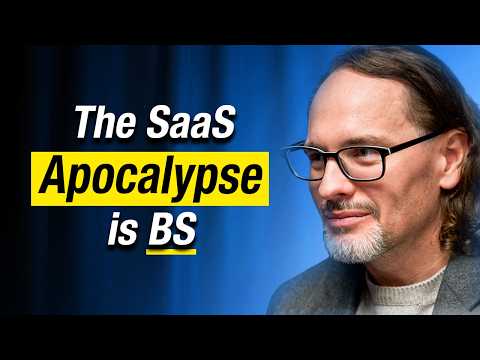
Mitchell Green: Why 50% of VCs Should Not Exist
Mitchell Green (guest), Harry Stebbings (host), Harry Stebbings (host)
In this episode of The Twenty Minute VC, featuring Mitchell Green and Harry Stebbings, Mitchell Green: Why 50% of VCs Should Not Exist explores mitchell Green on AI, SaaS sell-offs, and venture industry excess Mitchell Green argues the recent SaaS/public software sell-off is largely a reset of overly optimistic growth estimates rather than a signal that AI will wipe out incumbents, and he is actively buying cash-generative public software names.
Mitchell Green on AI, SaaS sell-offs, and venture industry excess
Mitchell Green argues the recent SaaS/public software sell-off is largely a reset of overly optimistic growth estimates rather than a signal that AI will wipe out incumbents, and he is actively buying cash-generative public software names.
He believes AI will drive major productivity gains mostly through sales, support, and distribution improvements—not by instantly replacing all software—and that job disruption will happen slower than people expect due to regulation, retraining, and adoption friction.
Green calls ByteDance the most advanced and underappreciated AI company, contending China has structural advantages (power buildout, talent, industrial policy) and shouldn’t be counted out in an AI “war.”
He also criticizes venture’s crowding and lack of price discipline, emphasizing that DPI (returned cash) matters more than paper marks, and that many VCs actively destroy value by pushing reckless burn and offering low-quality operational guidance.
Key Takeaways
The SaaS sell-off is more about estimate resets than existential AI threat.
Green argues sell-side numbers were too high across software, so stocks fell as estimates came down; once expectations reset, companies can beat and guide up again, making quality names attractive during “dead money” periods.
Get the full analysis with uListen AI
Profitable incumbents won’t vanish; leverage is the real vulnerability.
He bets legacy software persists (mainframes, Oracle, Microsoft, SAP) and says the companies most at risk in disruption are heavily levered ones that lack cash flow to invest and adapt.
Get the full analysis with uListen AI
If there’s no earnings, there’s no floor—scale into positions instead of timing bottoms.
Green recommends averaging in on down days, emphasizing that without profitability (or clear cash flow), valuation support can disappear quickly, making “catching the knife” unreliable.
Get the full analysis with uListen AI
AI’s near-term impact is a productivity boom inside existing operations, not instant software replacement.
He highlights that many software businesses are dominated by go-to-market and support costs; AI can raise worker output and slow hiring rather than trigger immediate mass layoffs—especially in regulated industries that can’t freely use tools yet.
Get the full analysis with uListen AI
Gross Dollar Retention is the core quality metric; weak GDR creates “living dead” companies.
He prioritizes gross retention over net retention, arguing that businesses with 60–80% gross retention become unsalvageable at scale because they must overspend just to refill churned revenue.
Get the full analysis with uListen AI
Selling is a job: constantly re-underwrite and take liquidity when windows open.
Green frames investing around achieving 2–5x in 3–7 years, and urges funds—especially emerging managers—to sell partial positions during financings to build DPI and stay fundable.
Get the full analysis with uListen AI
Venture is overcrowded and often value-destructive due to tourists and undisciplined pricing.
He claims 50–70% of VCs shouldn’t exist, pointing to “idea-at-$1–2B” spinouts and to investors pressuring founders to burn for growth to justify entry valuations, rather than building durable companies.
Get the full analysis with uListen AI
Notable Quotes
““ByteDance is the most advanced AI company in the world… very underappreciated by the Western world.””
— Mitchell Green
““Buying is glamorous, selling is the job.””
— Mitchell Green
““Marks are opinions. DPI is math.””
— Mitchell Green
““I think fifty percent of people in the venture business should not actually be in the business.””
— Mitchell Green
““If you don’t have earnings… there is no floor.””
— Mitchell Green
Questions Answered in This Episode
You said software estimates were simply too high—what specific signals tell you estimates have fully reset and it’s time to size up aggressively?
Mitchell Green argues the recent SaaS/public software sell-off is largely a reset of overly optimistic growth estimates rather than a signal that AI will wipe out incumbents, and he is actively buying cash-generative public software names.
Get the full analysis with uListen AI
You prioritize gross dollar retention over net—how do you adjust for usage-based pricing or seat-model erosion where “retention” is structurally changing?
He believes AI will drive major productivity gains mostly through sales, support, and distribution improvements—not by instantly replacing all software—and that job disruption will happen slower than people expect due to regulation, retraining, and adoption friction.
Get the full analysis with uListen AI
What concrete product/ops evidence makes you call ByteDance the most advanced AI company (data flywheel, infra, models, distribution, or applied AI ROI)?
Green calls ByteDance the most advanced and underappreciated AI company, contending China has structural advantages (power buildout, talent, industrial policy) and shouldn’t be counted out in an AI “war.”
Get the full analysis with uListen AI
If China’s edge is power and speed of buildout, what US investable bets (generation, grid, permitting, nuclear, data-center supply chain) best hedge that disadvantage?
He also criticizes venture’s crowding and lack of price discipline, emphasizing that DPI (returned cash) matters more than paper marks, and that many VCs actively destroy value by pushing reckless burn and offering low-quality operational guidance.
Get the full analysis with uListen AI
You predict local backlash to data centers—what regulatory outcomes do you expect, and how would they change AI economics (capex, pricing, location)?
Get the full analysis with uListen AI
Transcript Preview
ByteDance is the most advanced AI company in the world. You know, it's very underappreciated by the Western world.
Today, we have Mitchell Green at Lead Edge joining us. In a world of fluff and framework-thinking investors, Mitchell Green is a money maker. Mitchell has co-led or led investments in insane companies like Alibaba, Benchling, ByteDance, Grafana, among many others.
I think fifty percent of people in the venture business should not actually be in the business. There's too much money, and there's, like, too many tourists. Fifty, sixty percent of people in this industry that actually probably add negative value to companies. People that spin out of, like, Anthropic or OpenAI and raise [laughs] money at, like, two billion dollars for a freaking idea. Like, there's nothing more than an idea and a napkin. Tell us that seems complete lunacy. There's gonna be a really big downturn. Markets just don't go up forever, and I think it's gonna happen in the next ten years. Buying is glamorous, selling is the job. Don't count China out. I bet they win the AI world.
Ready to go? [upbeat music] Mitchell, dude, it is so good to have you back in the studio. I love doing these with-- You and Larry are my favorites. You know why?
We gotta have us on together.
No, I-- Do you know what'd be great to have you on together? If you're in London together, we should do it, and we should do it actually over, like, a dinner and mic everyone up.
Hundred percent.
proper style.
It'll be amazing.
Uh, listen, I wanna start with, um, something that's actually quite disarming for a lot of investors today, which is bluntly the SaaSpocalypse, the SaaSaca. And we're looking at the markets, and they're just in the shitter. And I think there's a lot of people who are questioning whether they are actually [chuckles] good investors or whether we were just in a bullian cycle. Is this justified in terms of the downturn, or is this an overreaction to AI and anthropic product releases?
We are buyers. We're buying software stocks right now. You know, a portion of our funds can be invested in public equities, so we're buying companies like Procore, Workday, Appian. Um, we love Clearwater Analytics, but it's in the process of being taken private, so the stock doesn't move. Um, we're big investors in Toast, which we've been buying back. We were early investors in it and sold and are rebuying. These companies aren't going anywhere. Like, the incumbents have distribution, data, and balance sheets. You know, it's a, it's a fool's errand to think all these companies are gonna go away. Now, that being said, in any period when there is big periods of disruption, you know, y-you know, there will be new companies that are created, there will be incumbents that thrive and adapt, and there'll be some incumbents that blow up.
Help me understand. I, I love your perspective, but I don't understand it. Workday is at six point eight percent growth now. We're seeing the cannibalization of the seat model. We're seeing bluntly no impressive use of any agent products within the existing incumbent set.
Install uListen to search the full transcript and get AI-powered insights
Get Full TranscriptGet more from every podcast
AI summaries, searchable transcripts, and fact-checking. Free forever.
Add to Chrome