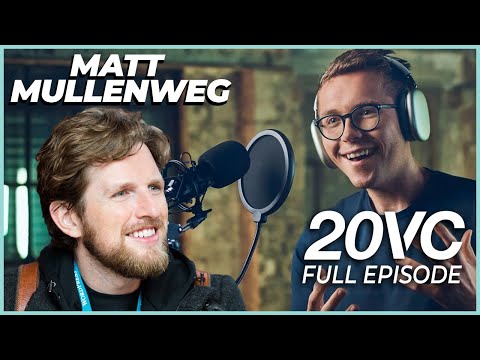
Matt Mullenweg: How I Founded WordPress; Storytelling Tips; How to Give Feedback | 20VC #905
Harry Stebbings (host), Matt Mullenweg (guest)
In this episode of The Twenty Minute VC, featuring Harry Stebbings and Matt Mullenweg, Matt Mullenweg: How I Founded WordPress; Storytelling Tips; How to Give Feedback | 20VC #905 explores matt Mullenweg on leadership, longevity, vulnerability, and building WordPress Matt Mullenweg discusses the origins of WordPress, how open source shaped its trajectory, and why he committed decades of his life to the project once he saw its global impact.
Matt Mullenweg on leadership, longevity, vulnerability, and building WordPress
Matt Mullenweg discusses the origins of WordPress, how open source shaped its trajectory, and why he committed decades of his life to the project once he saw its global impact.
He goes deep on his leadership philosophy at Automattic: radical transparency, written communication over email, distributed teams, varying between wartime and peacetime styles, and balancing autonomy with accountability.
The conversation also explores his personal psychology—insecurities, coping with risk, grief over his father’s passing, friendship, and why self-awareness work (meditation, hypnotherapy, coaching) matters for leaders.
He closes by outlining Automattic’s long-term mission to democratize publishing and commerce, keep the web weird and independent, and build tools that enhance individual creativity rather than compress it into uniform social profiles.
Key Takeaways
Prioritize written, transparent communication to scale culture and decision-making.
Automattic replaced internal email with company-wide blogs (P2), creating a searchable, persistent record of decisions, investor meetings, and debates that new employees can instantly access instead of losing context in private inboxes.
Get the full analysis with uListen AI
Vary your leadership style explicitly between wartime and peacetime modes.
Matt tells teams when he’s in “command and control” mode (e. ...
Get the full analysis with uListen AI
Default to trust and optimism, but accept paying an “optimism tax.”
He starts by fully trusting people and occasionally gets burned, yet believes the upside of a default-trusting, optimistic life and culture far outweighs the relatively rare downside cases where trust is abused.
Get the full analysis with uListen AI
Design organizations around clear goals and autonomy, not micromanaged tactics.
Where Automattic works best is when leaders set crisp outcomes and give teams wide latitude in how to get there; performance degrades when senior leaders get too involved in the “how,” especially when teams are already doing well.
Get the full analysis with uListen AI
Make reversible decisions fast and irreversible ones slowly and carefully.
Borrowing from Tony Schneider, Matt tries to move quickly on choices that can be undone, but approaches one-way doors (like big leases, benefits that ratchet, or major hires) with deliberate modeling of what they look like over 5–10 years.
Get the full analysis with uListen AI
Use self-awareness tools to understand the hidden drivers behind your behavior.
Hypnotherapy and coaching helped Matt uncover childhood experiences shaping his body insecurities and coping patterns; he argues that leaders who don’t understand their own triggers inevitably lead from fear, tension, or ego.
Get the full analysis with uListen AI
Consistency beats intensity in building habits and personal resilience.
The COVID travel shutdown forced him to face patterns he’d been avoiding; he found that small, consistent practices (exercise, meditation, relationship investment) are more sustainable and effective than sporadic extreme efforts.
Get the full analysis with uListen AI
Notable Quotes
“It's not what you say, it's what people hear.”
— Matt Mullenweg (quoting Frank Luntz)
“A friend is someone who calls you out… a true friend will always tell you if you have something in your teeth.”
— Matt Mullenweg
“I’d much rather live my life in a way that is default trusting and optimistic, even if sometimes I pay an optimism tax.”
— Matt Mullenweg
“We try to make reversible decisions quickly and irreversible decisions very deliberately.”
— Matt Mullenweg
“If you’re going through heck, keep going. Don’t stop and hang out there.”
— Matt Mullenweg
Questions Answered in This Episode
How could more companies practically adopt Automattic’s P2-style transparent communication without overwhelming employees or compromising privacy?
Matt Mullenweg discusses the origins of WordPress, how open source shaped its trajectory, and why he committed decades of his life to the project once he saw its global impact.
Get the full analysis with uListen AI
What signals should a CEO look for to know it’s time to switch from peacetime to wartime leadership (or back again)?
He goes deep on his leadership philosophy at Automattic: radical transparency, written communication over email, distributed teams, varying between wartime and peacetime styles, and balancing autonomy with accountability.
Get the full analysis with uListen AI
How can leaders cultivate default trust and optimism while still protecting the organization from repeated abuses of that trust?
The conversation also explores his personal psychology—insecurities, coping with risk, grief over his father’s passing, friendship, and why self-awareness work (meditation, hypnotherapy, coaching) matters for leaders.
Get the full analysis with uListen AI
In your own company, which “irreversible” decisions deserve much more deliberate modeling of their 5–10 year consequences?
He closes by outlining Automattic’s long-term mission to democratize publishing and commerce, keep the web weird and independent, and build tools that enhance individual creativity rather than compress it into uniform social profiles.
Get the full analysis with uListen AI
How might embracing more personal vulnerability—around insecurities, grief, or shame—change the way your leadership team operates day to day?
Get the full analysis with uListen AI
Transcript Preview
Three, two, one, zero.
You have now arrived at your destination.
Matt, I'm so excited for this show. Obviously, we have to thank the main man, Shaq, for making this one happen. I've wanted to do it for a long time. So thank you so much for joining me first.
It's really a pleasure to finally connect in this format.
It totally is. As I said, thrilled to make it happen. But I want to start by saying, you know, we see the incredible journey that you've been on with WordPress and Automattic, but I wanna go back just for the beginning to set some context. How did you come up with the idea for WordPress and Automattic? And take me back to that starting ah-ha moment in the early days.
Yeah. So WordPress was very much born out of open source. So, um, I didn't come up with any idea. Blogging was already happening. There was lots of tools, including, like, LiveJournal, Blogger, et cetera. Um, but I wanted something that was open source, so I started using some software called b2cafe log, actually from a developer, uh, out of Corsica, France. And, um, you know, started volunteering on the farms, forums, helping other people out, contributing code. And then what happened was that software actually was abandoned. The, uh, the developer kind of disappeared. And myself and a gentleman in, uh, the UK named Mike Little said, "Hey, we really like this." Um, we were both kinda contributors and, and part of the community, so we're like, "Hey, why don't we, you know, pick up this torch and keep it going?" 'Cause it seemed like really valuable software. In open source, that's called forking. Uh, fork, like you would eat with. And, uh... (laughs) Now, the, the main thing with forking is... I mean, one of the beauties of open source is you could take all the code, but you need to come up with a new name. So that's, uh, a friend in Houston suggested the name WordPress, and we were off to the races.
I want to ask a question from Tony Schneider, actually. And he asked, when he first met you, he said, uh, "How long do you wanna work on WordPress and Automattic for?" And you very clearly said, within seconds, "Decades." And he was taken aback by your longterm mindset, and he asked the question, "When did you know this was a project that you wanted to commit decades of your life to?"
I'd say pretty early on. So, you know, first year of WordPress was very small, probably dozens of users. Um, but it was fun in that the developers, myself and the others, were really having a good time working on it and collaborating, and we were all over the world. We'd never met each other, but that's, that's how open source works. Uh, it was probably the second year that, um... One, I got a job offer, so I got basically hired by a company called CNET and moved to San Francisco because of my work on WordPress, so that was pretty cool. That felt like winning the lottery. And then, uh, as WordPress started to get translated into other languages. You know, I am unfortunately quite monolingual. F- I barely speak English that well (laughs) , but I've always been fascinated with other languages. And, um, particularly, uh, WordPress was translated into Japanese. Now, what was... This, nowadays, doesn't sound like a big deal, but what happened was a gentleman in Japan... We had no translation framework, so what he did was he actually went through every single line of the software, which must have been 60 to 80,000 lines at that point, and manually changed all the English text to Japanese (laughs) , which was like... I can't even imagine how many dozens or hundreds of hours that took. And, um, and then I, you know, I downloaded the software, I, I loaded it, and it was just one of the most beautiful things I've ever seen in my life, because it was like this interface in software that we'd been working on, but with the really beautiful, you know, Japanese scripts. Uh, katakana, hiragana, I think they're called. And I was like... I was just totally blown away. And, um, I thought, wow, if this, if this guy would take all this time to do it, maybe there's something bigger on our hands, and, uh, maybe we could have a bigger, bit of a, a bigger impact on the web. And shortly after that, maybe a year or two after that, we started to see WordPress show up in, like, whole internet numbers. And I remember the first time Google did a survey, and, um, they found this weird header in HTTP, uh, responses that, um, they were like, "We're not sure what this is, but it's on 0.8% of all the websites we, we, we looked at." And that was a header that WordPress added. And so, you know, me and the other developers, like, popped some virtual champagne. We're like, "Oh, my goodness, we're 0.8% of the websites out there." And it was just a, an incredible rush and incredible feeling. It's really rewarding, if you love the craft of software, to make things that other people use. And I get a lot of, uh... I get really jazzed from, you know, seeing what people do with the platforms we've created.
Install uListen to search the full transcript and get AI-powered insights
Get Full TranscriptGet more from every podcast
AI summaries, searchable transcripts, and fact-checking. Free forever.
Add to Chrome