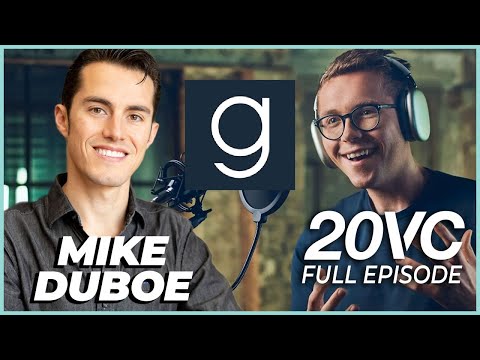
Mike Duboe: Top 5 Lessons Scaling Stitch Fix to IPO; Why CAC/LTV is a BS Metric | 20VC #978
Mike Duboe (guest), Harry Stebbings (host), Narrator
In this episode of The Twenty Minute VC, featuring Mike Duboe and Harry Stebbings, Mike Duboe: Top 5 Lessons Scaling Stitch Fix to IPO; Why CAC/LTV is a BS Metric | 20VC #978 explores scaling Growth Systems: Stitch Fix Lessons, Loops, and Paid Pitfalls Mike Duboe, former Head of Growth at Stitch Fix and current VC, unpacks how to think about growth as a holistic, cross-functional discipline rather than a set of marketing tricks or funnel optimizations.
Scaling Growth Systems: Stitch Fix Lessons, Loops, and Paid Pitfalls
Mike Duboe, former Head of Growth at Stitch Fix and current VC, unpacks how to think about growth as a holistic, cross-functional discipline rather than a set of marketing tricks or funnel optimizations.
He explains why getting the company’s objective function and growth model right is fundamental, how to structure and hire early growth teams, and why analytics foundations and experimentation culture matter more than any single channel.
Duboe dives deep into paid marketing, arguing it should be an accelerant not a crutch, advocating for incrementality and payback-period over LTV/CAC, and warning how early over-reliance on paid can mask weak product-market fit.
Throughout, he contrasts loops vs funnels, shares concrete processes (experiment one-pagers, ICE triage, weekly reviews), and offers tactical guidance on compensation, organization design, and interviewing for growth talent.
Key Takeaways
Define a holistic objective function for growth, not siloed KPIs.
Separating acquisition and retention into different teams with narrow metrics (e. ...
Get the full analysis with uListen
Do not hire a growth lead before product-market fit.
Pre-PMF, you need generalists talking to users and iterating on the product, not scaling top-of-funnel; premature growth hiring and spend can hide retention issues and waste capital.
Get the full analysis with uListen
Start growth hiring with analytics and a growth model.
An analytically strong early hire (often ex-biz ops / SQL-heavy analyst) should help instrument events, reduce “analytics debt,” build core dashboards, and formalize a growth model before you pour fuel on any channel.
Get the full analysis with uListen
Structure growth as cross-functional pods to accelerate learning.
Pods combining PM, engineering, marketing, analytics, design, and research can autonomously run experiments, avoid roadmap dependencies, and better operationalize growth loops instead of fragmented funnel steps.
Get the full analysis with uListen
Institutionalize experimentation via simple one-pagers and triage.
Use a standard experiment one-pager (objective, hypothesis, design, timeline, success metric, next steps) and a shared triage sheet scored with ICE (Impact, Confidence, Effort) so ideas can come from anywhere but are prioritized rigorously.
Get the full analysis with uListen
Treat paid marketing as an accelerant and measure incrementality.
Paid should amplify a working product, not compensate for its weaknesses; rely on holdout tests and lift measurement (e. ...
Get the full analysis with uListen
Replace CAC/LTV with granular payback-period thinking.
Lifetime value is highly speculative, especially early, and often averaged across very different cohorts; instead, set payback thresholds (e. ...
Get the full analysis with uListen
Notable Quotes
“Growth can be really detrimental if you're not focused on moving the right set of metrics.”
— Mike Duboe
“Never hire a growth person pre–product-market fit.”
— Mike Duboe
“The best ideas could come from anywhere within the org.”
— Mike Duboe
“Paid marketing is an accelerant, not a crutch.”
— Mike Duboe
“The notion of lifetime in LTV is the biggest flaw; early on you just don’t know how long customers will stay.”
— Mike Duboe
Questions Answered in This Episode
How would you practically translate a high-level growth loop into a 90-day roadmap for a specific product?
Mike Duboe, former Head of Growth at Stitch Fix and current VC, unpacks how to think about growth as a holistic, cross-functional discipline rather than a set of marketing tricks or funnel optimizations.
Get the full analysis with uListen AI
What early signal should a founder look for to know that it’s time to move from generalist growth efforts to hiring a dedicated growth leader?
He explains why getting the company’s objective function and growth model right is fundamental, how to structure and hire early growth teams, and why analytics foundations and experimentation culture matter more than any single channel.
Get the full analysis with uListen AI
How can non-consumer or B2B companies adapt the experimentation and loop-based growth frameworks discussed here?
Duboe dives deep into paid marketing, arguing it should be an accelerant not a crutch, advocating for incrementality and payback-period over LTV/CAC, and warning how early over-reliance on paid can mask weak product-market fit.
Get the full analysis with uListen AI
In a post-IDFA world, what’s the minimum viable measurement stack a Series A/B company should build to run proper incrementality tests?
Throughout, he contrasts loops vs funnels, shares concrete processes (experiment one-pagers, ICE triage, weekly reviews), and offers tactical guidance on compensation, organization design, and interviewing for growth talent.
Get the full analysis with uListen AI
How should a CEO balance empowering a growth team to run aggressive experiments with protecting long-term brand and product integrity?
Get the full analysis with uListen AI
Transcript Preview
Anyone could submit an experiment idea, even if you're not on the growth team. But we built this very simple, kind of one-pager framework that included an objective, a hypothesis you're testing, design or resources, uh, required to execute the experiment, timeline, so how long you need the experiment to run, and then what success quantifiably looks like, so you're not actually going and having revisionist history on like, "Hey, it actually did work even though, you know, the data showed this." And then finally, the next steps that one takes if the experiment fails or succeeds.
Mike, I am so excited for this. We've known each other for a while. We've been back and forth on Twitter DM. So first, thank you so much for joining me today, Mike.
Thanks for having me, Harry. I've been a longtime listener and learned a lot from your show over the years, so thank you.
Do you know what? I really needed that ego inflation. So thank you for that.
(laughs)
But, uh, I would love to dive in, you know. Growth is a weird and a wonderful world. And so how did you make your way into the world of growth and how did you come to lead the growth team at Stitch Fix?
Yeah, so I'll go back and I'll start with my undergrad. So I studied engineering undergrad. I finished up University of Michigan in 2007. Most folks at that time out of engineering school were either going to work in the auto industry in Detroit or move to Chicago or, or New York to work in, in "business," uh, I'm using air quotes. Uh, Google was just kinda opening up their Ann Arbor office at the time. And, you know, my, my objective when I was thinking about what I wanted to go do was really to go avoid r- routine, uh, so avoid getting bored, and then go optimize for learning, which is a theme that's held true throughout most of my career. I felt like in general, I was most stimulated by starting at the base of a new learning curve, working my way up and moving to the next, kinda like engineering problem sets. And so right outta school, I joined Bain, (laughs) uh, because of this pattern. I think from a distance it felt like, uh, the breadth of problems and clients w- would kind of offer that. Um, I actually had a great time and, and if anything, it trained my brain to be a structured thinker, but I always wished I could have been better aligned, I could have better aligned how I spent my time with what I actually cared about or had some passion for. And so at the time, uh, one of my colleagues at Bain, um, had went to go work for Danny Meyer and then Grant Achatz and Nick Kokonas who were running this big restaurant group, you know, the Alinea Group.
Install uListen to search the full transcript and get AI-powered insights
Get Full TranscriptGet more from every podcast
AI summaries, searchable transcripts, and fact-checking. Free forever.
Add to Chrome