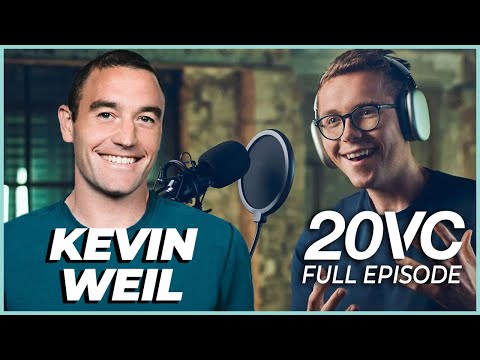
Kevin Weil: Lessons from Leading Product at Instagram & Twitter | 20VC #934
Harry Stebbings (host), Kevin Weil (guest)
In this episode of The Twenty Minute VC, featuring Harry Stebbings and Kevin Weil, Kevin Weil: Lessons from Leading Product at Instagram & Twitter | 20VC #934 explores kevin Weil on decisive product bets, mission, and humble leadership Kevin Weil traces his unplanned path from physics PhD to leading product at Twitter, Instagram, and now satellite company Planet, crediting much of his trajectory to his wife and co‑investor, Elizabeth. He explains how Instagram’s product excellence came from ruthless editing, problem-first thinking, and bold, conviction-driven bets like putting Stories front and center. Across Twitter, Instagram, Planet, and his fund Scribble, Weil emphasizes clear strategy, decisive execution, and mission-driven work, while warning against over‑processing product organizations and underestimating how context shapes both people and markets. He also discusses how early-stage investing sharpened his humility about “one right way,” reinforced the primacy of founders and mission, and highlighted the value of simple, repeated communication in scaling teams.
Kevin Weil on decisive product bets, mission, and humble leadership
Kevin Weil traces his unplanned path from physics PhD to leading product at Twitter, Instagram, and now satellite company Planet, crediting much of his trajectory to his wife and co‑investor, Elizabeth. He explains how Instagram’s product excellence came from ruthless editing, problem-first thinking, and bold, conviction-driven bets like putting Stories front and center. Across Twitter, Instagram, Planet, and his fund Scribble, Weil emphasizes clear strategy, decisive execution, and mission-driven work, while warning against over‑processing product organizations and underestimating how context shapes both people and markets. He also discusses how early-stage investing sharpened his humility about “one right way,” reinforced the primacy of founders and mission, and highlighted the value of simple, repeated communication in scaling teams.
Key Takeaways
Bold product bets need conviction and thoughtful integration, not timid experiments.
Instagram Stories worked not just because it copied Snapchat’s format, but because leadership committed to putting it at the top of the app and deeply re‑designed how sharing worked (ephemeral, private feedback, pull model), rather than hiding it in a back tab.
Get the full analysis with uListen AI
Testing and data don’t require timid rollouts; you can test boldly.
Weil argues you can run aggressive A/B tests (e. ...
Get the full analysis with uListen AI
Clear strategy is the primary filter for product prioritization.
Without a simple, shared strategy document, teams get trapped in endless one‑off debates; with one, they can quickly judge if an idea aligns with the direction and then either proceed decisively or say no.
Get the full analysis with uListen AI
Great internal communication is saying a few important things repeatedly.
As orgs scale, leaders should resist the urge to say something new every time; real alignment comes when the same core ideas are repeated so often that people start using the language and litmus tests themselves.
Get the full analysis with uListen AI
Revenue products should feel native to the user experience.
At Twitter, ads were designed as tweets in the feed because the product was mobile-first; by integrating monetization into the core interaction, they avoided jarring banners and preserved UX while building a real business.
Get the full analysis with uListen AI
Context heavily shapes people’s performance; don’t over-index on past environments.
Weil notes some of his worst missed investments were in founders who’d been mediocre or miscast in previous roles, but thrived when they were in the right environment or stage for their skills.
Get the full analysis with uListen AI
Mission and founder quality dominate at the earliest stages of investing.
For Scribble, Weil focuses mainly on whether the founder is ambitious, clear‑eyed, and mission‑driven, and whether there is a plausible path to 100x, rather than over‑fitting to today’s exact product or market size estimates.
Get the full analysis with uListen AI
Notable Quotes
“Testing doesn’t mean timidity. You can test something at 99% and have a 1% holdback.”
— Kevin Weil
“If you don’t have a strategy, every decision becomes a one-off ‘should we do this or not?’ conversation.”
— Kevin Weil
“It’s actually better to make a decision, launch something, realize you got it wrong, fix it, and launch the better version than to talk in a circle for three months.”
— Kevin Weil
“The only thing I know for sure is that anyone who says the answers are easy hasn’t thought about it hard enough or hasn’t been close to it.”
— Kevin Weil (on social media and free speech)
“There’s no one way to succeed. You have to find your own way, whether it’s investing or leadership.”
— Kevin Weil
Questions Answered in This Episode
How do you practically distinguish between a bold, necessary bet and a reckless product risk when you lack clear data?
Kevin Weil traces his unplanned path from physics PhD to leading product at Twitter, Instagram, and now satellite company Planet, crediting much of his trajectory to his wife and co‑investor, Elizabeth. ...
Get the full analysis with uListen AI
In hindsight, what would you have changed about Twitter’s approach to free speech and content moderation as the platform scaled?
Get the full analysis with uListen AI
How can early-stage founders avoid over‑processing their product organization while still maintaining enough structure to execute?
Get the full analysis with uListen AI
What are concrete ways a founder can sharpen that ‘10‑word billboard’ description so the mission sticks with both employees and customers?
Get the full analysis with uListen AI
Given your own tradeoffs on sleep, family, and endurance sports, what would you advise ambitious leaders about sustainable high performance over decades?
Get the full analysis with uListen AI
Transcript Preview
(beeping) Three, two, one, zero. You have now arrived at your destination. Kevin, this is such a joy to do. I've wanted to do this one for a while. I've heard so many good things, largely from a slightly biased person, being your wonderful wife, Elizabeth.
(laughs)
But thank you so much for joining me today, Kevin.
Thank you so much for having me.
Not at all. I'm excited for this. But I wanna start, when we see this kind of incredible, illustrious career. We've got Instagram, we've got Twitter, we've got Planet most recently. So, how did you make your way into the world of startups and to lead some of the most powerful product talks as you have done?
So, completely unintentionally is the answer. Um, I- I was... It's funny, I was actually... I was at Harvard when Zuck was at Harvard, so, uh, I'm a year older than him. And I went through school planning to do... I wanted to be a math professor or a physics professor. I was just like, you know, total tunnel vision on math and physics and science. Zuck, after I think a year or two or something, dropped out and went, uh, went to Palo Alto to do Facebook full time. And I remember thinking, you know, after- after Facebook had just taken over the campus, right? You remember back then, it was taking over every college campus one by one.
Yeah.
And I remember thinking, "He's gonna drop out of a Harvard education to go do some company? What an idiot." You know, and like... (laughs)
(laughs)
So I just had no conception, right? And then, uh, and I- I... So I came out to the Bay Area to continue a physics degree, and ended up meeting, uh, my now wife, Elizabeth. And she opened my eyes to the fact that you-ou j... We were just surrounded by all these startups doing amazing things. And at some point in there, I finally was like, "Wait a minute. I'm doing, you know, theoretical physics. If I'm lucky, I'll make an impact on physics in like 40 years, if I'm lucky. And I could go write code and like ship something at one of these companies, you know, tomorrow, to a million people. I wanna go do that." And so, uh, really, thanks to her and, you know, as w- if we talk about my career, we'll- we'll realize that almost all of my opportunities came from Elizabeth. I really just ride her coattails. Um, but that's how I got started. I hopped out of my PhD, I dropped out and, um, started working at startups as an engineer. Um, ended up at Twitter in the early days when it was about 40 people. Got really lucky, people took some bets on me that they really had no business taking. And, uh, I worked hard, tried to make those bets real. Ended up leading product at Twitter after about seven years. You know, then went to Instagram to lead product. Um, now at Planet. So, it's- it's been a wild ride. It has absolutely not been premeditated. (laughs)
Install uListen to search the full transcript and get AI-powered insights
Get Full TranscriptGet more from every podcast
AI summaries, searchable transcripts, and fact-checking. Free forever.
Add to Chrome