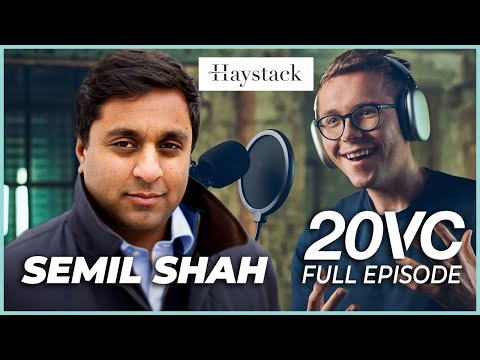
Semil Shah: Lessons Learned Scaling from a $1M to a $50M Fund | 20VC #951
Harry Stebbings (host), Semil Shah (guest), Harry Stebbings (host)
In this episode of The Twenty Minute VC, featuring Harry Stebbings and Semil Shah, Semil Shah: Lessons Learned Scaling from a $1M to a $50M Fund | 20VC #951 explores semil Shah Reveals Hard Truths About Scaling a Seed VC Fund Semil Shah discusses his journey building Haystack from a $1M proof-of-concept fund into a $50M seed franchise, and why he’s resisted scaling AUM beyond $100M. He breaks down ownership targets, check sizes, and why discipline around fund size, deployment pace, and deal selection matters more now than ever. A large portion of the conversation focuses on emerging managers: how to raise from LPs, build real track records, avoid common fundraising mistakes, and manage LP relationships over multiple vintages. Semil also reflects on industry-wide “sins” of the last cycle—oversized funds, lazy checkpoints, and disrespect for capital—and how both founders and GPs must adapt to a harsher, more Darwinian environment.
Semil Shah Reveals Hard Truths About Scaling a Seed VC Fund
Semil Shah discusses his journey building Haystack from a $1M proof-of-concept fund into a $50M seed franchise, and why he’s resisted scaling AUM beyond $100M. He breaks down ownership targets, check sizes, and why discipline around fund size, deployment pace, and deal selection matters more now than ever. A large portion of the conversation focuses on emerging managers: how to raise from LPs, build real track records, avoid common fundraising mistakes, and manage LP relationships over multiple vintages. Semil also reflects on industry-wide “sins” of the last cycle—oversized funds, lazy checkpoints, and disrespect for capital—and how both founders and GPs must adapt to a harsher, more Darwinian environment.
Key Takeaways
Keep fund size tightly aligned with realistic ownership and exit math.
Semil caps Haystack funds at ~$50M (and under $100M going forward) so 5–10% seed ownership can still translate into meaningful outcomes at exit without needing to own 15%+ or lead every deal.
Get the full analysis with uListen AI
Avoid conflating elite talent with true entrepreneurial grit.
Hot seeds with big-company product leaders and prestige logos often underperform because many are political operators, not ‘uncivilized’ builders; Semil explicitly looks for prior evidence of hustle, adversity, and self-driven money-making behavior.
Get the full analysis with uListen AI
Be flexible on role in the round, but decisive when you truly want to lead.
Haystack is willing to be lead, co-lead, or meaningful follower (5–10% ownership) and avoids party rounds; Semil believes speed and conviction win the deals he *must* lead while flexibility maximizes the quality of the overall portfolio and co-investor set.
Get the full analysis with uListen AI
Emerging managers must build real evidence and ‘chatter’ before chasing institutions.
He advises running small proof-of-concept vehicles (e. ...
Get the full analysis with uListen AI
LP relationships are multi-fund games, but not all LPs deserve to be kept.
Semil has intentionally blocked certain LPs from future funds for aggressive or shifting demands, arguing GPs must protect long-term alignment even when those LPs are ‘hot names’ others would covet.
Get the full analysis with uListen AI
The last cycle’s biggest sin was allowing fund size and capital allocation to bloat unchecked.
He criticizes LPs for enabling mega-funds and GPs for turning financing rounds into rubber stamps, which left enormous sums stranded in companies without product-market fit and undermined discipline at each stage.
Get the full analysis with uListen AI
Founder discipline around updates and capital respect will heavily influence survival now.
Consistent, metric-driven investor updates are both a signal of professionalism and a practical tool for socializing the story; in a constrained environment, founders who don’t respect capital or keep investors in the loop will struggle to raise follow-on rounds.
Get the full analysis with uListen AI
Notable Quotes
“We slowly creep up the cap table.”
— Semil Shah
“Are talented people also entrepreneurial? I don’t believe that.”
— Semil Shah
“Our job isn’t to invest when Accel or Lightspeed invest; our job is to invest a round before that.”
— Semil Shah
“If you don’t respect where the money came from, it’s going to be really hard to advance.”
— Semil Shah
“The business is that simple: DGD — do good deals.”
— Semil Shah (quoting Paul Martino)
Questions Answered in This Episode
How should an emerging manager decide the optimal first-fund size to balance meaningful ownership with realistic access?
Semil Shah discusses his journey building Haystack from a $1M proof-of-concept fund into a $50M seed franchise, and why he’s resisted scaling AUM beyond $100M. ...
Get the full analysis with uListen AI
What practical questions or exercises can investors use in founder meetings to test for true entrepreneurial grit rather than just résumé talent?
Get the full analysis with uListen AI
Given the coming ‘LP churn,’ how can smaller funds best position themselves to absorb capital reallocated away from mega-funds?
Get the full analysis with uListen AI
In a world where ‘one deal can change a franchise,’ how should funds think about concentration versus diversification at seed?
Get the full analysis with uListen AI
What concrete practices can founders adopt to ‘respect the dollar’ and keep investors engaged without being overwhelmed by reporting overhead?
Get the full analysis with uListen AI
Transcript Preview
Semil, this is going to be the best podcast you've ever done. You've done a few with me, you've done a few with other people-
Yeah.
... so this is going to be the best. Now, we've started before with, like, how you got into venture, so for any, you know, anyone that hasn't listened to that, fuck it, they can listen to the last episodes. I want to go-
Exactly.
... deep with you, my friend. We're going to go with we're all a function of our histories, and so we're all running towards something and we're running away from something. What are you running away from first, and then what are you running towards?
In a professional context, what I'm running from is just the fear of not being able to participate in the way I want to in the ecosystem. And so there was, you know, way, way before we met, there was like a long period of time where I would, you know, even confide in my wife and say like, "Hey, I don't, I don't know if we'll live in the Bay Area and, and make it here." You know? So I think over those, you know, 10 plus years also, I've had lots of industry friends, you know, the Bay Area's transit, but like move, move out of the Bay A- Bay Area would I say, like involuntarily. Um, and a lot of personal friends, especially through COVID and then the fires, move. Um, and I do love living in California. I feel like it's the only place I can live, um, and do what I want to do in the way that I want to do it. You know?
When did you start to believe that that would be possible and that you would be able to do it?
Kinda like 2015, 2016, um, but, but there was probably like a two to three year period where I just wasn't sure, and then you see other people drop off. Again, people drop off voluntarily, right, um, but it's when y- when you have people who, who leave involuntarily, um, and you start to see that and it builds up, it, it sort of, you sort- I sort of run away from that.
I totally get you. And so that's-
Yeah.
... what you're running away from. What are you running towards, my friend?
I think, um, you know, someone that you and I have talked about is like, someo- someone like Roger Ehrenberg where, where you're, you can try to become the investor of record in an important company and an important partner to a founder early, and then you show up on the S1, you know, and people are surprised. I think that's what you're running towards is like a lot of us as investors for the most part, we can't do what entrepreneurs do. We choose not to do what entrepreneurs do. And so, um, we have the best job in the world, and so to get a chance to be close to one, you know, to sort of steal a line from the Reagan speech, and touch the face of God is a, an amazing opportunity, you know?
Install uListen to search the full transcript and get AI-powered insights
Get Full TranscriptGet more from every podcast
AI summaries, searchable transcripts, and fact-checking. Free forever.
Add to Chrome