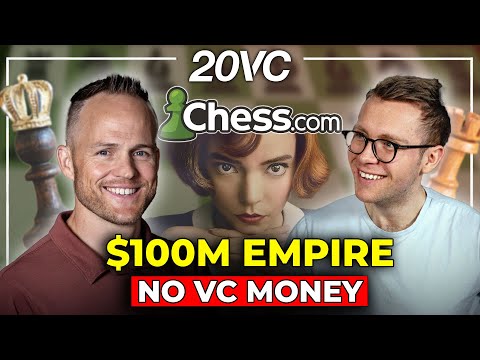
Erik Allebest: Scaling to $100M Revenue, 150M Members and 700 People, All with No Vc Funding | E1113
Erik Allebest (guest), Harry Stebbings (host)
In this episode of The Twenty Minute VC, featuring Erik Allebest and Harry Stebbings, Erik Allebest: Scaling to $100M Revenue, 150M Members and 700 People, All with No Vc Funding | E1113 explores bootstrapping Chess.com: Mission-Driven Growth to $100M Without VC Erik Allebest, co-founder and CEO of Chess.com, explains how he built a $100M+ revenue, 150M-member chess platform with 700 people and essentially no traditional venture funding.
Bootstrapping Chess.com: Mission-Driven Growth to $100M Without VC
Erik Allebest, co-founder and CEO of Chess.com, explains how he built a $100M+ revenue, 150M-member chess platform with 700 people and essentially no traditional venture funding.
He attributes success to a clear mission of serving the chess community, a relentless focus on content and product over paid acquisition, and a fully-remote, globally distributed team hired for passion over pay.
The conversation covers his personal evolution through business school and ayahuasca, his philosophy on money, capitalism, parenting, marriage, and self-worth, and how serendipitous cultural moments like The Queen’s Gambit and COVID accelerated growth.
Allebest also discusses refusing typical investor preferences, structuring secondary liquidity to reward employees, and his nuanced views on politics, leadership, and building a humane, mission-led company at scale.
Key Takeaways
Bootstrapping forced discipline, early monetization, and creative problem-solving.
Because Chess. ...
Get the full analysis with uListen AI
Content and community can replace paid acquisition at massive scale.
Instead of performance ads, Chess. ...
Get the full analysis with uListen AI
Product innovations that create early wins dramatically boost engagement and retention.
Features like Puzzle Rush—designed to make users feel successful quickly—were “needle-moving,” increasing enjoyment and stickiness, and data shows users who win their first game are 2–3x more likely to stay.
Get the full analysis with uListen AI
A strong mission and lifestyle-first employment model underpin Chess.com’s culture.
The company screens out people who optimize purely for money, emphasizes mission (“serve the chess community” and “best place to work”), gives employees autonomy via remote work, and expects egos and politics to bow to that mission.
Get the full analysis with uListen AI
Chess.com is only selectively metrics-driven, prioritizing mission and feel over dashboards.
For years they steered by gut, community feedback, and joy of creation rather than OKRs; only more recently have they adopted metrics like DAU, habit-based retention (Duolingo-style CUR), and conversion from players to learners.
Get the full analysis with uListen AI
Liquidity events were structured to share upside with non-equity team members.
When a major shareholder exited to General Atlantic, Erik insisted that ~7% of gains—tens of millions of dollars—be carved into a pool to pay out to employees over time, effectively retrofitting them into the cap table.
Get the full analysis with uListen AI
Personal work on self-awareness improves leadership, parenting, and partnership.
Direct feedback at Stanford (being called an “asshole”), plus later ayahuasca work, led Erik to focus on kindness, deposits vs. ...
Get the full analysis with uListen AI
Notable Quotes
“The weight of our mission crushes egos. If you have an ego, this is the wrong place for you.”
— Erik Allebest
“We did the opposite of Silicon Valley. We thought about monetizing immediately. Everybody was remote. There was no office.”
— Erik Allebest
“Raising money feels a lot like earning money. It’s a self‑validation.”
— Erik Allebest
“I am every day microdosing on Slack, on email, on Zoom. I am under the influence of drugs every single day and every single moment of my life.”
— Erik Allebest
“I have so few regrets in life, but selling that first 10% is one.”
— Erik Allebest
Questions Answered in This Episode
How would Chess.com’s trajectory and culture have differed if early venture investors had backed the company on traditional terms?
Erik Allebest, co-founder and CEO of Chess. ...
Get the full analysis with uListen AI
What are the risks and limits of running a large consumer internet business that intentionally underweights metrics in favor of mission and intuition?
He attributes success to a clear mission of serving the chess community, a relentless focus on content and product over paid acquisition, and a fully-remote, globally distributed team hired for passion over pay.
Get the full analysis with uListen AI
Could Erik’s idea of a fund that caps investor returns and redistributes excess to workers be made practical given today’s legal, tax, and global regulatory constraints?
The conversation covers his personal evolution through business school and ayahuasca, his philosophy on money, capitalism, parenting, marriage, and self-worth, and how serendipitous cultural moments like The Queen’s Gambit and COVID accelerated growth.
Get the full analysis with uListen AI
How far should product teams ethically go in designing for early wins (like ensuring first-game victories) to improve retention without misleading users?
Allebest also discusses refusing typical investor preferences, structuring secondary liquidity to reward employees, and his nuanced views on politics, leadership, and building a humane, mission-led company at scale.
Get the full analysis with uListen AI
What specific practices could other founders adopt from Chess.com’s remote, mission-first culture to reduce politics and ego in their own organizations?
Get the full analysis with uListen AI
Transcript Preview
Chess.com is my third chess business, which is totally absurd to say.
This is Eric Alabast, co-founder and CEO of Chess.com. He started the business in 2005. Now it does over $100 million per year in revenue. And the most impressive part? They did not raise a single dollar in venture. As a result of not raising money, did you do things differently?
I mean, I had to do it differently. Everything I saw going on in Silicon Valley was like spend, spend, spend. We did the opposite. We thought about monetizing immediately. Everybody was remote. There was no office. I think raising money feels a lot like earning money. It's a self-validation.
In the earlier years, was there a needle-moving moment?
There were a couple of moments that things took off. So one was...
Eric, I am so excited for this. Dude, I've got to hand it to you, you have the best headshot that I've ever seen, and we're gonna, we're gonna put it on social because everyone does, you know, like serious, looking into the distance, and you just smashed it. So thank you for being here, Eric. (laughs)
(laughs) Thanks for having me. I try not to take myself very seriously. I love, I love dressing up in different costumes and being weird, so, uh, thanks for, thanks for using it.
No, listen, dude. It kind of goes straight to our first point though, which is, you know, you love doing things that are slightly out there. I heard that your first entrepreneurial activity happened at nine. What was it? That's at, that's at a young age.
Yeah, I was always, like, scrappy. And I don't know, like, my dad was the same way. He was always starting stuff, doing things. I did several things at a young age. I would sell things at school. We would sell, like, you know, either candy bars or bracelets or things. I would, uh, go to where the high school kids would drink beer and leave all their cans, and I would collect them all and go recycle them. I would go door-to-door to sell stationery. I was just always hustling for something, some way to kind of, like, you know, make money and, like, do something. So yeah, it's in, like, the blood.
I have this theory that exceptional people show exceptionalism early in terms of entrepreneurial activity. (laughs) Do you agree with that in terms of the best entrepreneurs show entrepreneurialism early? I'm just intrigued.
I mean, you probably have a... You probably look at a wider sample size than I do. I, I look at myself and, you know, obviously I did start young, um, and several of the other people I know have as well. But there's also some great, you know, later-in-life entrepreneurs who kind of did something and then they had, like, a, a moment and a spark. So, um, you know, I don't, I don't know. It's a, it's a fair thesis.
Install uListen to search the full transcript and get AI-powered insights
Get Full TranscriptGet more from every podcast
AI summaries, searchable transcripts, and fact-checking. Free forever.
Add to Chrome