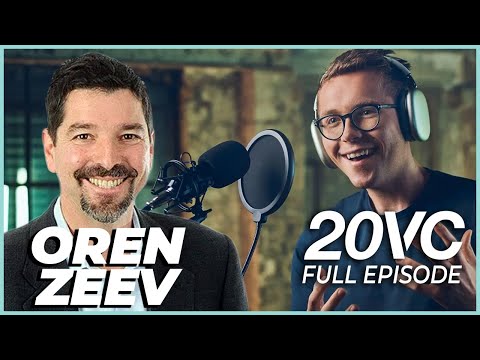
Oren Zeev: How I Raised $1 BILLION in 12 Months | 20VC #888
Harry Stebbings (host), Oren Zeev (guest), Narrator
In this episode of The Twenty Minute VC, featuring Harry Stebbings and Oren Zeev, Oren Zeev: How I Raised $1 BILLION in 12 Months | 20VC #888 explores solo VC Oren Zeev Explains Billion-Dollar Fundraising And Contrarian Strategy Oren Zeev, a solo GP with a long track record in venture, discusses how he raised roughly $1.5B across multiple funds in rapid succession while ignoring conventional portfolio-construction dogma. He contrasts today’s downturn with the dot-com bust and 2008, arguing current pain is largely valuation-driven rather than business-fundamental driven. Zeev explains his opportunistic, founder-first investing style: no pacing targets, no ownership targets, minimal diversification, and aggressive follow-ons when his conviction exceeds the market’s. He critiques partnership dynamics, LP incentives, and standard VC practices such as vintage diversification, rigid ownership rules, and pro-rata obsession, positioning his model as structurally better aligned with founders.
Solo VC Oren Zeev Explains Billion-Dollar Fundraising And Contrarian Strategy
Oren Zeev, a solo GP with a long track record in venture, discusses how he raised roughly $1.5B across multiple funds in rapid succession while ignoring conventional portfolio-construction dogma. He contrasts today’s downturn with the dot-com bust and 2008, arguing current pain is largely valuation-driven rather than business-fundamental driven. Zeev explains his opportunistic, founder-first investing style: no pacing targets, no ownership targets, minimal diversification, and aggressive follow-ons when his conviction exceeds the market’s. He critiques partnership dynamics, LP incentives, and standard VC practices such as vintage diversification, rigid ownership rules, and pro-rata obsession, positioning his model as structurally better aligned with founders.
Key Takeaways
Don’t over-generalize from past crashes; respond to the current reality.
Zeev notes that unlike the dot-com era, today’s downturn is mostly about lower valuations, not demand collapse, so investors should avoid reflexively applying 2000 or 2008 playbooks and instead focus on business fundamentals.
Get the full analysis with uListen AI
Abandon artificial deployment pacing and invest purely on opportunity quality.
He refuses to manage capital by time or quotas, raising new funds as needed and doing deals only when they meet his bar, even if that means multiple funds in a year or long stretches with few new investments.
Get the full analysis with uListen AI
Prioritize conviction and upside over rigid ownership or valuation discipline.
Zeev cares less about target percentages and more about whether a stake can “move the needle,” preferring to risk slightly overpaying in high-growth companies rather than miss great outcomes by being overly price-sensitive.
Get the full analysis with uListen AI
Be candid and decisive when a company isn’t working, and avoid “death by extension.”
When he loses faith in a business, he communicates directly with founders, seeks soft landings or sales, and warns against dragging companies out for an extra few months, which often multiplies pain and destroys dignity.
Get the full analysis with uListen AI
Partnership structures can suppress contrarian bets and encourage mediocrity.
Because partners must convince committees, they tend to avoid controversial deals and optimize for what’s easy to approve, whereas a solo GP can fully own contrarian decisions and move faster without internal politics.
Get the full analysis with uListen AI
LP and VC diversification norms are often excessive and misaligned with returns.
He argues funds are already diversified baskets, so LPs holding dozens of GP relationships are typically over-diversified, while GPs diversifying into too many portfolio companies dilute conviction and attention.
Get the full analysis with uListen AI
Being the founders’ best alternative is the core competitive edge in venture.
Zeev emphasizes that founders—not LPs—are the true customers; superior treatment, alignment, and decisiveness win access to the best deals, which in turn makes LP fundraising straightforward.
Get the full analysis with uListen AI
Notable Quotes
“I just do good deals. I don’t want to think about portfolio construction and vintage diversification and all that.”
— Oren Zeev
“If something’s not working, something’s not working. Don’t over-obsess about saving it—just be positive, help if you can, and focus on the future.”
— Oren Zeev
“Partnerships drive things more towards mediocrity as opposed to exceptionalism.”
— Oren Zeev
“The customers are the founders, not the LPs. We work for the founders.”
— Oren Zeev
“The ones that you want to sell, you can’t, and the ones that you can sell, you don’t want to sell.”
— Oren Zeev
Questions Answered in This Episode
How can a multi-partner venture firm realistically adopt elements of Oren’s solo-GP, high-conviction model without blowing up its internal politics?
Oren Zeev, a solo GP with a long track record in venture, discusses how he raised roughly $1. ...
Get the full analysis with uListen AI
Where is the line between healthy conviction against the market and dangerous overconfidence when leading follow-on rounds others don’t want?
Get the full analysis with uListen AI
What practical signals should founders and investors use to decide when it’s the right time to shut down rather than pursue another bridge round?
Get the full analysis with uListen AI
Given pervasive LP incentive misalignment, how might an LP structure their own compensation and portfolio to behave more rationally and long-term oriented?
Get the full analysis with uListen AI
If traditional diversification and ownership targets are flawed, what alternative frameworks should emerging managers use to design fund size, number of bets, and check sizes?
Get the full analysis with uListen AI
Transcript Preview
(reversing beeps) Three, two, one, zero. You have now arrived at your destination. Oren, this is such a joy for me to do. As we chatted about before, third time guest. This is, uh, very, very rare. But there's always so many things that I bluntly learn from our conversations, so thank you so much for joining me today.
My pleasure, yeah.
I would love to start, Oren, for those that missed our prior episodes, uh, first off, like one to two minutes, how did you make your way into the world of venture before we dive in?
So I started as a EE engineer, started as a research fellow at, um... and then I was just staff member at IBM. Got a business degree, got back to Israel. I, I didn't say, I was born and raised in Israel. It was 1994 and the whole venture industry literally started overnight and the whole industry was 10 people. And I was lucky enough to be hired by, uh, to, uh, to be hired by, uh, Apex who wanted to open, uh, operations in Israel, one of two people. That's how I got into venture. I spent 12 years in... with Apex, the first seven years in Israel, and then they asked me to move t- to the US and strengthen the, uh, US operation, which I did. I moved to the Silicon Valley 20 years ago, 2002, and I, uh, for about five years I was heading their tech practice and then, and then I retired and, or got fired, and then I really started the, uh, you know, the interesting, uh, part of my career which is the, you know, go- doing it my way on my own.
I totally get you and what a journey it has been doing it your way on your own. And I mean this question respectfully, Oren, but you're a little bit more seasoned than me, you've seen a few more crashes than me. When we look at where we are today, what's different and what's the same about the current crash? I'm fascinated given, you know, you've seen 2008, you've seen the dot-com, how's this different? How's it the same?
Well, it's very different from the dot-com which was like really nuclear because back then it's not just the valuations collapsed, it... and really collapsed, not 50%, 95%. But it's also that the businesses collapsed. There was no business, you know. You could be selling to a certain segment, you know, of the market and overnight all your customers basically go out of business, for example. So, um, that was something that I think is one in a hundred years hopefully. I, I, I hope I never see anything like that again. 2008 was, uh, not as, m- nuclear and b- big in terms of, uh, the tech, uh, industry. It was maybe bigger if you look at the overall maybe effect, uh, because it wasn't specific to tech. Unlike 2001, it was specific to tech. 2008 was much more general. So in many aspects the worst, but in tech it was not, uh, it was not as bad. Uh, but still, e- there was a lot of real pain. I think that today valuations were cut by 50% in the public markets, uh, on average, but most of the businesses are still f- going very strong. You know, most of my companies we don't see necessarily any weakening of demand. And, uh, some companies decide to grow a little bit slower because they wanna maybe reserve a little bit more cash, uh, but the fundamentals are there, the fundamental demands... If that, if, if there was a healthy business before it's a healthy business now. So, I don't equate, uh, the current crisis to those two big ones.
Install uListen to search the full transcript and get AI-powered insights
Get Full TranscriptGet more from every podcast
AI summaries, searchable transcripts, and fact-checking. Free forever.
Add to Chrome