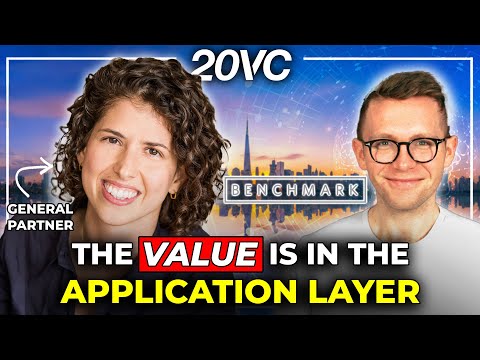
Sarah Tavel: Will Foundation Models Be Commoditised? | E1149
Sarah Tavel (guest), Harry Stebbings (host)
In this episode of The Twenty Minute VC, featuring Sarah Tavel and Harry Stebbings, Sarah Tavel: Will Foundation Models Be Commoditised? | E1149 explores sarah Tavel on AI, Venture Discipline, and Foundation Model Oligopolies Benchmark partner Sarah Tavel discusses how AI is reshaping both the infrastructure and application layers, arguing that most long‑term value will accrue to applications that “sell the work” rather than just improve productivity. She predicts foundation models will likely be controlled by a small oligopoly due to escalating compute and power requirements, making frontier models predominantly closed source, with Meta’s LLaMA as a possible exception. Tavel explains why many first‑wave AI startups are just thin wrappers around models and how newer companies must own more of the workflow and outcome to be defensible against incumbents. Beyond AI, she walks through Benchmark’s partnership model, views on pricing and dilution, board quality, and why strong “why now” timing and founder ambition matter more than ever in hyper‑competitive markets.
Sarah Tavel on AI, Venture Discipline, and Foundation Model Oligopolies
Benchmark partner Sarah Tavel discusses how AI is reshaping both the infrastructure and application layers, arguing that most long‑term value will accrue to applications that “sell the work” rather than just improve productivity. She predicts foundation models will likely be controlled by a small oligopoly due to escalating compute and power requirements, making frontier models predominantly closed source, with Meta’s LLaMA as a possible exception. Tavel explains why many first‑wave AI startups are just thin wrappers around models and how newer companies must own more of the workflow and outcome to be defensible against incumbents. Beyond AI, she walks through Benchmark’s partnership model, views on pricing and dilution, board quality, and why strong “why now” timing and founder ambition matter more than ever in hyper‑competitive markets.
Key Takeaways
AI enables startups to “sell the work,” not just productivity tools.
Instead of charging per seat for small productivity gains, AI companies can package and deliver entire outputs (e. ...
Get the full analysis with uListen AI
Most first‑wave AI apps are too dependent on foundation models to be defensible.
If 90% of an app’s value comes directly from an OpenAI API, incumbents can quickly replicate it and bundle it into existing products, so newer winners must own more of the workflow, data integration, and end‑to‑end experience to avoid being commoditized wrappers.
Get the full analysis with uListen AI
Foundation models are likely headed toward an oligopoly, not broad commoditization.
Training each successive frontier model is increasingly compute and power constrained and 10x more expensive, which favors a small number of players able to fund massive infrastructure, keeping frontier models mostly closed source except for special cases like Meta’s LLaMA.
Get the full analysis with uListen AI
“Why now” is a critical and often underweighted determinant of startup success.
Strong timing acts like a current that can push a company forward despite mistakes, whereas weak or purely conceptual ‘why now’ stories leave founders paddling hard against powerful incumbents or countervailing consumer behaviors (e. ...
Get the full analysis with uListen AI
The best AI application opportunities compound as models improve, rather than get steamrolled.
Tavel aligns with the view that if a 100x better model doesn’t massively enhance your product, the model provider will likely outcompete you; good AI apps should become more capable, less human‑dependent, and higher margin as underlying models advance.
Get the full analysis with uListen AI
In hyper‑competitive AI segments, founder quality and urgency are decisive.
Because many teams are chasing similar ideas (e. ...
Get the full analysis with uListen AI
Benchmark’s model rejects heavy platforms and automatic pro‑rata to stay aligned with founders.
They keep a small equal partnership, avoid delegating core work to internal “platform” teams, rarely rely on reserves, and view pro‑rata as something to be earned by continued value creation, aiming to minimize unnecessary founder dilution and misaligned board dynamics.
Get the full analysis with uListen AI
Notable Quotes
“If you want a model that's on the frontier, you're gonna be closed source.”
— Sarah Tavel
“AI enables a very different unit of work that you sell, which is doing the work.”
— Sarah Tavel
“When you have a strong why now, it’s like this strong current that just pushes the company forward.”
— Sarah Tavel
“If you like everything but the price, you pay the price.”
— Sarah Tavel
“The model of partnership with big platforms is more about scaling the GP than it is the founder.”
— Sarah Tavel
Questions Answered in This Episode
How can an early‑stage AI startup practically move from being a thin ‘wrapper’ around a model to truly owning the workflow and outcome?
Benchmark partner Sarah Tavel discusses how AI is reshaping both the infrastructure and application layers, arguing that most long‑term value will accrue to applications that “sell the work” rather than just improve productivity. ...
Get the full analysis with uListen AI
In a world where frontier models are controlled by an oligopoly, what specific moats can application companies build beyond UX to avoid being displaced?
Get the full analysis with uListen AI
How should founders rigorously assess whether their ‘why now’ is truly durable versus a short‑lived narrative or consumer fad?
Get the full analysis with uListen AI
Where is the line between healthy, moat‑building capital raises in AI (e.g., for GPUs) and undisciplined FOMO investing that just burdens companies with future dilution?
Get the full analysis with uListen AI
Given Benchmark’s skepticism of pro‑rata and large platforms, how should founders think about selecting investors and constructing boards that actually help them scale?
Get the full analysis with uListen AI
Transcript Preview
Right now, it feels like if you need a model that's on the frontier, you're gonna be closed source. I focus on the application layer because I do think that's where a tremendous amount of value ends up being captured and created. You just see the tremendous amount of investment that has to happen right now in order to progress these models. At this point, it's kind of compute constrained. Each successive model is going to be more and more expensive. That suggests a world where you're gonna have an oligopoly.
Ready to go? Sarah, I am so excited for this. I always love our chats. So first-
I love it.
... thank you so much for joining me today.
No, thanks for having me as always, Harry.
Now, well, I want to start, for those that do not know, how did you come to be at Benchmark? I- I love a good story, Sarah. So like, did they call you up and they're like, "Hey, join Benchmark?" Is it over dinner? Like talk to me, what was that courting process?
It's, um, you know, for... It's a very serious decision for us when we bring on a new partner because it's, you know, it's a s- very small group. Right now we're five general partners. And so it is a bit of a, uh, uh, it's a very deep getting-to-know-you process. Wh- how it started initially was actually, um, Peter Fenton reached out to me (laughs) and we grabbed a, a coffee at Sightglass. I was at Greylock at the time, and he, he just mentioned that for whatever reason, uh, they, they, uh, wanted to, to get to know me and, and, and, and kind of talk about what it would be like to partner together. Uh, and I, I said no (laughs) . Um, I, uh, I just didn't, you know, I was ha- like Greylock was just, it's a great group of people that been nothing but great to me. And I'd been there for, you know, a year and a half or so, and it just didn't feel right, uh, to me at the time. And so we kind of parted ways, and then they smartly had, uh, Rich Barton call me. I had met Rich at a prior event. And Rich, you know, had been a, a... Rich is the CEO of Zillow, um, amongst other things. And he called me up and we talked about it a little bit 'cause he knew the, the Benchmark crew very well, and he basically told me, he's like, "Look, what do you have to lose by spending time with the team, right?" Like, "If you wanna be great in this business, see how some of the greats practice the business of venture capital." And when he said that way, I just felt like, you know, he was right, that what did I have to lose by getting to know the team? And then as I did then start to get to know the team and see what felt so different to me about the way Benchmark practiced partnering with founders in this like very small, equal, uh, very committed way of doing things, it was just one of those things that once you saw it, you couldn't unsee it, you know? And that's, and, and so ultimately, thankfully, stars aligned and, uh, they felt the same way. And so it's been, it's been, uh, almost seven years now.
Install uListen to search the full transcript and get AI-powered insights
Get Full TranscriptGet more from every podcast
AI summaries, searchable transcripts, and fact-checking. Free forever.
Add to Chrome