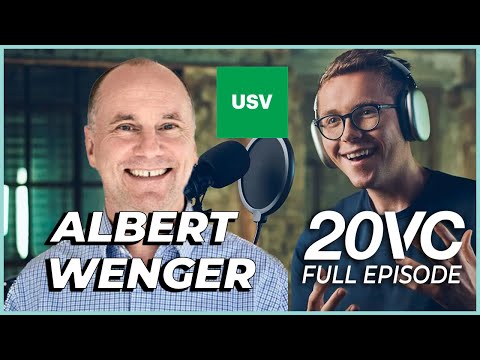
Albert Wenger: Elon & Twitter; Impact of SBF; Income Inequality; Will they ban TikTok? | 20VC #969
Harry Stebbings (host), Albert Wenger (guest), Narrator
In this episode of The Twenty Minute VC, featuring Harry Stebbings and Albert Wenger, Albert Wenger: Elon & Twitter; Impact of SBF; Income Inequality; Will they ban TikTok? | 20VC #969 explores albert Wenger on climate, crypto, inequality and rebuilding our attention Albert Wenger discusses the macro transition from the industrial age to a ‘knowledge age,’ arguing that human attention—not capital—is now the main constraint, and that markets alone can’t guide attention to what matters most.
Albert Wenger on climate, crypto, inequality and rebuilding our attention
Albert Wenger discusses the macro transition from the industrial age to a ‘knowledge age,’ arguing that human attention—not capital—is now the main constraint, and that markets alone can’t guide attention to what matters most.
He connects income inequality, lack of societal purpose, and worsening mental health to this poorly managed transition, advocating for universal basic income, new education models, and ‘psychological freedom’ to help people adapt.
On climate, Wenger calls for radical, non‑incremental action, including devoting a huge share of GDP to climate and sustainability, supported by civil disobedience and political leadership that frames climate as both existential threat and opportunity.
He remains long‑term optimistic on crypto despite FTX, critical of centralized financial and media power (central bank digital currencies, Twitter, TikTok), and offers practical advice for founders navigating the current venture downturn.
Key Takeaways
Reorient attention, not just capital, to enable the knowledge age.
Wenger argues that humanity’s binding constraint is now attention, not physical capital, and that markets can’t price many crucial domains (climate, fundamental science, care, culture), so we need new norms and institutions to consciously direct individual and collective focus.
Get the full analysis with uListen AI
Treat inequality as a floor problem, not a quest for full equality.
He distinguishes between ‘healthy’ and ‘unhealthy’ inequality, stressing the need for a robust social floor—via mechanisms like universal basic income—to prevent social collapse, reduce outsized influence of the ultra‑wealthy, and give everyone basic security and purpose.
Get the full analysis with uListen AI
Use automation to shrink the ‘economic sphere’ and expand non‑market work.
Rather than fearing AI and robotics, Wenger suggests we should emulate agriculture’s historical shrinkage: let automation handle more market work so humans can spend more time on non‑priced but vital activities like caregiving, art, nature stewardship, and deep learning.
Get the full analysis with uListen AI
Address mental health by building ‘psychological freedom’ in a hyper‑stimulating media world.
He believes our brains are maladapted to infinitely personalized feeds, so individuals must cultivate practices like mindfulness, boundaries with devices, and critical media literacy—supported by large‑scale reforms in education and information systems.
Get the full analysis with uListen AI
Climate action must be non‑incremental and politically central, not a side issue.
Wenger calls for devoting on the order of tens of percent of GDP to climate and sustainability, framing it as a wartime‑scale mobilization; he views civil disobedience and bold political platforms as historically proven levers to force systemic change.
Get the full analysis with uListen AI
Crypto’s long‑term value lies in rebalancing power in money and platforms.
Despite FTX and volatility, he sees crypto as both an inflation hedge in weaker currencies and a way to resist over‑centralized control (e. ...
Get the full analysis with uListen AI
Founders must prioritize cashflow positivity and realistic expectations in downturns.
With capital tighter and down rounds extremely hard to execute, Wenger urges companies that raised at high valuations to cut burn and get to cashflow positive, warning that many investors will simply walk away rather than fight through complex restructurings.
Get the full analysis with uListen AI
Notable Quotes
“The rate‑limiting factor for humanity really is attention.”
— Albert Wenger
“Sufficiently technologically advanced societies, such as the US, ought to provide a floor for everybody.”
— Albert Wenger
“We’re not on a path to fixing this problem. Every second it’s four to seven Hiroshima‑sized nuclear bombs worth of heat being trapped.”
— Albert Wenger, on the climate crisis
“Either we’re being programmed by the system or we can program the system.”
— Albert Wenger, on Twitter, TikTok and social platforms
“The only safe place is cashflow positive.”
— Albert Wenger, on startup strategy in a downturn
Questions Answered in This Episode
If attention is the new scarce resource, what concrete institutional designs could help societies allocate it better than today’s ad‑driven platforms?
Albert Wenger discusses the macro transition from the industrial age to a ‘knowledge age,’ arguing that human attention—not capital—is now the main constraint, and that markets alone can’t guide attention to what matters most.
Get the full analysis with uListen AI
How might universal basic income be implemented at scale without creating political backlash or dependency narratives that stall adoption?
He connects income inequality, lack of societal purpose, and worsening mental health to this poorly managed transition, advocating for universal basic income, new education models, and ‘psychological freedom’ to help people adapt.
Get the full analysis with uListen AI
What does a ‘knowledge age’ education system actually look like day‑to‑day for students, teachers, and parents?
On climate, Wenger calls for radical, non‑incremental action, including devoting a huge share of GDP to climate and sustainability, supported by civil disobedience and political leadership that frames climate as both existential threat and opportunity.
Get the full analysis with uListen AI
How can climate leaders persuade voters in developing countries that decarbonization is compatible with rapid economic growth and higher living standards?
He remains long‑term optimistic on crypto despite FTX, critical of centralized financial and media power (central bank digital currencies, Twitter, TikTok), and offers practical advice for founders navigating the current venture downturn.
Get the full analysis with uListen AI
What governance or technical safeguards are needed so that digital currencies (state or private) don’t become tools of financial authoritarianism?
Get the full analysis with uListen AI
Transcript Preview
Albert, I have been so looking forward to this. I think it's been like four or five years since we last did this, so thank you so much for joining me again.
Happy to be here.
Now, I would love to start, for those that missed our first episode, which to be fair, Albert said, four or five years ago, how did you make your way into the world of venture and come to be at USV in a short two to three minutes, my friend? (laughs)
Yeah. (laughs) It is actually a long and circuitous road, but, um, suffice it to say that I was at MIT, uh, in the sort of '93, '96 timeframe, uh, getting a PhD and the web was exploding. Uh, and I thought, "What am I doing here writing a dissertation about it when everybody else is building?" And so I decided to launch a company with two MIT professors. Uh, it ultimately didn't go anywhere, but I loved the process. I also learned about myself that I wasn't gonna be a good operator, um, but I loved startups. And so I was like, well, if I'm not gonna be a good operator-
Why did you learn you weren't gonna be a good operator?
Because, um, to be a, a good operator, you have to really stay on one thing, um, with a kind of a singular focus for a prolonged period of time, and you also have to deal a lot with people, and I'm not really a people person at the end of the day. So, um, so the fact that my mind kind of, um, likes to, you know, go between different things, and the fact that I, uh, like to, you know, um, not have to deal with people, uh, for the most part. You know, I have lovely c- uh, relationships with entrepreneurs, don't get me wrong, but that's a very different relationship from, um, having a reporting relationship, you know?
Yeah.
From there, I decided I should get into venture capital, and it took me, you know, a variety of false starts. I won't bore you with all the details, but, uh, it, it along the way included an incubator at the height of the dot-com bubble. (laughs)
(laughs)
Uh, Brad and I tried to raise a fund after the... you know, in the nuclear winter after the implosion of the dot-com bubble, uh, and then eventually Brad and Fred raised the fund and, uh, they launched in 2004 and I joined in 2006. In between that, I, I briefly worked with Joshua Shechter, who had, uh, started Delicious and I kind of became the president of that, and Yahoo acquired it shortly thereafter. And then I started hanging out in the USB offices.
Albert, can I ask, you saw that bust. We're now going through a downturn of sorts. I've never been through a downturn. Many listeners have never been through a downturn before. How does it feel? What's different? What's the same?
Install uListen to search the full transcript and get AI-powered insights
Get Full TranscriptGet more from every podcast
AI summaries, searchable transcripts, and fact-checking. Free forever.
Add to Chrome