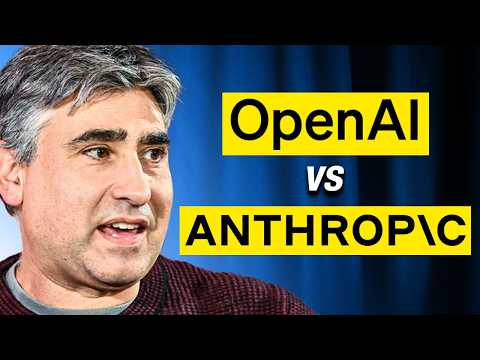
a16z GP, Martin Casado: Anthropic vs OpenAI & Why Open Source is a National Security Risk with China
Martin Casado (guest), Harry Stebbings (host), Harry Stebbings (host), Narrator
In this episode of The Twenty Minute VC, featuring Martin Casado and Harry Stebbings, a16z GP, Martin Casado: Anthropic vs OpenAI & Why Open Source is a National Security Risk with China explores aI Supercycle, Open Source Risks, and Venture Bets in Uncertain Times Martin Casado of a16z argues we’re in an AI supercycle where nearly every layer of the stack—chips, cloud, models, and apps—is accruing value, and the only real investing sin is sitting out or thinking in zero-sum terms. He predicts the model market will resemble cloud computing: an oligopoly of major providers like Anthropic, OpenAI, Google, plus specialized ‘flavor’ models, with brand strength a key moat while markets rapidly expand. Casado pushes back on simplistic narratives around open source and safety, calling Chinese open-source leadership a genuine national security concern but arguing the U.S. should respond with *more* open innovation, not less. Throughout, he dissects how AI shifts developer productivity, defensibility, and venture strategy, while also sharing candid views on risk, conflicts, wealth, and the realities of building and running a large venture platform.
AI Supercycle, Open Source Risks, and Venture Bets in Uncertain Times
Martin Casado of a16z argues we’re in an AI supercycle where nearly every layer of the stack—chips, cloud, models, and apps—is accruing value, and the only real investing sin is sitting out or thinking in zero-sum terms. He predicts the model market will resemble cloud computing: an oligopoly of major providers like Anthropic, OpenAI, Google, plus specialized ‘flavor’ models, with brand strength a key moat while markets rapidly expand. Casado pushes back on simplistic narratives around open source and safety, calling Chinese open-source leadership a genuine national security concern but arguing the U.S. should respond with *more* open innovation, not less. Throughout, he dissects how AI shifts developer productivity, defensibility, and venture strategy, while also sharing candid views on risk, conflicts, wealth, and the realities of building and running a large venture platform.
Key Takeaways
Avoid zero-sum thinking; every layer of the AI stack is winning.
Casado notes hardware (NVIDIA), hosting, models, and applications all continue to grow in value despite years of skepticism, so the real error is refusing to participate rather than worrying which layer captures margin.
Get the full analysis with uListen AI
Expect an oligopoly of major model providers, not a single monopoly.
He likens models to cloud: early dominance (like AWS) eventually gave way to a few big players able to subsidize heavily (Microsoft, Google); similarly, Anthropic and OpenAI will face strong competition from Google, Meta, and others as models are distilled and commoditized.
Get the full analysis with uListen AI
Brand is a powerful moat in fast-expanding AI markets.
Because the user frontier is growing so quickly, household names like ChatGPT and Midjourney gain outsized adoption even when technical differences are small, with ‘brand monopolies’ likely persisting until market growth slows and buyers start doing more structured product comparisons.
Get the full analysis with uListen AI
Model businesses vary wildly; some are great ventures, some are capital traps.
Diffusion-style models (e. ...
Get the full analysis with uListen AI
Open source AI is a double-edged sword, especially with China in the lead.
Casado believes Chinese open-source models are a genuine national security concern, but argues the U. ...
Get the full analysis with uListen AI
AI coding tools mainly improve robustness and maintainability, not just speed.
He finds coding assistants transform the developer experience by handling frameworks, tooling, and boilerplate, freeing humans to focus on core logic; they likely produce cleaner, less buggy codebases more than radically accelerating fundamental product innovation, especially in deep infrastructure.
Get the full analysis with uListen AI
Venture strategy should prioritize owning category leaders over quibbling on price.
Casado says a16z optimizes for ownership and leadership position, not entry valuation; in massive, brand-driven markets, paying up for the leader is rational, while their main ‘sin’ is backing the wrong company in the right market—not merely misjudging whether a space will be big.
Get the full analysis with uListen AI
Notable Quotes
“There's only been one sin, and that one sin is zero-sum thinking.”
— Martin Casado
“These markets are so large and they're growing so fast, we're actually seeing brand effects take place… we haven't seen that since the internet.”
— Martin Casado
“I think that right now, open source is most dangerous because China is better at it than we are.”
— Martin Casado
“The only sin in investing is missing the winner.”
— Martin Casado
“I just think behavior should follow business. It shouldn't follow marks.”
— Martin Casado
Questions Answered in This Episode
How should smaller AI startups realistically position themselves when brand effects and oligopolistic dynamics favor a few large model providers?
Martin Casado of a16z argues we’re in an AI supercycle where nearly every layer of the stack—chips, cloud, models, and apps—is accruing value, and the only real investing sin is sitting out or thinking in zero-sum terms. ...
Get the full analysis with uListen AI
If Chinese open-source AI is a national security concern, what concrete steps should the U.S. government and private sector take in the next 2–3 years to counterbalance it?
Get the full analysis with uListen AI
For founders building on top of Anthropic or OpenAI, what specific strategies can reduce platform risk if those providers vertically integrate into their space?
Get the full analysis with uListen AI
How can developers and companies measure whether AI coding tools are improving long-term code quality and reliability, not just short-term productivity metrics?
Get the full analysis with uListen AI
Given the high capital intensity and risk in frontier models, what should non-mega funds do: avoid models entirely, co-invest selectively, or focus on specialized ‘flavor’ models and applications?
Get the full analysis with uListen AI
Transcript Preview
There's only been one sin, and that one sin is zero-sum thinking. We always worry about, like, "Oh, is this defensible? Oh, will this layer get margin? Will this layer get value?" And the answer has kinda been unilaterally yes. The answer has been every layer has gotten value, every layer has winners. These markets are so large, and they're growing so fast, we're actually seeing brand effects take place. In this phase of model scaling, a lot of the approaches to scaling don't generalize. This gives a ton of room for the application developers to build their own models. I think that right now, open source is most dangerous because China is better at it than we are and, as a result of that...
Ready to go? (instrumental music plays) Martin, man, I love our conversations. I was so excited when you said you'd join me again. Thank you so much for doing this, man.
So excited to be here. Great to see you.
Dude, I freaking hate these, like, how did you get into venture intro questions, so I just wanna dive right in. It is a freaking nuts time. So starting off, how do you evaluate where we're at today in the AI investing landscape? Peak hype cycle, great, super excited, both: How do you evaluate it?
So I'm kind of of two minds. Of one mind is I do feel like my intuition doesn't really work like it has the last 20 years. Um, it's just, the future's very uncertain. And, and, and one of the reasons is, is because, you know, this is really the first time, like, software development and software creation is, is being disrupted. And so on one hand, I'm just like, "I don't really know what to think." On the other hand, observationally, there's only been one sin, and that one sin is zero-sum thinking. We always worry about, like, "Oh, is this defensible? Oh, will this layer get margin? Will this layer get value?" And the answer has kinda been unilaterally yes. The answer has been every layer has gotten value, every layer has winners. Uh, things that we thought were silly are making money. It's been solved. Th- the, the, these, there's profitable companies. I mean, th- the business case is there, et cetera. And so I, I, I think the one sin is, is not, is not playing the game.
Do you agree with the playing the game on the field sentiment? You know, when we look back at '21, you know, I remember everyone saying playing the game on the field. I wish I hadn't played the game on the field. (laughs) To be transparent, Martin, do you agree that you have to play the game on the field in venture?
I think you, I think behavior should follow business. It shouldn't follow marks. And I think in 2021, behavior was following marks, right? It was like the public markets just decided these companies were valued a whole bunch. You know, Tiger came in with a ton of money and depleted a whole bunch, and so, like, I think behavior following investment and marks is, is, is, is a bad idea. But in this case, you have some of the fastest-growing companies we've ever seen, by users, by revenue. I mean, the amount of value that's kind of shifted to this is so significant, and so I think investors' behavior should follow that. If not, I mean, eh, what are we doing?
Install uListen to search the full transcript and get AI-powered insights
Get Full TranscriptGet more from every podcast
AI summaries, searchable transcripts, and fact-checking. Free forever.
Add to Chrome