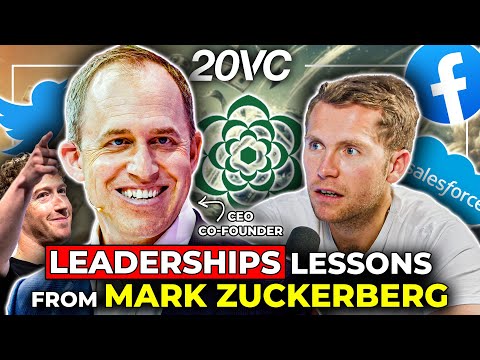
Bret Taylor: Why Pre-Training is for Morons & Companies Will Build Their Own Software | E1209
Bret Taylor (guest), Harry Stebbings (host), Narrator, Narrator
In this episode of The Twenty Minute VC, featuring Bret Taylor and Harry Stebbings, Bret Taylor: Why Pre-Training is for Morons & Companies Will Build Their Own Software | E1209 explores bret Taylor Explains AI Bubbles, Agents, And Why Models Commoditize Bret Taylor discusses the current AI boom, arguing it is a bubble that “rhymes” with the dot‑com era—wildly excessive in places yet still producing multiple trillion‑dollar and enduring enterprise companies.
Bret Taylor Explains AI Bubbles, Agents, And Why Models Commoditize
Bret Taylor discusses the current AI boom, arguing it is a bubble that “rhymes” with the dot‑com era—wildly excessive in places yet still producing multiple trillion‑dollar and enduring enterprise companies.
He is deeply skeptical of most startups doing their own model pre‑training, believing value will lie in applications and solutions, not in yet another frontier model, and that economics will favor companies whose costs are tied to inference, not massive training runs.
Taylor predicts AI will mirror the cloud market, with a few hyperscalers and research labs owning the heavy infrastructure and models, while most companies buy specialized, SaaS‑like AI applications and customer‑facing agents rather than building everything themselves.
He also describes his new company, Sierra, which builds branded conversational agents for consumer companies, and outlines how conversational, multimodal interfaces will become a primary way consumers interact with businesses, raising new design, governance, and change‑management challenges.
Key Takeaways
Treat AI like the cloud stack: few model providers, many solution vendors.
Taylor expects AI to stratify into infrastructure (hyperscalers and labs training frontier models), tools, and SaaS‑like applications, just as cloud did—most economic value will accrue to solution‑oriented products that solve concrete business problems.
Get the full analysis with uListen AI
Avoid pre‑training your own large models unless you’re a true AGI lab.
For almost all startups, spending heavily on pre‑training is like building your own data center in 2024: capital‑destructive and off‑mission compared with fine‑tuning strong existing models (proprietary or open source) to reach product–market fit.
Get the full analysis with uListen AI
Anchor your AI costs to inference usage, not massive upfront training bets.
Taylor argues sustainable AI businesses keep training costs modest and variable costs tied to inference, which in turn correlates with real customer usage and revenue; this sharply reduces the risk that sunk training costs never get paid back.
Get the full analysis with uListen AI
Expect foundation models to commoditize quickly while frontier models leapfrog.
Open models like LLaMA already provide GPT‑3. ...
Get the full analysis with uListen AI
Every company will need a branded conversational agent, not just a website.
Taylor believes we’re entering an era where consumers primarily interact with companies through conversational, multimodal agents (text, voice, images) that handle support, sales, and transactions—Sierra is aimed at powering that shift for brands.
Get the full analysis with uListen AI
Designing AI agents is about goals and guardrails, not just rules.
Unlike rigid chatbots, effective agents need freedom (agency) to be empathetic and useful, while still respecting strict business constraints; companies must explicitly define objectives, acceptable behaviors, and boundaries, then tune how much creativity they allow.
Get the full analysis with uListen AI
Leadership and entrepreneurship are largely learnable, but require unusual intensity.
Taylor rejects the idea of the “natural leader” as destiny—he sees leadership as a craft that can be trained like in the military—but notes that the emotional intensity and constant crisis of entrepreneurship select for certain personality traits.
Get the full analysis with uListen AI
Notable Quotes
“I am inherently skeptical of companies doing pre‑training. Unless you are an AGI research lab, doing pre‑training on a model, I believe, is just burning capital.”
— Bret Taylor
“Software is like a lawn, it needs to be tended to. It's not like you write software once and it just works forever.”
— Bret Taylor
“The AI bubble will rhyme with the dot‑com bubble… We will look back and laugh at some of the excess, but I’m confident we will have a brand‑defining, likely trillion‑dollar consumer company come out of this.”
— Bret Taylor
“We're going from the age of rules to the age of goals and guardrails.”
— Bret Taylor
“In 1995, the way you existed digitally as a business was to have a website. In 2025, the way you will exist digitally is to have an AI agent.”
— Bret Taylor
Questions Answered in This Episode
If pre‑training is economically irrational for most startups, how should founders decide when, if ever, it becomes justified to train their own models?
Bret Taylor discusses the current AI boom, arguing it is a bubble that “rhymes” with the dot‑com era—wildly excessive in places yet still producing multiple trillion‑dollar and enduring enterprise companies.
Get the full analysis with uListen AI
What governance frameworks and internal processes should companies adopt to safely give their AI agents more ‘agency’ without compromising brand, compliance, or customer trust?
He is deeply skeptical of most startups doing their own model pre‑training, believing value will lie in applications and solutions, not in yet another frontier model, and that economics will favor companies whose costs are tied to inference, not massive training runs.
Get the full analysis with uListen AI
How might the dominance of a few hyperscalers and labs in frontier models affect long‑term competition, pricing power, and innovation at the application layer?
Taylor predicts AI will mirror the cloud market, with a few hyperscalers and research labs owning the heavy infrastructure and models, while most companies buy specialized, SaaS‑like AI applications and customer‑facing agents rather than building everything themselves.
Get the full analysis with uListen AI
In what concrete ways will conversational agents change the structure, staffing, and workflows of customer service, sales, and legal departments over the next five years?
He also describes his new company, Sierra, which builds branded conversational agents for consumer companies, and outlines how conversational, multimodal interfaces will become a primary way consumers interact with businesses, raising new design, governance, and change‑management challenges.
Get the full analysis with uListen AI
Given the erosion of trust in digital content authenticity, what are practical ways AI itself can be deployed to help individuals and institutions assess what is real?
Get the full analysis with uListen AI
Transcript Preview
(instrumental music) I think we are in a bubble. I am inherently skeptical of companies doing pre-training. Unless you are a AGI research lab, (laughs) doing pre-training on a model, I believe, is just burning capital. Software is like a lawn, it needs to be tended to. It's not like you write software once and it just works forever.
Ready to go? (instrumental music) Brett, I am so excited for this, my friend. I've been a fan from afar for a long time. You've had such an incredible career, so thank you so much for joining me.
No, thanks for having me.
I know this one's a little bit off back, 'cause it's not even on the schedule. So you're like, you're breaking the rules from round one. But when I go through the different achievements you have, eh, it really is incredible. When you were young, did you know that you were gonna be successful? Did you have that innate feeling?
I don't think so. You know, when I was young, first I wanted to be Indiana Jones, which I know is not a job, but to me, he was by far the coolest example of an adult that I'd ever seen. By the time that I, uh, you know, was in school and started thinking about a job, I wanted... I thought I wanted to be an attorney, um, in high school. And, uh, I'm happy to tell this story. It's actually kind of an interesting story, but I ended up getting a job at a gas station, and then, uh, sort of hustling my way into making a website for a mechanic that was nearby. Um, I was getting paid $4.25 at the gas station an hour, which was minimum wage at the time, and, uh, ended up getting paid $400 for the website. So I quit the gas station (laughs) job the next day, and ended up making websites for a lot of local businesses in my, my hometown. Most of those websites endured for decades, you know, because it turns out if you're a florist, it's not like you're actively SEOing your website, so... (laughs) You know, my, my fingerprints on the internet in 1996 and '97 lasted for longer than you'd expect. And even when I went to Stanford, I, um, I think if you'd met me that summer before, I probably would've said, "I probably want to be a lawyer." But then the combination of my accidental entrepreneurial, um, experience, plus going to Stanford in the dot-com bubble, I... Uh, my first quarter at Stanford, I took a class called CS106A, which was sort of the intro class, and the rest is history. I, I was so obsessed with software at that point. I would do it in my spare time. Um, it had nothing to do with school. I was just totally obsessed with the, the craft.
Do you think people are born entrepreneurs, or do you think it can be learned?
Install uListen to search the full transcript and get AI-powered insights
Get Full TranscriptGet more from every podcast
AI summaries, searchable transcripts, and fact-checking. Free forever.
Add to Chrome