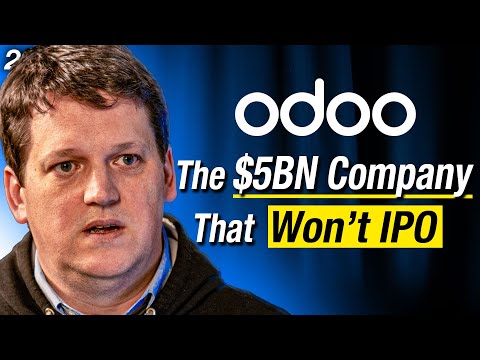
Fabien Pinckaers, CEO @Odoo: The Billionaire Founder Who Doesn’t Care About Money | E1259
Fabien Pinckaers (guest), Harry Stebbings (host), Harry Stebbings (host)
In this episode of The Twenty Minute VC, featuring Fabien Pinckaers and Harry Stebbings, Fabien Pinckaers, CEO @Odoo: The Billionaire Founder Who Doesn’t Care About Money | E1259 explores billionaire Odoo Founder Rejects IPOs, Hierarchies, and High Prices Fabien Pinckaers, founder and CEO of Odoo, explains how he built a 5,000-person, €550M-revenue open-core SaaS company by obsessively focusing on product quality, low pricing, and long-term thinking rather than fundraising, branding, or exits.
Billionaire Odoo Founder Rejects IPOs, Hierarchies, and High Prices
Fabien Pinckaers, founder and CEO of Odoo, explains how he built a 5,000-person, €550M-revenue open-core SaaS company by obsessively focusing on product quality, low pricing, and long-term thinking rather than fundraising, branding, or exits.
He recounts years of near-bankruptcy, multiple business model pivots (services, support, SaaS, then open core), and a painful clash with his open-source community before finding the monetization model that unlocked consistent 50% annual growth.
Odoo’s culture rejects traditional management: no external VP hires, minimal KPIs, no recurring meetings, fast hiring based on practical tests and IQ, internal-only promotions, and extreme emphasis on autonomy, responsibility, and evolution for largely very young teams.
Pinckaers insists he doesn’t care about valuation or personal wealth, refuses the idea of an IPO or sale, and aims instead to commoditize business management software globally, ultimately displacing incumbents like SAP and Salesforce.
Key Takeaways
Build an exceptional, integrated product before over-optimizing for distribution.
Odoo spent years building a broad, deeply integrated suite (accounting, CRM, logistics, e‑commerce, etc. ...
Get the full analysis with uListen AI
Be willing to pivot your business model repeatedly—even at cultural cost.
Odoo shifted from services to support contracts to SaaS to an open-core model, upsetting its open-source community in the process, but that final model turned a large user base into sustainable, high-growth revenue.
Get the full analysis with uListen AI
Pricing can unlock or destroy years of growth; experiment, but course-correct fast.
A misdesigned pricing scheme (charging per user times apps) cost Odoo roughly a year of growth and strained its partner network, while a 2022 price cut for small customers (from ~€120 to €20/user/month) nearly tripled customer acquisition.
Get the full analysis with uListen AI
Hire for demonstrated ability, not credentials, and promote only from within.
Odoo ignores CVs, uses on-the-job tests plus IQ tests, makes offers in days, and never hires external managers; team leads must be the best individual contributors on their teams, which strengthens culture and execution consistency.
Get the full analysis with uListen AI
Minimize bureaucracy: few KPIs, no recurring meetings, and no local budgets.
Team leaders are judged by whether their teams get better, not by dashboards; finance controls overall budgets, but individuals are trusted to spend responsibly, which Pinckaers believes saves money and increases ownership.
Get the full analysis with uListen AI
Retention and second-tier locations are strategic levers for scaling.
By building offices in tier-two cities like Buffalo rather than talent-war hotspots like San Francisco, Odoo gains higher retention and better ROI on talent, compounding performance as experienced employees become far more productive over time.
Get the full analysis with uListen AI
Ignore valuation as a goal; focus on long-term compounding and control.
Despite being a paper billionaire who still owns 57% of Odoo, Pinckaers has done only two low-valuation fundraises, refuses to IPO or sell, and uses periodic secondaries for investor liquidity so he can keep building for decades.
Get the full analysis with uListen AI
Notable Quotes
“You have to be obsessed. I don't think you can succeed if you are not obsessed.”
— Fabien Pinckaers
“Our product is years ahead of the competition. There is no way they can do what we do.”
— Fabien Pinckaers
“If you look for people that are perfect in everything, you will get people that are average in everything.”
— Fabien Pinckaers
“I don't care about money. I don't need money.”
— Fabien Pinckaers
“No, there will never be an IPO. I don't want to.”
— Fabien Pinckaers
Questions Answered in This Episode
How sustainable is Odoo’s anti-IPO, anti-exit stance if market conditions or leadership change over time?
Fabien Pinckaers, founder and CEO of Odoo, explains how he built a 5,000-person, €550M-revenue open-core SaaS company by obsessively focusing on product quality, low pricing, and long-term thinking rather than fundraising, branding, or exits.
Get the full analysis with uListen AI
Can Odoo’s culture of no external managers and minimal KPIs still work at 10,000+ employees or under a different CEO?
He recounts years of near-bankruptcy, multiple business model pivots (services, support, SaaS, then open core), and a painful clash with his open-source community before finding the monetization model that unlocked consistent 50% annual growth.
Get the full analysis with uListen AI
Will the push to commoditize business software inevitably force price competition that squeezes innovation budgets?
Odoo’s culture rejects traditional management: no external VP hires, minimal KPIs, no recurring meetings, fast hiring based on practical tests and IQ, internal-only promotions, and extreme emphasis on autonomy, responsibility, and evolution for largely very young teams.
Get the full analysis with uListen AI
How might advances in AI agents reshape Odoo’s integrated-apps strategy or its advantage over point solutions?
Pinckaers insists he doesn’t care about valuation or personal wealth, refuses the idea of an IPO or sale, and aims instead to commoditize business management software globally, ultimately displacing incumbents like SAP and Salesforce.
Get the full analysis with uListen AI
Could Odoo’s horizontal approach eventually hit limits in deeply specialized verticals that demand heavy customization?
Get the full analysis with uListen AI
Transcript Preview
You have to be obsessed. I don't think you can succeed if you are not obsessed. I always wanted the price to be low, because in every transaction, I was purchasing shares. All the manager are always buying shares at Odoo. We never sold shares. No, there will never be an IPO. When I was 26, I purchased the domain name sorrysep.com, because I thought that one day I would be much bigger than them and then I would use this domain name. (laughs)
Ready to go? Fabien, I am so excited for this. Listen, I am a SaaS nerd, and Odoo is one of the most incredible stories. So thank you so much for joining me today.
Thank you for having me.
Now, I would love to start. You started your first business at 13 with a business management software company. Dude, what's the story there?
Oh, it was just, uh, I- I'm a developer. I also like management. I was reading a lot of books. It was just friends of my father and I did management software for them. And I started with one and then two and then a lot of people.
Okay, so you started with one to a lot of people. Were you kind of aware that you were building a business and you were wanting to make money at the time? Like, how were you thinking about it?
Uh, it was not so much about getting money. It was more about building something. What I live- like is to build software that people use, that, uh, have an impact for them. So the money was great. I, I mean, but it was 150 euro at the time, so. (laughs) So it, it was just for doing something.
What happens next? Then you're in school. You're 15, 16. Are you just, like, the smartest kid in school and school's easy?
I didn't go to the lecture. I was more doing business or having fun and drinking beers. (laughs)
(laughs)
But, uh, yeah, I was doing a lot of... I continued developing software for, for companies during, during the university. I did a lot of things like e-commerce. I did virus, antivirus, games, uh, a lot of... I had a T-shirt company, a lot of different things.
You had a T-shirt company?
Yeah.
What was that about?
Oh, I, I'm passionate about open source, you know, Linux stuff and so on. So I did a e-commerce with Linux T-shirts and ties and DBN and everything. And I sold, I actually sold a lot, but (laughs) it was really painful to, to post all these T-shirts every day.
My God, you realize the, the challenges of actually selling physical products.
It started to be a logistic challenge-
Oh my God.
... for, for a student that wants to drink beer, it's not great. (laughs)
(laughs) I- I love that. Okay, so what would you say was your, like, first real business?
Install uListen to search the full transcript and get AI-powered insights
Get Full TranscriptGet more from every podcast
AI summaries, searchable transcripts, and fact-checking. Free forever.
Add to Chrome