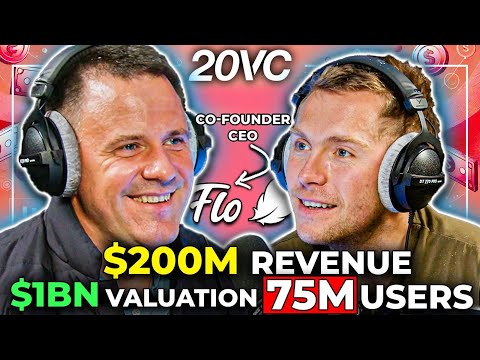
Dmitry Gurski: From Potato Farm to $200M in Revenue: The Never-Before-Told Story of Flo Health|E1205
Dmitry Gurski (guest), Harry Stebbings (host), Narrator
In this episode of The Twenty Minute VC, featuring Dmitry Gurski and Harry Stebbings, Dmitry Gurski: From Potato Farm to $200M in Revenue: The Never-Before-Told Story of Flo Health|E1205 explores potato Fields to Femtech Unicorn: Flo Health’s Relentless, Simple Focus Dmitry Gurski, co‑founder and CEO of Flo Health, shares his journey from poverty in 1990s Belarus and mushroom-picking side hustles to building a $200M‑revenue femtech subscription app valued over $1B.
Potato Fields to Femtech Unicorn: Flo Health’s Relentless, Simple Focus
Dmitry Gurski, co‑founder and CEO of Flo Health, shares his journey from poverty in 1990s Belarus and mushroom-picking side hustles to building a $200M‑revenue femtech subscription app valued over $1B.
He attributes Flo’s success to ruthless product simplicity, exceptional retention driven by a naturally recurring user case (menstrual cycles), and massive, long-term investment in product over brand or PR.
Gurski rejects generic startup advice, arguing that every company’s path is uniquely nuanced, and emphasizes data-driven decisions, humility, and obsessive listening to users and doctors rather than founder “personal pain”.
The conversation also covers fundraising bias, the brutality of relocation during war, the power and limits of consumer subscriptions, and his personal philosophy on money, leadership, and giving wealth back to society.
Key Takeaways
Build for a recurring, unavoidable user case to unlock retention.
Gurski stresses that retention is primarily about the nature of the use case, not just product quality; menstruation is inherently recurring and non-optional, giving Flo an unusually strong retention base compared to typical health and fitness apps.
Get the full analysis with uListen AI
Radical simplicity beats feature-rich complexity in consumer products.
Flo’s first two period trackers failed because they were too complicated; the winning version was deliberately simpler, confirming that consumers value ease and clarity far more than feature count.
Get the full analysis with uListen AI
Organic growth comes from retention-driven word of mouth, not hope.
Early growth came from app-store algorithms rewarding high retention, which then fed word of mouth; today he views retention as the prerequisite for predictable organic acquisition, with paid marketing effective only once value is proven.
Get the full analysis with uListen AI
Monetization requires selling the value, not just creating it.
Initially Flo assumed a great product would automatically monetize; after hundreds of A/B tests, they increased onboarding conversion to premium by 8x by learning to explain and present value effectively, not by degrading the product.
Get the full analysis with uListen AI
Generic startup advice is dangerous; context and nuance are everything.
Gurski dismisses broad rules like “only build what you’ve personally experienced” or “speed is everything,” arguing that every successful company follows a highly specific path, and founders must design strategies around their own strengths and situations.
Get the full analysis with uListen AI
Obsess over product investment and be frugal elsewhere.
He has spent ~$150M on product, keeps engineering costs efficient in Eastern Europe, and personally refuses luxuries like business class flights, preferring to divert every possible dollar into product rather than PR or brand campaigns he can’t quantify.
Get the full analysis with uListen AI
Long-term value in subscriptions comes from cohort revenue behavior, not static churn.
Unlike B2B SaaS, Flo’s consumers often leave and return; Gurski evaluates subscription health via revenue retention and cohort behavior over time, arguing that simple B2B-style churn logic misreads consumer subscription dynamics.
Get the full analysis with uListen AI
Notable Quotes
“For consumers, simplicity is much more significant than number of features, much more significant than anything.”
— Dmitry Gurski
“What many people don't understand is that retention is not about product. Retention is about user case.”
— Dmitry Gurski
“Never take general advice. It's always bullshit.”
— Dmitry Gurski
“Smart people, they work in McKinsey. And founders, they're crazy.”
— Dmitry Gurski
“I despise luxury. I don’t even have a car. I’d rather pay a developer’s salary than fly business class.”
— Dmitry Gurski
Questions Answered in This Episode
How can founders in less ‘obvious’ recurring categories approximate Flo’s retention advantage without an inherently unavoidable user case like menstruation?
Dmitry Gurski, co‑founder and CEO of Flo Health, shares his journey from poverty in 1990s Belarus and mushroom-picking side hustles to building a $200M‑revenue femtech subscription app valued over $1B.
Get the full analysis with uListen AI
Where is the line between healthy humility and self-sabotaging underselling when leading a high-growth company?
He attributes Flo’s success to ruthless product simplicity, exceptional retention driven by a naturally recurring user case (menstrual cycles), and massive, long-term investment in product over brand or PR.
Get the full analysis with uListen AI
If product should dominate spend, under what specific conditions does it make sense to meaningfully invest in brand and PR for a consumer app?
Gurski rejects generic startup advice, arguing that every company’s path is uniquely nuanced, and emphasizes data-driven decisions, humility, and obsessive listening to users and doctors rather than founder “personal pain”.
Get the full analysis with uListen AI
How can consumer subscription businesses best model and communicate their cohort-based revenue retention to investors accustomed to B2B SaaS metrics?
The conversation also covers fundraising bias, the brutality of relocation during war, the power and limits of consumer subscriptions, and his personal philosophy on money, leadership, and giving wealth back to society.
Get the full analysis with uListen AI
What practical steps can leaders take to maintain product simplicity and coherence as they evolve into super apps with many teams and features?
Get the full analysis with uListen AI
Transcript Preview
Smart people, they work in McKinsey. And founders, they're crazy. For consumers, simplicity is much more significant than number of features, is m- much more significant than anything. What many people don't understand, that retention is not about product. Retention is about user case. It means that you may create the perfect app for gym and will have terrible retention. Why? Because gyms themself have terrible retention. Never take general advice. It's always bullshit. If you look on history of any company or any CEO, you would see that everything is so nuanced, everything is so unique. Thousands of ways to be successful and you just should choose your way.
Ready to go? (instrumental music plays) Dmitry, I am such a fan of the incredible journey with Flow. So first off, thank you so much for joining me today.
Oh, thank you for you for inviting.
Not at all. Listen, I wanted to make this happen for a while. I would love to start, I- I read actually, uh, an interview you'd done before, and I heard that you had a single mother who worked as a librarian, uh, you got your first job at 16. Take me to that. How did those early years shape you as an entrepreneur?
Mm. As we- as I see you, I'm not so young. I'm 41 years old and, uh, uh, my childhood was in '90s in Belarus. Difficult times. Like the world, Soviet world, was destroyed. Like everything ruined. People didn't have salaries, uh, shelters were empty. The salary of my mother was maybe 30 bucks and nothing to buy because, uh, shelters in shops were empty. And, uh, we were growing our own food. We had potato field, vegetables in this field, we had a garden. We were making like hundreds of jars of, uh, pickles and mostly we were feeding ourself by, uh, this production. Like I still don't like potato, honestly.
(laughs)
I can't eat anymore. Uh, but it was a good life lesson. It was a lesson of farming and the lesson of farming teach you just can't fake farming. It means that you should, uh, take potato, not eat- eat it immediately, even if you're hungry, and you should put this potato to ground. And, uh, then you must eat this potato next day and even one month after, you should wait. And then you should work hard and you should- you can't f- uh, fake this job. And then, uh, it's like you never have, uh, 100% of chances that, uh, you would get your potato back because... I don't know. It might be hail, it might be frost, it might be bugs. But then if you are lucky and you work hard, so then you will get your harvest. But also it's a lesson of, uh, diversification because you should have not just potato, you shou- also should have vegetables in the garden because like if, uh, it's like bad, uh, harvest of, uh, potatoes, then vegetables or apples or something and, uh, like something you will have to eat.
Install uListen to search the full transcript and get AI-powered insights
Get Full TranscriptGet more from every podcast
AI summaries, searchable transcripts, and fact-checking. Free forever.
Add to Chrome