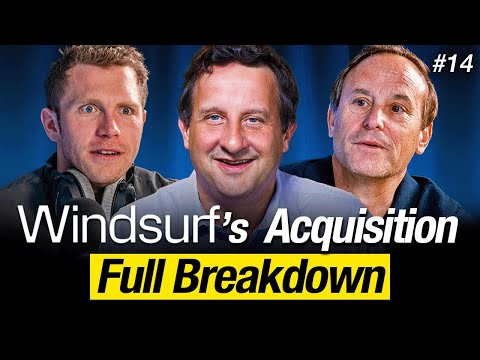
Windsurf x Google x Cognition: Full Breakdown: Who Made Money, Who Did Not
Jason Lemkin (guest), Harry Stebbings (host), Rory O’Driscoll (guest), Guest (guest), Narrator
In this episode of The Twenty Minute VC, featuring Jason Lemkin and Harry Stebbings, Windsurf x Google x Cognition: Full Breakdown: Who Made Money, Who Did Not explores windsurf’s AI Saga: Winners, Losers, and Wildcard Grok Emerges The episode dissects Windsurf’s convoluted M&A saga: an aborted OpenAI acquisition, regulatory and platform pressures, Google’s asset-licensing structure, and Cognition’s rapid-fire purchase of the remaining business. The hosts analyze how Windsurf’s decelerating revenue, loss of Anthropic access, and FTC constraints pushed the founder and board toward a fast, imperfect exit that richly rewarded early investors and top engineers but left many employees with little. They argue Google and other hyperscalers are pioneering new ‘license + team’ deal structures to skirt antitrust scrutiny, often leaving behind “empty husks” that can still represent huge upside for sharp acquirers like Cognition. The conversation then zooms out to broader AI dynamics: the durability of AI dev-tool revenues, the viability of vibe-coding platforms like Replit and Lovable, Elon’s Grok as a serious model contender, and how capital intensity and regulation are reshaping competitive strategy.
Windsurf’s AI Saga: Winners, Losers, and Wildcard Grok Emerges
The episode dissects Windsurf’s convoluted M&A saga: an aborted OpenAI acquisition, regulatory and platform pressures, Google’s asset-licensing structure, and Cognition’s rapid-fire purchase of the remaining business. The hosts analyze how Windsurf’s decelerating revenue, loss of Anthropic access, and FTC constraints pushed the founder and board toward a fast, imperfect exit that richly rewarded early investors and top engineers but left many employees with little. They argue Google and other hyperscalers are pioneering new ‘license + team’ deal structures to skirt antitrust scrutiny, often leaving behind “empty husks” that can still represent huge upside for sharp acquirers like Cognition. The conversation then zooms out to broader AI dynamics: the durability of AI dev-tool revenues, the viability of vibe-coding platforms like Replit and Lovable, Elon’s Grok as a serious model contender, and how capital intensity and regulation are reshaping competitive strategy.
Key Takeaways
Decelerating revenue can rapidly flip a $3B growth story into a forced sale.
Windsurf reportedly went from ~$100M ARR to ~$82M in a few months, plus lost Anthropic access; that combination made continuing as an independent #2 player in a brutal AI tools market far riskier than taking a multi‑billion acquisition outcome.
Get the full analysis with uListen AI
New FTC‑aware deal structures separate ‘people and IP’ from ‘revenue and shell.’
Google licensed Windsurf’s IP and hired ~40 key engineers, paying the company rather than its shareholders directly, then Cognition bought the revenue and remaining assets; this structure aims to avoid the FTC labeling it a full acquisition, but creates complex tax and equity consequences.
Get the full analysis with uListen AI
Top engineers and early investors captured most of the upside; many employees did not.
Because dividends and buybacks flow only to existing shareholders, late‑joining staff and those without vested equity were largely left out, not from deliberate malice, the hosts argue, but from structural and regulatory constraints that made equitable treatment legally and mechanically difficult.
Get the full analysis with uListen AI
Cognition likely turned a doomed asset into a high‑leverage growth platform.
By snapping up Windsurf’s remaining 80+M in ARR, ~$100M in cash, Anthropic access, and a known brand for roughly $400M, Cognition can plug its elite 40‑person team into a large revenue base and potentially rebuild Windsurf into something stronger within months.
Get the full analysis with uListen AI
Vibe coding platforms have very high early churn but potentially very sticky power users.
Most casual ‘roll‑your‑own Notion/HubSpot’ experiments fail fast, but if a non‑developer actually gets a production‑grade app running in Replit or Lovable, they’re likely to pay substantial recurring fees and keep iterating—creating a high‑NRR, high‑lifetime‑value cohort that offsets low‑end churn.
Get the full analysis with uListen AI
Brand and simplicity may matter more than raw capability in AI dev tools.
For non‑experts choosing between multiple tools, recognizable brands (e. ...
Get the full analysis with uListen AI
Grok proves world‑class models are no longer limited to the original ‘golden circle’ teams.
In two years, Elon Musk’s xAI assembled strong (if not marquee) talent plus billions in GPUs to ship a chat model competitive with leaders on many benchmarks, implying that the know‑how to build frontier‑level systems is diffusing—and raising questions about over‑investment and eventual market structure.
Get the full analysis with uListen AI
Notable Quotes
“Almost everything you need to know about the AI revolution is embedded somewhere in this kind of play.”
— Rory
“Windsurf was hopeless before this deal. You could never attract 30 S-tier developers to fix Windsurf, but they fixed it in one hour.”
— Jason
“There’s a lot of revealed preference going on about how founders think about the upside of independence versus the safety of a shit ton of money.”
— Rory
“These deals sound too cheap. You see undifferentiated companies raising at 300 pre with less than a million in revenue, and Windsurf is selling for 20X.”
— Jason
“With committed leadership and a couple billion dollars worth of GPU, the next level down people know how to do this too.”
— Rory on Grok/xAI
Questions Answered in This Episode
How sustainable is Cognition’s bet that it can quickly rebuild Windsurf into a stronger product and business using its own S-tier team?
The episode dissects Windsurf’s convoluted M&A saga: an aborted OpenAI acquisition, regulatory and platform pressures, Google’s asset-licensing structure, and Cognition’s rapid-fire purchase of the remaining business. ...
Get the full analysis with uListen AI
Do these FTC-driven ‘IP and team’ licensing deals represent a regulatory success (limiting consolidation) or simply push value into murkier, less worker‑friendly structures?
Get the full analysis with uListen AI
For employees joining late‑stage, high-valuation AI startups, what compensation and legal protections would actually mitigate the risk of being excluded in a complex partial sale?
Get the full analysis with uListen AI
Will vibe-coding platforms like Replit and Lovable evolve into a mainstream layer of enterprise software creation, or remain a niche used by a small set of power users and teams?
Get the full analysis with uListen AI
If Grok and other new entrants can technically match OpenAI within a couple of years, will differentiation in AI shift more to distribution, ecosystem, and brand than to raw model performance?
Get the full analysis with uListen AI
Transcript Preview
Windsurf was hopeless before this deal. You could never attract 30 S-tier developers to fix Windsurf, but they fixed it in one hour. Literally, in 90 days, Windsurf could be better than it was before this deal. This deal is crazy, it sounds, because they have the people. Some of these deals almost seem too cheap. If you look at the crappy multiples we see for some startups, undifferentiated company raising at 300 pre, with less than a million in revenue. And then you see, what is Windsurf, uh, selling for? 20X revenue? Lovable's raising at 20.
Ready to go? (upbeat music plays) Guys, I am so excited for this. I literally have been looking at the news over the last few days going like, "Ah, when's this show? When's this show?" Uh, so, uh, what else would we fricking start with? I would love it if we went with a different topic to start with. (laughs) But on Friday, I think it was, Windsurf announced and Varun announced that there would be an agreement with Google whereby the IP and the team would be joining Google, uh, and DeepMind, and they announced that on Friday. And so if we just start there, how did we break down, how did we assess, how did we think about that news of the core team and the IP going to Google?
Here's a framing comment. So, um, the, the, the memo that Cognition sent to its employees was that they were buying an $82 million ARR business, okay? And it'll be interesting to see what they paid for it, because, you know, not much probably, right? So that sounds very exciting, right? It's, it se- And I do think Cognition got an amazing deal, but here's the framing question. And again, so many AI folks stretch reality when they quote revenue numbers, okay? But Windsurf said like 60 days ago, uh, 90 days ago, before the, before, uh, before the OpenAI deal was announced and before they lost access to Claude, that they were doing 100. 100. So did they decel- If they decelerated from 100 before the OpenAI deal to 82 million today, that's a lot of deceler- I would take any deal. And I, I think that may explain a lot of it, right? The minute... If you, if you're decelerating li- that level, the minute the OpenAI deal falls apart, you've gotta find a lily pond to jump on, don't you? That's massive deceleration if it's accurate.
I think it's clear they ha- they wanted to find a lily pond. But again, zooming out, it is just worth restating the kind of, the cast of characters here, 'cause literally this is one of those Agatha Christie mo- mysteries where anyone could have killed th- you know, anyone could have killed the victim, right? Stepping back, three months ago, OpenAI said they were gonna buy this company, or at least intimated they were going to buy this company. It sounds like some combination of Microsoft and the FTC prevented them from buying this company. In the meantime, Anthropic mugged this company by taking away access to their API, which is how this company delivered its product. Then, as you say, on Friday, Google stepped in once the exclusive period was gone and bought part of this company, leaving an empty husk, and then on Monday, Cognition bought the empty husk and got, you know, general all around Silicon Valley cute ohs and plaudits for stepping up and being a good buy, board buy. That's a lot. That's a fricking saga start to finish. And you know, it's almost like you gotta unpick it bit by bit and figure out all the... There's a c- genuine comment here. Almost everything you need to know about the AI revolution is embedded somewhere in this kind of play, because all the characters are playing, are all doing their thing, and there's just a lot in it.
Install uListen to search the full transcript and get AI-powered insights
Get Full TranscriptGet more from every podcast
AI summaries, searchable transcripts, and fact-checking. Free forever.
Add to Chrome