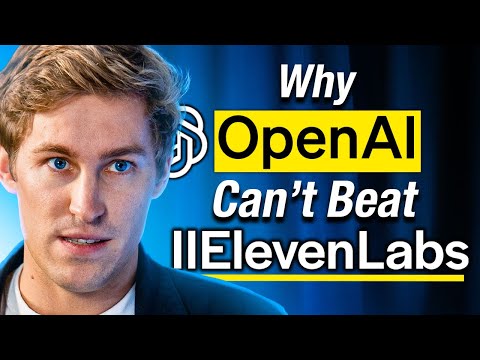
ElevenLabs CEO/Co-Founder, Mati Staniszewski:The Untold Story of Europe’s Fastest Growing AI Startup
Mati Staniszewski (guest), Harry Stebbings (host), Narrator, Narrator
In this episode of The Twenty Minute VC, featuring Mati Staniszewski and Harry Stebbings, ElevenLabs CEO/Co-Founder, Mati Staniszewski:The Untold Story of Europe’s Fastest Growing AI Startup explores elevenLabs’ meteoric rise: Europe’s voice-AI rocket to $200M ARR Harry Stebbings interviews ElevenLabs CEO and co‑founder Mati Staniszewski on building one of the fastest‑growing AI startups from Europe, going from beta launch in January 2023 to over $200M ARR in under two years.
ElevenLabs’ meteoric rise: Europe’s voice-AI rocket to $200M ARR
Harry Stebbings interviews ElevenLabs CEO and co‑founder Mati Staniszewski on building one of the fastest‑growing AI startups from Europe, going from beta launch in January 2023 to over $200M ARR in under two years.
Mati explains ElevenLabs’ origins in bad Polish movie dubbing, their decision to build proprietary voice models, and the strategic choice to be a global company built from Europe with a small, high‑density team.
He walks through difficult early fundraising, landing top‑tier US investors like a16z, Sequoia, and Nat Friedman/Daniel Gross, and details their philosophy on speed of execution, product over PR, and pairing research excellence with focused use cases.
The conversation also covers culture, hiring, talent retention, competition with OpenAI, unit economics, infrastructure strategy, and the future of agentic voice platforms for call centers and customer support.
Key Takeaways
Pair deep research with a sharp, evolving product focus.
ElevenLabs started with a dubbing idea, discovered tepid demand, and pivoted to narration/voice‑over where creators had immediate, painful problems—while still using that work to build the technical foundation for dubbing and broader voice AI.
Get the full analysis with uListen
Use proprietary models when off‑the‑shelf quality clearly limits the product.
In 2021–2022, existing TTS models were obviously subpar, so ElevenLabs invested in its own text‑to‑speech, speech‑to‑text, and now music models, gaining a 6–12 month quality lead that underpins their platform and differentiates them from API‑wrappers.
Get the full analysis with uListen
Time funding and PR to real product milestones, not vanity events.
They routinely delayed funding announcements until they could pair them with substantive product launches; traditional press drove little user growth, whereas niche channels (Discord, Reddit, Hacker News, AI newsletters, YouTubers) were far more effective.
Get the full analysis with uListen
Speed of execution across research, product, and fundraising is a core moat.
Mati repeatedly emphasizes that in a commoditizing AI landscape, moving faster than incumbents—shipping models, products, and deals quickly—is often more decisive than any single technical or capital advantage.
Get the full analysis with uListen
Small, autonomous teams with high talent density beat large headcount.
Even at ~250 people, ElevenLabs is organized into ~20 small, product‑oriented squads (5–10 people), avoids formal titles, and lets leadership emerge by impact, which preserves ownership, speed, and cross‑functional learning.
Get the full analysis with uListen
Building globally from Europe is viable if ambition and talent bar are high.
Mati argues Europe has world‑class engineers who often lack truly ambitious local companies; by treating ElevenLabs as a global company headquartered in Europe, and topping up with US capital and advisors, they defy the “Europe = hard mode” narrative.
Get the full analysis with uListen
Voice agents and AI‑driven customer support are the next massive growth engine.
Beyond creator tools, ElevenLabs is betting heavily on conversational/voice agents for call centers and support, already signing ~$2M contracts and seeing this as a future multi‑billion‑dollar line of business.
Get the full analysis with uListen
Notable Quotes
“Pre‑seed was tough. Pre‑seed was hard. We spoke with between 30 to 50 investors.”
— Mati Staniszewski
“They definitely will do something, but I think they lack the genius that I’m happy my co‑founder and the team has.”
— Mati Staniszewski (on OpenAI as a competitor)
“We did 20 months to 100 [million], and then around 10 months to 200.”
— Mati Staniszewski
“More people frequently doesn't fix the problem. You don't need that many people to do something special.”
— Mati Staniszewski
“You can build a company from Europe at the global scale.”
— Mati Staniszewski
Questions Answered in This Episode
How sustainable is ElevenLabs’ 6–12 month research lead in voice as foundation models become more multimodal and widely available?
Harry Stebbings interviews ElevenLabs CEO and co‑founder Mati Staniszewski on building one of the fastest‑growing AI startups from Europe, going from beta launch in January 2023 to over $200M ARR in under two years.
Get the full analysis with uListen AI
What specific cultural practices allow ElevenLabs to scale from 250 to 400 people while preserving small‑team speed and no‑titles autonomy?
Mati explains ElevenLabs’ origins in bad Polish movie dubbing, their decision to build proprietary voice models, and the strategic choice to be a global company built from Europe with a small, high‑density team.
Get the full analysis with uListen AI
How might widespread adoption of voice agents in call centers impact employment, and what guardrails should companies put in place for that transition?
He walks through difficult early fundraising, landing top‑tier US investors like a16z, Sequoia, and Nat Friedman/Daniel Gross, and details their philosophy on speed of execution, product over PR, and pairing research excellence with focused use cases.
Get the full analysis with uListen AI
To what extent is building proprietary infrastructure (like in‑house data centers) a durable advantage versus a temporary financial optimization?
The conversation also covers culture, hiring, talent retention, competition with OpenAI, unit economics, infrastructure strategy, and the future of agentic voice platforms for call centers and customer support.
Get the full analysis with uListen AI
What lessons from ElevenLabs’ experience suggest that Europe can consistently produce global AI leaders, and what systemic blockers still remain?
Get the full analysis with uListen AI
Transcript Preview
So, we crossed 200 million. (cash register dings)
Whoa. (cash register dings)
20 months to 100. (cash register dings) And then, uh, 10 months to 200. (cash register dings) (baby laughing)
Today, we have one of the fastest-growing AI companies in the world, ElevenLabs. And I'm so thrilled... ... to welcome their co-founder... ... Matti, to the hot seat today.
(cash register dings) Pre-seed was tough. Pre-seed was hard. I think we spoke with a good amount of double-digit investors, between 30 to 50.
How much did you raise in the pre-seed?
We raised $2 million.
Do you remember the price? (cash register dings)
$9 million. For us, even from investor, from product perspective is like, especially now, the speed of execution, speed of investing is- is the only thing you have. Our biggest contract is around $2 million, and they are mostly in a call center, customer support, personal assistant space.
What do you believe that most around you disbelieve?
That you can build a company from Europe at the global scale.
How do you answer the question, "Why won't OpenAI just do this?"
They definitely will, but I think they, you know, they- they lack the... (guitar music plays)
Ready to go? (upbeat music plays) Matti, dude, I cannot wait for this. I've wanted to do this one for a while, so thank you so much for joining me today.
Harry, thanks for having me. After working on a number of projects together, I'm so happy we can finally speak.
Dude, I am so thrilled we could do this. Now, I spoke to so many people beforehand, and I have to say, Luke was phenomenal on your team in prepping me so much. But I do want to start a little bit with the origins pre. You grew up in Poland, and this was Luke's... How did growing up in Poland impact your mindset towards the world and company building first?
You know, in Poland, the... It's a, it's a very different, much smaller world. So it's, um... For- for growing up, I was in a very lucky position where I was in suburbs of Warsaw, then I went to high school in Warsaw, then kind of started seeing more of that world, which, um, which was, of course, incredible because that kind of opens your eyes of like what's possible, that there's so much world beyond what you've seen in, uh, smaller cities. And I think in a similar way as you think about building ElevenLabs now, it's- it's, uh, the scale of what- what we don't know is still ahead of us, and this is, like, what's exciting, that we know that if we climb those- those traditional hills, the other mountains, we will see increasingly more. Um, and I think the second thing was in, um... I saw the transition where in- in suburbs of Warsaw, it's in like a public school, so, uh, school where- where you would have just any- any kids that would live in the area. And then high school and where I met my co-founder, you would have, um, a- a slightly different crowd, like a- a crowd of- of people that would win competitions, uh, need to go through a few steps to get there. And- and suddenly that like kind of density of talent was the most motivating factor to like explore more, learn more and do more, which now we are trying to, of course, replicate at- at ElevenLabs where, and any other company I'm sure too, is like you try to keep that density as high as possible because at the end of the day, that's what's most motivating being part of this incredible set of people.
Install uListen to search the full transcript and get AI-powered insights
Get Full TranscriptGet more from every podcast
AI summaries, searchable transcripts, and fact-checking. Free forever.
Add to Chrome