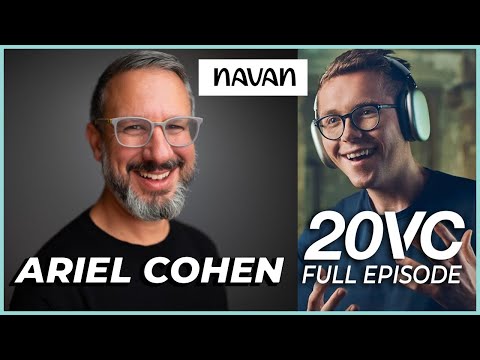
Ariel Cohen: The Death of Salesforce; How OpenAI is Changing the Travel Industry | 20VC #975
Ariel Cohen (guest), Harry Stebbings (host)
In this episode of The Twenty Minute VC, featuring Ariel Cohen and Harry Stebbings, Ariel Cohen: The Death of Salesforce; How OpenAI is Changing the Travel Industry | 20VC #975 explores ariel Cohen Predicts AI Super Apps Will Kill Legacy Enterprise Software Ariel Cohen, CEO and co‑founder of Navan (formerly TripActions), discusses how AI and product innovation are redefining business travel, expense management, and enterprise software. He explains Navan’s evolution from a travel tool to an AI-powered T&E super app, including hard decisions like reallocating teams, killing legacy products, and doubling down through COVID when revenue went to zero. Cohen argues that legacy vendors like Salesforce, SAP, Concur, and Amex GBT have structurally lost the ability to innovate and will be displaced by people-centric, AI-native products. He also details how Navan is integrating OpenAI to automate the majority of support interactions, radically improve margins, and reshape the economics of the travel industry.
Ariel Cohen Predicts AI Super Apps Will Kill Legacy Enterprise Software
Ariel Cohen, CEO and co‑founder of Navan (formerly TripActions), discusses how AI and product innovation are redefining business travel, expense management, and enterprise software. He explains Navan’s evolution from a travel tool to an AI-powered T&E super app, including hard decisions like reallocating teams, killing legacy products, and doubling down through COVID when revenue went to zero. Cohen argues that legacy vendors like Salesforce, SAP, Concur, and Amex GBT have structurally lost the ability to innovate and will be displaced by people-centric, AI-native products. He also details how Navan is integrating OpenAI to automate the majority of support interactions, radically improve margins, and reshape the economics of the travel industry.
Key Takeaways
Pick markets with real, proven problems—not just cool technology.
Cohen’s first startup, StreamOnce, failed to make meaningful impact because it targeted a small, unproven problem that nobody urgently needed solved; with Navan, he focused on a massive, obvious pain point—corporate travel and expenses—where demand and budget were already clear.
Get the full analysis with uListen AI
Continuously kill and rebuild your own products to stay innovative.
Navan repeatedly rebuilt core systems—travel UX, payments, expense, and support—whenever new technology (like modern ML or OpenAI) made older approaches obsolete, even if it meant discarding years of work shortly before launch.
Get the full analysis with uListen AI
Use hypotheses and hard metrics to decide when to kill or double down on projects.
Cohen frames every new feature as a hypothesis with defined success metrics; if it doesn’t deliver, it gets cut—unless it’s strategically core, in which case they pivot and iterate relentlessly, as they did with Navan’s rewards program until usage finally took off.
Get the full analysis with uListen AI
In crises, anchor on enduring beliefs and reallocate aggressively around them.
When COVID erased all travel revenue overnight, Cohen revisited his core beliefs (travel will return, T&E is critical, people-centric software wins) and used them to justify layoffs, heavy investment into expense management, continued sales efforts, and fundraising on a “travel will come back” thesis.
Get the full analysis with uListen AI
AI can transform service businesses into high-margin, scalable software companies.
By using AI and now OpenAI to automate most customer support interactions, Navan has pushed gross margins to ~75% and targets ~80–85%, showing how AI can fundamentally change the unit economics of traditionally low-margin, service-heavy categories like travel management.
Get the full analysis with uListen AI
Customer experience must be so good you don’t need to enforce usage.
Cohen contrasts Navan—designed to be delightful for travelers while giving CFOs full visibility—with legacy tools like Concur and Salesforce that rely on enforcement, compliance, and change management; his goal is software employees willingly use because it benefits them directly.
Get the full analysis with uListen AI
Cultural courage is a moat: be willing to upset teams for the right decisions.
He emphasizes that leaders must sometimes make deeply unpopular calls—shifting resources, killing projects, or redesigning last-minute—even at the cost of losing team members, as long as those decisions are right for the company’s long-term strategy.
Get the full analysis with uListen AI
Notable Quotes
“We invented a problem that nobody needed us to solve.”
— Ariel Cohen
“My nightmare is that one day Navan will be that kind of company—innovating only through M&A and market power.”
— Ariel Cohen
“By March 2020 it was obvious we had lost product-market fit overnight.”
— Ariel Cohen
“Nobody is going to use software that makes you fight with your employees all day long.”
— Ariel Cohen
“Maybe AI is eating the world and eating software, and companies that will not join the party will not be around.”
— Ariel Cohen
Questions Answered in This Episode
How can a fast-growing startup practically build the cultural muscle to repeatedly kill and rebuild its own products without burning out teams?
Ariel Cohen, CEO and co‑founder of Navan (formerly TripActions), discusses how AI and product innovation are redefining business travel, expense management, and enterprise software. ...
Get the full analysis with uListen AI
What specific signals should a founder watch for to distinguish between a strategically core but underperforming feature worth doubling down on versus a vanity project that should be cut?
Get the full analysis with uListen AI
If legacy platforms like Salesforce and SAP truly “die,” what replaces their role as the system of record in large enterprises—and how should CIOs prepare for that transition?
Get the full analysis with uListen AI
How far should companies go in depending on external AI providers like OpenAI before they risk losing defensibility or negotiating leverage?
Get the full analysis with uListen AI
In a world where AI handles 80–90% of customer interactions, what new skills and roles should human support agents and travel consultants be trained for?
Get the full analysis with uListen AI
Transcript Preview
... I would say maybe AI is eating the world, and eating software, and companies that will not join the party will not be around. (instrumental music)
Ariel, I am so excited for this. It's been quite a few years now. So first, thank you so much for joining me again.
Thank you. I'm so happy to be here again, and I'm always listening, uh, to you, uh, really, uh, interviewing really smart people. And it's really, really interesting to hear you and also Dave kind of, eh, talking with you. I recently, uh, you know, eh, listened to your Jeff Jordan, eh, one, and it was really fascinating.
That's very, very kind. I'll pay you later. Um-
(laughs)
... but we were talking beforehand. You said to me, you know, school and university, you didn't really go to that many lectures or lessons. I was just intrigued like, why?
I... You know, it's interesting. I'm the, the type of person that I am, I can learn stuff by myself, but I can only learn stuff that really, really interests me. And-
Mm-hmm.
... the reality is that I think that most of the things that you learn at school and universities, they're just not interesting. Uh, there are things that, like, you know, like, for example, some case studies, uh, that you're gonna go through, and I was, I could be so much fascinated by that, by then I go- I can go all in. So for me, the way that I can learn, it's only if, eh, it interests me. If it's not, I cannot really study it. And that was kind of my school, my school life. I was actually, eh, an extremely average student. But ev- It's really average, right? So I could either have, like, really, really, really good, like, straight A, but on the, like, really good, eh, side of it, or I would totally fail, and it's really based on, eh, the way that kind of maybe my brain works. If it, if it gets my interest, I would geek out and learn everything about it. If it doesn't, you cannot get me even, eh, starting to get interested in this.
It's totally the same as me. Gosh, does that impact how you advise your children when it comes to how they pick up and learn new things?
100%. So I have three kids. Uh, two of them, th- they are twins. Eh, a boy and a girl. They are 15, right? So they are starting to think, you know, what will they do next and, eh, and so on. And one of the things that I've told them, "Hey, do whatever you want to, but my advice to you, don't even at age 18 have this pressure to go to college, because I don't think that you know, eh, what you really want to do with your life at age 18." And I know that a lot of t- eh, people are doing, eh, skip year. And I like traveling, and a lot of my conclusions are happening while I'm traveling and meeting people. So my advice to them, what you're gonna do with your life and school and all of these things, uh, it will get figured out. But first, kind of, you know, take the time to really, uh, learn, to really understand what, eh, you know, what interests you. And I think that in any case, we are in such a interesting, eh, time in our lives with the, the development, and I know that we're gonna talk about it, but with the developments of, eh, machine learning and AI. Eh, so I'm not even sure that the things that we are learning today are not kind of obsolete. So, uh, my advice to them, don't take this too seriously. Do whatever you want to with your life.
Install uListen to search the full transcript and get AI-powered insights
Get Full TranscriptGet more from every podcast
AI summaries, searchable transcripts, and fact-checking. Free forever.
Add to Chrome