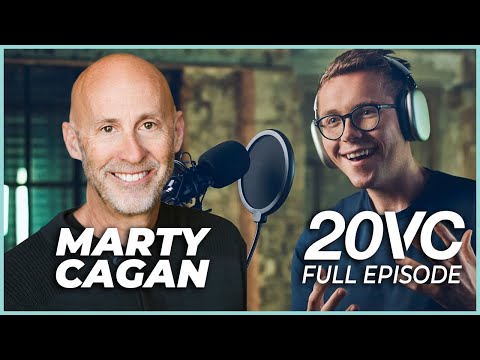
Marty Cagan: Product Lessons from Steve Jobs and Elon Musk; Why do we idolize engineers? | 20VC #957
Harry Stebbings (host), Marty Cagan (guest)
In this episode of The Twenty Minute VC, featuring Harry Stebbings and Marty Cagan, Marty Cagan: Product Lessons from Steve Jobs and Elon Musk; Why do we idolize engineers? | 20VC #957 explores marty Cagan on true product risk, empowered teams, and anti-process dogma Marty Cagan traces his journey from engineer at HP and Netscape to head of product at eBay and later advisor to leading startups, stressing that great products come from empowered product teams, not lone product managers. He argues most founders obsess over secondary risks (business model, pricing, GTM) while ignoring the primary risk: building something significantly better than alternatives that customers will actually buy and use. Cagan outlines a rigorous product discovery approach focused on rapid qualitative and quantitative testing of four core risks—value, usability, feasibility, and viability—plus intense customer immersion. He also critiques overreliance on process, outsourced engineering, and weak onboarding, advocating for founder-led product, coaching-based scaling, and PMs who think like founders and own outcomes, not outputs.
Marty Cagan on true product risk, empowered teams, and anti-process dogma
Marty Cagan traces his journey from engineer at HP and Netscape to head of product at eBay and later advisor to leading startups, stressing that great products come from empowered product teams, not lone product managers. He argues most founders obsess over secondary risks (business model, pricing, GTM) while ignoring the primary risk: building something significantly better than alternatives that customers will actually buy and use. Cagan outlines a rigorous product discovery approach focused on rapid qualitative and quantitative testing of four core risks—value, usability, feasibility, and viability—plus intense customer immersion. He also critiques overreliance on process, outsourced engineering, and weak onboarding, advocating for founder-led product, coaching-based scaling, and PMs who think like founders and own outcomes, not outputs.
Key Takeaways
Treat product-market fit as the primary risk, not an afterthought.
Founders often tinker with pricing, personas, and GTM while keeping the same weak product; Cagan argues that none of that matters if the product isn’t truly valuable and significantly better than alternatives.
Get the full analysis with uListen AI
Structure product discovery around four risks: value, usability, feasibility, and viability.
Every product idea must be tested for whether customers will buy/use it, can figure it out, can it be built with available tech and resources, and can it legally and economically sustain a business.
Get the full analysis with uListen AI
Use fast qualitative methods to learn ‘why’, and quantitative data to confirm ‘if’.
Qualitative tests with real users can reveal, in hours, why a product won’t be adopted, while quantitative metrics validate at scale; great teams run both continuously instead of waiting months for statistical proof.
Get the full analysis with uListen AI
Stop asking customers what to build; probe for why they wouldn’t use your product.
Cagan dismisses leading questions and focus-group wishlists; instead, he advocates value tests (e. ...
Get the full analysis with uListen AI
Hire for product skills and potential, not domain dogma.
He argues most breakthrough products are built by people new to the domain, who aren’t constrained by entrenched assumptions; domain knowledge can be learned in the first few months via deep customer and stakeholder immersion.
Get the full analysis with uListen AI
Scale product through coaching and empowerment, not processes and ‘feature factories’.
Cagan sharply criticizes process-heavy organizations and ‘product owners’ focused on output; he favors empowered product teams where PMs own value/viability, engineers are partners in discovery, and leaders invest heavily in coaching.
Get the full analysis with uListen AI
Founders should lead product until they can’t be close to the teams anymore.
He prefers at least one founder to be a proven product leader and suggests you only bring in dedicated product leadership once you have ~25–30 engineers organized into several teams that can no longer get enough founder time.
Get the full analysis with uListen AI
Notable Quotes
““The most important thing is to know what you can’t know.””
— Marty Cagan, quoting Marc Andreessen
““I’ve never seen a product come from a product manager. I’ve only seen great products come from product teams.””
— Marty Cagan
““All this other stuff is only relevant if you can come up with a product that people are willing to buy. Full stop.””
— Marty Cagan
““We don’t really care what people say. We know our customers, as much as we love them, don’t know what’s possible.””
— Marty Cagan
““If you’re just using your engineers to code, you’re only getting about half their value.””
— Marty Cagan
Questions Answered in This Episode
How can an early-stage founder practically run 50–100 product iterations in a few months without overwhelming their team?
Marty Cagan traces his journey from engineer at HP and Netscape to head of product at eBay and later advisor to leading startups, stressing that great products come from empowered product teams, not lone product managers. ...
Get the full analysis with uListen AI
What are concrete examples of effective qualitative ‘value tests’ for different types of products (B2B SaaS vs consumer apps)?
Get the full analysis with uListen AI
How should a startup balance hiring an experienced product leader versus growing junior PMs when budgets and coaching capacity are limited?
Get the full analysis with uListen AI
What does ‘empowered engineers’ look like day-to-day in a startup that’s used to top-down roadmaps?
Get the full analysis with uListen AI
How can a product leader dismantle an entrenched process-heavy culture and shift toward coaching and outcome ownership without causing chaos?
Get the full analysis with uListen AI
Transcript Preview
Marty, this is such a joy to do. I, I, I'm sure you know, but I, I've loved your writing for quite a while now, so a bit of a fanboy moment for me having you on. But thank you so much for joining me today.
Well, thanks for inviting me. I'm flattered to be on your show. (laughs)
That is very, very kind of you. I wanna start though with a little bit of context. So, you are the OG of product management, as many have, uh, cited. How, how did you come to be the OG of product management, Marty, in a swift two to three minutes?
Well, the truth is, I, um, I, I do hear things like that, and I can't help but laugh a little. My interest has actually never been really product management. My interest has always been product teams, um, to m- 'cause I've never seen a product come from a product manager. I've only seen great products come from product teams. And so, um, anyway, sort of a long way of explaining that is, uh, or a shorter way (laughs) of explaining that, I, um, I started as an engineer for 10 years and, uh, I was lucky. I was at a great place, HP Labs. It was, uh, uh, and I was working on tools and products for other developers, other engineers. So, s- very fun 10 years. I had a great time. And that was during the time where they were kind of in their prime.
Yep.
They were known as the consis- most consistently innovative company in the world at the time, and that's why I went there, and I had a great time. Uh, I did get interested there in more than just engineering. I started asking the questions about, "Who decides we should build this particular product? How do they know that's gonna be a good thing to do?" I started asking those questions, sort of beyond the little swim lane of a typical engineer, and I learned about product, I learned about design, and I learned about go-to-market, and I learned about all these things, uh, which was great. Um, my lucky break happened actually because, uh, I had done all these products for developers, and as you know, Netscape was really the original internet company, and, uh, I got to work for Marc Andreessen. I was, you know, there was already a browser team, there was already a server team, but I was for, uh, platform and tools, in other words, again, doing products for developers. Uh, in this case though, it was the internet, new platform instead of just, you know, W- Windows. And so, um, that was a dream job, honestly. I'd still be there if, uh, if, if it was still going as a company, uh, but as you know, after about five or six years, we, uh, lost the browser wars, to Microsoft and your internet history, and, um, I, and I got to meet, during my time at Netscape, I got to meet the bou- the founder of eBay, Pierre, Pierre Omidyar, and I really liked him. Uh, I loved his vision for the company. You know, eBay was probably the first real app in the internet era, the child of the internet, um, and so it was a great, I was brought on to be their head of, their original head of product and design. Really, he was the original head of product, that's the truth, but, you know, he was the founder, um, and they had got some real traction, really, because of his innovations. And then, um-
Install uListen to search the full transcript and get AI-powered insights
Get Full TranscriptGet more from every podcast
AI summaries, searchable transcripts, and fact-checking. Free forever.
Add to Chrome