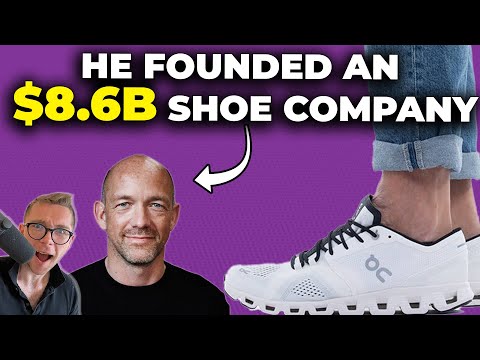
David Allemann: How I founded On Running; Working with Roger Federer; Brand Marketing Tips | E1021
Harry Stebbings (host), David Allemann (guest)
In this episode of The Twenty Minute VC, featuring Harry Stebbings and David Allemann, David Allemann: How I founded On Running; Working with Roger Federer; Brand Marketing Tips | E1021 explores from Garden-Hose Prototype To Global Brand: On Running’s Ascent Co‑founder David Allemann recounts how On Running began with a hacked-together prototype made from a shaved-off shoe and pieces of garden hose that delivered a radically new running sensation. He explains the company’s grassroots go-to-market strategy: building credibility via specialty retailers, elite athletes, and community runs while simultaneously embracing early e‑commerce and global expansion. The conversation covers On’s distinctive design and brand philosophy, its move into apparel and own retail stores, and the cultural principles—especially the ‘explorer spirit’—that drive constant reinvention. Allemann also details the unconventional partnership with Roger Federer, who joined not as a paid endorser but as an investing co‑entrepreneur deeply involved in product and brand building.
From Garden-Hose Prototype To Global Brand: On Running’s Ascent
Co‑founder David Allemann recounts how On Running began with a hacked-together prototype made from a shaved-off shoe and pieces of garden hose that delivered a radically new running sensation. He explains the company’s grassroots go-to-market strategy: building credibility via specialty retailers, elite athletes, and community runs while simultaneously embracing early e‑commerce and global expansion. The conversation covers On’s distinctive design and brand philosophy, its move into apparel and own retail stores, and the cultural principles—especially the ‘explorer spirit’—that drive constant reinvention. Allemann also details the unconventional partnership with Roger Federer, who joined not as a paid endorser but as an investing co‑entrepreneur deeply involved in product and brand building.
Key Takeaways
Prototype relentlessly and validate through lived experience, not just theory.
On’s breakthrough came from Olivier’s crude prototype with hollow ‘cloud’ elements; once co-founders, athletes, and factory partners physically felt the difference, skepticism turned into conviction and momentum.
Get the full analysis with uListen AI
Build from the core community outwards before chasing mass awareness.
On spent its first years winning over specialist running shops, serious runners, and triathletes one by one, accepting a 2–3 year grind in each market before the ‘hockey stick’ adoption curve kicked in.
Get the full analysis with uListen AI
Use distinct design and stripped-back aesthetics as strategic differentiation.
Instead of copying ‘blingy’ performance visuals, On emphasized visible sole technology plus minimalist, Swiss-inspired form-follows-function design, which initially felt risky but ultimately created instant wall recognition.
Get the full analysis with uListen AI
Combine wholesale partnerships with early DTC and digital to own the relationship.
Alongside investing in best-in-class retail partners, On launched e‑commerce early, leveraged social and mobile, and ran hundreds of community events to maintain a direct line to consumers and data.
Get the full analysis with uListen AI
Expand categories only when you can bring true innovation and brand coherence.
On moved into apparel and own stores not for line-extension’s sake, but to apply its performance and design capabilities “to the full body” and reimagine retail (e. ...
Get the full analysis with uListen AI
Treat star talent as co‑entrepreneurs, not just paid endorsers.
With Roger Federer, On refused a classic endorsement deal and instead invited him to invest and co-create, resulting in deep, ongoing engagement (30–40 lab days per year) and a powerful, authentic brand boost.
Get the full analysis with uListen AI
Balance explorer mentality with experienced operators to scale safely.
Near-death supply chain crises and rapid growth taught the founders to bring in complementary leaders (like co‑CEOs for finance and operations) and to operate as a partnership rather than a single heroic founder model.
Get the full analysis with uListen AI
Notable Quotes
“We asked ourselves, 'If we can't take a risk of doing something crazy like this, who can?'”
— David Allemann
“A brand, in the core, is a community and an idea.”
— David Allemann
“How about not us giving you money, but you giving us money and becoming a co-investor and a co-entrepreneur together with us?”
— David Allemann (to Roger Federer)
“We try always to operate nimble. Probably we waited a little bit long until we started to invest into On being bigger out there and having this cultural relevance.”
— David Allemann
“I feel doing something to perfection in many cases beats kind of optimizing for efficiency, especially when it comes to product.”
— David Allemann
Questions Answered in This Episode
How can early-stage founders practically balance grassroots, community-led growth with the need to build broader brand awareness sooner?
Co‑founder David Allemann recounts how On Running began with a hacked-together prototype made from a shaved-off shoe and pieces of garden hose that delivered a radically new running sensation. ...
Get the full analysis with uListen AI
What specific internal processes or guardrails does On use to decide when an unconventional idea is worth scaling versus killing quickly?
Get the full analysis with uListen AI
How would On’s story have been different—better or worse—if they had raised large amounts of venture capital much earlier?
Get the full analysis with uListen AI
In what ways could AI enhance or threaten On’s product design ethos of simplicity and human-centered innovation?
Get the full analysis with uListen AI
How transferable is On’s “explorer spirit” culture to more mature or legacy companies that want to reinvent themselves?
Get the full analysis with uListen AI
Transcript Preview
How did it come to be that Roger and On came together?
Roger said, "Hey, I would love to get involved." Said, "Hey, that's fantastic, but, you know, you know, something like classic sports, sports star endorsement, us giving money to you, that's not, that's not really On style, because we've always been growing out of the community, and that's not in our playbook. But how about not us giving you money, but you giving us money and becoming a co-investor and a co-entrepreneur together with us?" And to our surprise, Roger said, "Yes, that's what I'm going to do."
David, I am so excited for this. As we just said, I am one of the biggest On fans, so this is a personal highlight for me, and thank you so much for joining me today.
Mm-hmm. Hey, Harry, thanks a lot for having me. Great to be with you.
Now, I've been following the On story for years, and it's just such a great one. So, I want to start at the beginning with 2010, two other co-founders. What was that co-founding aha moment for the three friends?
You know, it was actually 2009 in the rainy morning when, uh, Olivier, my co-founder and, uh, duathlon, um, uh, world champion, tri-ath- triathlete, he said, "Hey, I have this amazing idea of a new running shoe," um, and invited Casper and me for a, for a test run. And so it was a morning, it was raining, he had some wet shoes because he had already had some tests, done some testing. And he had shaved off a pair of running shoes and glued rubber pieces that he had gotten from cutting his garden hose underneath the shoe. So, these hollow elements. And, yes, Casper and I had said before, "Hey, why let we, uh, l- why do we let Olivier invest his hard-earned athlete money into a crazy idea?" But then we took the shoe for a spin, and it was just an amazing sensation.
Can I ask, why was it an amazing sensation? What did it feel like?
So, Olivier, um, obviously as a triathlete had had a lot of time to think while running.
(laughs)
And, um, he, he a- he asked himself, "Hey, um, I go for these training runs on very cushioned shoes, but then when you compete, you literally run in, in shoes that are called racing flats."
Mm-hmm.
"And so they're very hard, and you feel it the next day. Wouldn't there be a way to engineer it that you have, that I have best of both worlds in one shoe?" And that was the breakthrough idea. And what these hollow elements do is they give you a lot of cushioning when you land, but then they fully compress and they give you this flat surface so that you can push off with all your energy. And so that made this sensation of being super soft, but also super responsive and explosive when you push off. And, uh, and that got us. So, because we also had been a generation that first discovered suspension, um, bikes, full suspension mountain bikes and, uh, carving skis. And in both of these occasions, it was a revelation where you felt, "Hey, wow, this changes skiing for me," or, "This changes biking for me." And so on this morning, we had that, uh, pattern recognition of, "Hey, this could change running for me."
Install uListen to search the full transcript and get AI-powered insights
Get Full TranscriptGet more from every podcast
AI summaries, searchable transcripts, and fact-checking. Free forever.
Add to Chrome