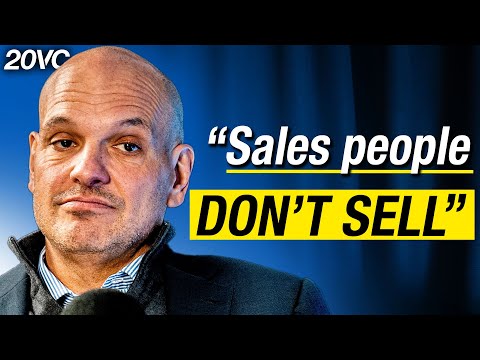
Carlos Delatorre, CRO @Harness: Why Every Sales Rep Should Do Pipeline Generation | E1251
Carlos Delatorre (guest), Harry Stebbings (host)
In this episode of The Twenty Minute VC, featuring Carlos Delatorre and Harry Stebbings, Carlos Delatorre, CRO @Harness: Why Every Sales Rep Should Do Pipeline Generation | E1251 explores carlos Delatorre: Why Elite Sales Reps Must Own Pipeline Generation Carlos Delatorre, CRO at Harness and longtime enterprise sales leader, argues that great sales is far more science than art, and that every account executive must be excellent at generating their own pipeline. He details a rigorous, week-long operating cadence around “Pipeline Generation Tuesdays,” where reps intensely research, target, and outbound into carefully chosen accounts. Carlos explains how to hire and train reps for challenger environments, emphasizing innate attributes, self-sourced pipeline experience, and tight ramp milestones over resumes and logos. He also covers deal qualification, in-person team dynamics, discounting, churn, AI’s impact on sales productivity, and lessons from his own CEO stint and hiring mistakes.
Carlos Delatorre: Why Elite Sales Reps Must Own Pipeline Generation
Carlos Delatorre, CRO at Harness and longtime enterprise sales leader, argues that great sales is far more science than art, and that every account executive must be excellent at generating their own pipeline. He details a rigorous, week-long operating cadence around “Pipeline Generation Tuesdays,” where reps intensely research, target, and outbound into carefully chosen accounts. Carlos explains how to hire and train reps for challenger environments, emphasizing innate attributes, self-sourced pipeline experience, and tight ramp milestones over resumes and logos. He also covers deal qualification, in-person team dynamics, discounting, churn, AI’s impact on sales productivity, and lessons from his own CEO stint and hiring mistakes.
Key Takeaways
Prioritize innate attributes and PG history over big logos when hiring.
Carlos stresses you can’t change a person’s ‘DNA’—their drive, curiosity, empathy, and pain tolerance—so start there, then assess which core skills they already have. ...
Get the full analysis with uListen AI
Founder-led selling and junior ICs beat early sales leadership hires.
For the first couple of years, he advises founders to be the primary rep, hiring junior SDRs/AEs to co-locate and iterate on messaging and plays in real time. ...
Get the full analysis with uListen AI
Every AE should own pipeline generation to avoid dependence and entitlement.
Carlos argues that excellence in PG is almost synonymous with excellence in sales, and that outsourcing pipeline to SDRs/marketing creates finicky, entitled AEs who reject anything but ‘ready-to-buy’ leads. ...
Get the full analysis with uListen AI
Use a rigorous weekly PG cadence anchored on one dedicated action day.
His system: Thursday declare focus accounts; Friday/weekend research and hypothesize pain; Monday review prep and role-play; Tuesday all-day PG with the team in-office; the rest of the week follow up and harvest, then Friday celebrate wins. ...
Get the full analysis with uListen AI
Measure PG on qualified pipeline, not just meetings booked.
While Carlos expects roughly two outbound meetings per week per AE, he warns against over-fixating on volume metrics alone. ...
Get the full analysis with uListen AI
Shorten ramp mistakes with clear milestones and early intervention.
Rather than waiting 9–18 months to decide a rep is failing, he decomposes ramp into early indicators—training performance, early meetings set, access to economic buyers, basic conversions. ...
Get the full analysis with uListen AI
In-person, hub-based teams dramatically outperform lone remote reps.
MongoDB data showed ‘lone rangers’ in a city had 4x higher attrition. ...
Get the full analysis with uListen AI
Notable Quotes
“I don’t believe salespeople sell. Buyers buy. All salespeople can do is create an environment that is conducive to that purchase decision.”
— Carlos Delatorre
“Art is what we call something when we don’t understand it yet. I think sales is more science than art.”
— Carlos Delatorre
“Excellence in pipeline generation equals excellence in sales.”
— Carlos Delatorre
“Outbound is not dead. That’s crazy talk. And I hope the companies that believe that are our competitors.”
— Carlos Delatorre
“Better to be late [on hiring] than to hire mediocre people.”
— Carlos Delatorre
Questions Answered in This Episode
If most elite PG-ers are under 10% of sales reps, how can a typical company realistically raise its overall PG bar without paralyzing hiring?
Carlos Delatorre, CRO at Harness and longtime enterprise sales leader, argues that great sales is far more science than art, and that every account executive must be excellent at generating their own pipeline. ...
Get the full analysis with uListen AI
For an early-stage founder without sales experience, what’s the most practical way to learn and codify ‘the plays’ quickly enough to justify being the first rep?
Get the full analysis with uListen AI
How should compensation and quotas be structured to reward AEs appropriately for both self-sourced and non-AE-sourced pipeline?
Get the full analysis with uListen AI
In a world of rising AI automation, which specific human sales skills will become most valuable and hardest to replace?
Get the full analysis with uListen AI
How can remote or hybrid sales teams replicate some of the learning, energy, and culture benefits Carlos attributes to fully in-person PG hubs?
Get the full analysis with uListen AI
Transcript Preview
I think for an early-stage company, the CEO really has to develop the plays, figure out the message, at least that initial message. I don't believe salespeople sell. Buyers buy. All salespeople can do is create an environment that is conducive to that purchase decision.
Ready to go? Carlos, I've wanted to do this one for a while. I'd heard so many things about you from prior guests, so thank you so much for joining me today.
It's a pleasure, Harry, thank you for having me. I have arrived. (laughs)
(laughs) It is great to do it in person as well, it makes it so much more special. I love to start with context, though. When did you first realize that you had this love of sales first?
Probably as a teenager. Um, I had a cousin, uh, my cousin Tais was dating a guy who was a manager of a clothing store and (clears throat) I think I was 14 or 15 at the time. And I had worked, you know, for several years mowing lawns and raking leaves and doing odd jobs, uh, paid by the hour. (clears throat) And, uh, he decided to give me a shot at the store. He would let me come in on the weekends and sell men's suits and, uh, the commission rate was 10%. And the suits were $800 to $1,000 and over the course of a weekend, I could usually sell one suit, maybe two, maybe three. Uh, and so to make a hundred bucks in the air conditioning in the mall was pretty amazing, and I thought, "Hmm, there's something to this."
Do you think people are born salespeople or do you think it can be learned?
I think it absolutely can be learned. And I think when people say that someone is born a sales, uh, a salesperson, usually what they're referring to is charisma and a big personality and, um, I don't know that those things are necessarily what makes a great salesperson. They don't hurt, but they're not the core of it. Um, so sure, uh, having more empathy, having, uh, (clears throat) uh, you know, being genuinely curious, I think those things help, uh, you know, are innate, uh, innate attributes that make people better salespeople. But I think most of it is learned.
EQ, empathy, that pain tolerance, all feels a little bit like a game of art. And then we see the world today and it feels a lot more scientific.
Mm-hmm.
How do you think about sales being art or science?
Yeah, I think art is what we call something when we don't understand it yet. Um, (clears throat) you know, people could say, "Oh, you know, Picasso, that's, that's art. How does he do it?" And then you have, you know, students studying for years and then they break it down, "Well, it's the colors and the shapes," or whatever it is that's the basis of, uh, of Picasso's art. And so I think like anything, um, there, there are people who are savants, who are gifted, and there are people who can, uh, connect dots that others don't see. But then, um, others can, can follow, can learn, and can, can replicate those things. So I think it's more science than art, candidly.
Install uListen to search the full transcript and get AI-powered insights
Get Full TranscriptGet more from every podcast
AI summaries, searchable transcripts, and fact-checking. Free forever.
Add to Chrome