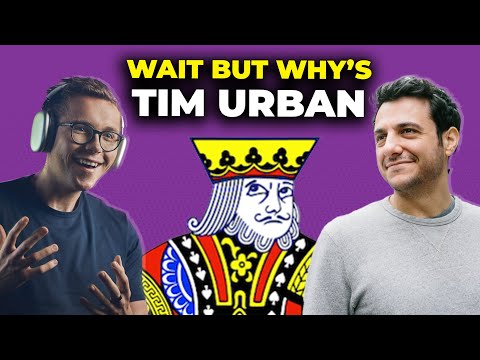
Tim Urban: How "Wait But Why" Grew to 600k Readers; AI's Revolutionary Impact on Media | E1048
Tim Urban (guest), Harry Stebbings (host), Narrator
In this episode of The Twenty Minute VC, featuring Tim Urban and Harry Stebbings, Tim Urban: How "Wait But Why" Grew to 600k Readers; AI's Revolutionary Impact on Media | E1048 explores tim Urban on Curiosity, Creative Freedom, AI, and Media’s Future Tim Urban discusses how he built Wait But Why into a large, loyal audience by obsessing over deep research, clear explanations, and protecting his creative freedom from traditional business pressures.
Tim Urban on Curiosity, Creative Freedom, AI, and Media’s Future
Tim Urban discusses how he built Wait But Why into a large, loyal audience by obsessing over deep research, clear explanations, and protecting his creative freedom from traditional business pressures.
He breaks down his topic selection, research, and writing processes, emphasizing excitement-driven curiosity, intuitive metaphors, and aiming for a 'sweet spot' of depth that delights smart general readers.
Urban and Stebbings examine trade-offs between growth and autonomy: monetization choices, not scaling a big team, resisting side ventures like VC funds, and using lightweight systems to manage his own procrastination.
They close by exploring AI’s impact on civilization and media, with Urban arguing AI will both solve huge problems and destabilize shared reality, making trusted brands and verification more critical than ever.
Key Takeaways
Build your career around genuine curiosity, not just market demand.
Urban only writes on topics that feel 'delicious' to him—things he’d research for fun anyway—which sustains multi-week deep dives and leads to uniquely engaging explanations.
Get the full analysis with uListen AI
Aim for the “sweet spot” of depth: from 2–3 to a 6 out of 10.
He deliberately avoids both shallow overviews and hyper-technical detail, targeting a level where a reasonably smart layperson keeps getting 'dopamine hits' of insight without being lost.
Get the full analysis with uListen AI
Use systems and external pressure to beat procrastination.
Urban sets modest daily quotas (e. ...
Get the full analysis with uListen AI
Monetize in ways that don’t corrupt the core creative mission.
He rejected intrusive ads in favor of Patreon, merch, speaking, and books, and has avoided building a big team or a VC fund because he doesn’t want schedule obligations to crowd out deep work.
Get the full analysis with uListen AI
Exploit one strong format, then repurpose across platforms.
Rather than chasing every channel natively, he focuses on A+ blog posts and books, then extracts drawings, quotes, and ideas into tweets, Instagram posts, and other formats as efficient distribution.
Get the full analysis with uListen AI
Expect and normalize backlash, especially on polarizing topics.
He counters harsh comments by zooming out—comparing a handful of angry voices against hundreds of thousands of readers—to keep perspective and continue taking principled positions, especially in politics.
Get the full analysis with uListen AI
Prepare for AI to both empower and destabilize media ecosystems.
Urban believes AI will solve major problems but also erode trust in information via deepfakes and misinformation, increasing the importance of verification layers and trusted, non-tribal brands.
Get the full analysis with uListen AI
Notable Quotes
“I just want total freedom. If I have anything on my schedule at 5 p.m., I’m in a bad mood the whole day.”
— Tim Urban
“My job is to get from a two or three to a six on a topic, then explain it so readers get a dopamine hit every minute.”
— Tim Urban
“I don’t want to turn around in ten years and realize the business got big but I lost what I cared about.”
— Tim Urban
“If you’re doing something with a strong point of view, especially on politics, it will piss people off. That’s inevitable.”
— Tim Urban
“AI is like a spaceship of super-intelligent aliens coming toward us. They’ll solve our problems, but we don’t know what their deal is.”
— Tim Urban
Questions Answered in This Episode
How should creators decide when growth opportunities (like funds or bigger teams) are worth the loss of personal freedom?
Tim Urban discusses how he built Wait But Why into a large, loyal audience by obsessing over deep research, clear explanations, and protecting his creative freedom from traditional business pressures.
Get the full analysis with uListen AI
What practical steps can media brands take now to become the 'trusted verification layer' in an AI-saturated information ecosystem?
He breaks down his topic selection, research, and writing processes, emphasizing excitement-driven curiosity, intuitive metaphors, and aiming for a 'sweet spot' of depth that delights smart general readers.
Get the full analysis with uListen AI
Where is the line between valuable external pressure for productivity and harmful self-imposed stress that kills creativity?
Urban and Stebbings examine trade-offs between growth and autonomy: monetization choices, not scaling a big team, resisting side ventures like VC funds, and using lightweight systems to manage his own procrastination.
Get the full analysis with uListen AI
How can writers and educators better locate that 'sweet spot' of complexity for different audiences and topics?
They close by exploring AI’s impact on civilization and media, with Urban arguing AI will both solve huge problems and destabilize shared reality, making trusted brands and verification more critical than ever.
Get the full analysis with uListen AI
If AI does start to replace large parts of writing and research, what uniquely human elements of Tim’s process are hardest to automate?
Get the full analysis with uListen AI
Transcript Preview
We really need well-known media brands or personalities or science institutions that we all can say, "Well, if they're saying it, then it's probably true." That creates a shared reality. We already see, of course, the fracture of the shared reality 'cause of tribal narrowcast media, you know, each telling their own story, and social media creating bubbles of reality, and I think AI can just accelerate these trends.
Tim, I am so excited for this. As I just said to you before, I've been a big, big fan of your writing for many years. I just mentioned that I actually tried to pass some of it off as my own intellect on AI about seven years ago and it worked.
(laughs)
So, I owe you for that, but thank you for joining me.
Yes. Thank you for having me.
No, that's cool.
And for being so well-prepared.
Oh, I mean, you're very kind. I stalk the shit out of you, so, uh-
(laughs)
... I'm ready for this. But I hate shows which actually start conventionally, and so I wanna start with a bit of a weird one. But think back to when you were a child. What did you want to be when you grew up?
Well, I think it depends on the age. I think, like, f- five, you know, six, I would've, it would've been something to do with space or dinosaurs. Those were my two obsessions then.
(laughs)
Um, so probably just, you know, oh, yeah, astronaut, something like that. Then, um, I think, you know, by the time I was 13, 14, 15, it was like I wanted max attention, so like president. Uh, like, it was just like hyper, hyper ambition, like want max everything, you know, and president or something like that. Um, and then that, I think, dissipated by... I was actually the class president at 17 and that was the end of me wanting to ever be a politician.
(laughs)
Um, (laughs) uh, it's like, this is, this is not, this is not-
The pressure was too much-
... what I like. It just-
... too much for you.
No, just campaigning, trying to get people's votes, like, and then for what? So that you can have, like, what's actually just kind of like a glorified bureaucratic, like, you know, administrative role? Uh, I was like, "No. I don't want that." Um, and, uh, and then from then on it was basically like I- I probably, uh, I always wanted to be in something creative, music or writing.
Okay.
Um, yeah.
So, we have these different stages of your background. I always think that one is running from and towards something, and that our backgrounds shape a lot of how we are today. And I know it's kind of armchair psychologist, but, you know, I'm a venture ambassador, so we have a lot of time to think. Um, my question to you is, what do you think you're running from, and what do you think you're running towards, Tim?
Install uListen to search the full transcript and get AI-powered insights
Get Full TranscriptGet more from every podcast
AI summaries, searchable transcripts, and fact-checking. Free forever.
Add to Chrome