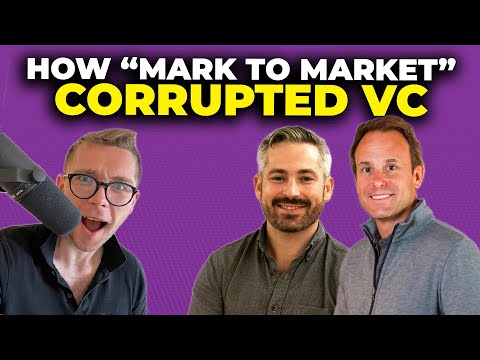
Jason Lemkin & Rick Zullo: How "Mark to Market" Corrupted Venture Capital | E1052
Jason Lemkin (guest), Harry Stebbings (host), Rick Zullo (guest)
In this episode of The Twenty Minute VC, featuring Jason Lemkin and Harry Stebbings, Jason Lemkin & Rick Zullo: How "Mark to Market" Corrupted Venture Capital | E1052 explores how Mark-to-Market Incentives Broke Venture Discipline and Founder Behavior Jason Lemkin and Rick Zullo argue that mark-to-market accounting, mega-funds, and asset-management style incentives have structurally distorted venture capital. Markups on paper valuations pushed VCs to over-fund and over-price companies, prioritize IRR optics, and drift away from hands-on, Jerry Maguire–style company building.
How Mark-to-Market Incentives Broke Venture Discipline and Founder Behavior
Jason Lemkin and Rick Zullo argue that mark-to-market accounting, mega-funds, and asset-management style incentives have structurally distorted venture capital. Markups on paper valuations pushed VCs to over-fund and over-price companies, prioritize IRR optics, and drift away from hands-on, Jerry Maguire–style company building.
They contend this environment encouraged founders to overspend, ignore basic financial discipline (like not running out of cash), and optimize for top-line growth and high valuations rather than sustainable business models and efficiency. Board oversight and honest pushback weakened as investors chased NPS with founders and rapid fundraises over fiduciary responsibility.
Both believe the industry is moving toward larger, more professionalized asset managers with multiple strategies, but see a simultaneous need to return to basics: smaller portfolios, deep engagement, realistic outcomes (including $300M–$1B exits), and “stairstepping” value rather than hunting only for decacorns.
They also discuss the likely resurgence of mega-funds, the coming wave of busts instead of down rounds, the importance of efficient growth and business model quality, and why AI funding will likely increase sharply despite clear signs of froth.
Key Takeaways
Mark-to-market incentives pushed VCs to over-fund and mis-fund startups.
Paper markups created strong pressure to show high IRRs early, leading funds to chase valuation step-ups rather than underlying business quality, distorting decision-making from seed through growth.
Get the full analysis with uListen AI
Founders must treat ‘not running out of money’ as rule number one.
Lemkin insists that taking a big round at a high price is fine only if founders maintain strict burn discipline, forecast zero-cash dates, and avoid driving off a cliff assuming the next round is guaranteed.
Get the full analysis with uListen AI
Board members have underperformed their fiduciary duty by avoiding hard conversations.
Zullo highlights that many investors, especially at mega-funds, dodge tough topics like burn and RIFs to preserve relationships and NPS, even when responsible governance would mean forcing painful but necessary changes.
Get the full analysis with uListen AI
SaaS has proven it can be highly profitable; inefficiency is now a choice, not a law.
Public SaaS companies rapidly shifted to strong operating margins in about a year, showing founders that efficient growth and healthy CAC/ROI are possible and may be required for public-market support going forward.
Get the full analysis with uListen AI
Venture outcomes don’t all need to be decacorns; ‘stairstepping’ works.
Both emphasize that repeatedly 3x-ing from round to round and accepting strong sub–$10B outcomes can build excellent funds, and that forcing non-decacorn companies into decacorn paths wastes capital and time.
Get the full analysis with uListen AI
LP trust now hinges more on transparency and realistic marks than on headline IRR.
Zullo and Lemkin note LPs are increasingly skeptical of aggressive marks; they value directionally correct valuations, honest markdowns (e. ...
Get the full analysis with uListen AI
AI will likely attract significantly more capital, but in a concentrated way.
They predict roughly 2x dollar deployment into AI in 2024, with capital pooling into a few platforms like OpenAI and Anthropic rather than being broadly distributed—despite concerns that many such bets aren’t fundamentally sound.
Get the full analysis with uListen AI
Notable Quotes
“As a founder, your job is not to run out of money.”
— Jason Lemkin
“Venture would be radically different if there were no markups—and I’m confident it would be a better industry.”
— Jason Lemkin
“We all got a little high at the party, and people are paying a lot for that right now.”
— Rick Zullo
“If you’re a great SaaS CEO, you should never have a RIF.”
— Jason Lemkin
“Let’s just cut through the sales for a second and actually just have substance.”
— Rick Zullo
Questions Answered in This Episode
How should founders practically balance ‘swinging for the fences’ with the stairstepping, 3x-per-round discipline Lemkin describes?
Jason Lemkin and Rick Zullo argue that mark-to-market accounting, mega-funds, and asset-management style incentives have structurally distorted venture capital. ...
Get the full analysis with uListen AI
What concrete governance changes could realign board incentives with long-term company health rather than short-term markups?
They contend this environment encouraged founders to overspend, ignore basic financial discipline (like not running out of cash), and optimize for top-line growth and high valuations rather than sustainable business models and efficiency. ...
Get the full analysis with uListen AI
How can early-stage founders build true financial acumen around burn, runway, and business model quality without prior finance experience?
Both believe the industry is moving toward larger, more professionalized asset managers with multiple strategies, but see a simultaneous need to return to basics: smaller portfolios, deep engagement, realistic outcomes (including $300M–$1B exits), and “stairstepping” value rather than hunting only for decacorns.
Get the full analysis with uListen AI
In a world of mega-funds and asset managers, what sustainable role is left for smaller, hands-on ‘Jerry Maguire’ style firms?
They also discuss the likely resurgence of mega-funds, the coming wave of busts instead of down rounds, the importance of efficient growth and business model quality, and why AI funding will likely increase sharply despite clear signs of froth.
Get the full analysis with uListen AI
Given the predicted surge in AI funding, how can non-AI startups avoid being starved of capital yet still maintain rational valuations and expectations?
Get the full analysis with uListen AI
Transcript Preview
I don't mean to be patronizing but I mean to be a little bit patronizing. As a founder, your job is not to run out of money. If you got eight million instead of two million, it's not to spend it all. Why are they spending it all? The great founders are going big. Why can't they use a spreadsheet and do the math and say, "I got a gift from heaven, why can't the best founders take advantage of this?"
(instrumental music) I am so excited for this. This is gonna be such a fun discussions today. Now, we're gonna dive right in because I got teed up by a comment from Rick First who said that, uh, we need a Jerry Maguire moment in venture. I love Jerry Maguire but I was intrigued. What did you mean by this, Rick?
So, Jerry Maguire is one of my all-time favorite movies. Like, part of me really wishes I was a sport agent. Um, you know, and for those who don't know what this movie is about, Jerry is this kind of soulless sports agent working in this big agency that has come ... And he has kind of a come to Jesus moment and he realizes that they're working with too many clients, they're trying to scale too much, you know, that they've lost the kind of, like, hands-on connection with their clients and that they need to go, like, back to the core business, focus on the clients over making money. He writes this big ma- manifesto, Catch On The Rise style, uh, and then he ends up getting fired for it. But all ends well that ends well. You know, he ends up developing a close relationship, helps his client through a bunch of these struggles, and, you know, hilarity ensues a- all along the way. And, you know, in many ways, I think this is what venture used to look like. It was a really hands-on connection between a board member and a ma- and the founder. Uh, and then you guys talked a little bit on your last round table about this factory model, and I think that's really torn that a- all out of whack, where it's become about how much we can be an asset management business, how much we can scale the capital that we have, and that's really taking VCs away from the founders, um, and really focused on some things that I think are some really unhealthy behaviors. But make no mistake, the asset management business is a better business than the venture business. You know, fees are guaranteed, carry isn't. For me at least, early in my career, like, we had these... I had two big nine-figure exits that were founders that didn't take a lot of paid-in capital and the relationships that I had with those folks was really, really intimate. And, you know, one of those founders made close to 100 million dollars on it, changed his life, it changed, you know, uh, his family's life and, uh, as I went back to some other venture capital firms, like, you need another zero on that for that to matter. Like, when are any of these deals that you do are gonna, uh, are they ever gonna m- move the needle? And certainly it moved the needle for that founder and that was kind of like my Jerry moment of realizing there's an opportunity to go back to basics, do less companies. We have 15 companies at Alpha Fund.
Install uListen to search the full transcript and get AI-powered insights
Get Full TranscriptGet more from every podcast
AI summaries, searchable transcripts, and fact-checking. Free forever.
Add to Chrome