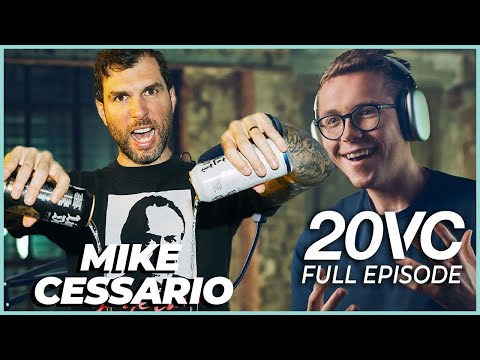
Liquid Death CEO Mike Cessario: How I Turned Canned Water to a $700M Company | E968
Mike Cessario (guest), Harry Stebbings (host)
In this episode of The Twenty Minute VC, featuring Mike Cessario and Harry Stebbings, Liquid Death CEO Mike Cessario: How I Turned Canned Water to a $700M Company | E968 explores how Liquid Death Turned Punk Humor Into a $700M Beverage Powerhouse Mike Cessario, CEO and founder of Liquid Death, explains how he built a $700M canned water brand by applying irreverent, punk-inspired entertainment marketing to a fundamentally healthy product. He contrasts traditional, functional CPG branding with Liquid Death’s approach of making content people actually want to watch and share, using brand as the true moat rather than ingredients or packaging. Cessario details his unconventional background, the importance of data and early digital traction in defying skeptical investors, and the gritty operational realities of scaling in a distributor‑dominated beverage market. He also discusses evolving social content strategy, celebrity partnerships, and how Liquid Death aims to become a hybrid of beverage company and comedy-driven entertainment brand.
How Liquid Death Turned Punk Humor Into a $700M Beverage Powerhouse
Mike Cessario, CEO and founder of Liquid Death, explains how he built a $700M canned water brand by applying irreverent, punk-inspired entertainment marketing to a fundamentally healthy product. He contrasts traditional, functional CPG branding with Liquid Death’s approach of making content people actually want to watch and share, using brand as the true moat rather than ingredients or packaging. Cessario details his unconventional background, the importance of data and early digital traction in defying skeptical investors, and the gritty operational realities of scaling in a distributor‑dominated beverage market. He also discusses evolving social content strategy, celebrity partnerships, and how Liquid Death aims to become a hybrid of beverage company and comedy-driven entertainment brand.
Key Takeaways
Use brand, not product features, as your primary moat.
Ingredients, packaging formats, and functional benefits can be copied by bigger, cheaper competitors, but a distinct tone of voice, creative style, and cultural point of view are hard to replicate and become the enduring differentiator.
Get the full analysis with uListen AI
Healthy products can win by marketing like unhealthy, ‘fun’ categories.
Cessario saw that alcohol, soda, and junk food owned youth culture with bold, humorous marketing, while healthy brands were quiet and earnest; Liquid Death succeeded by bringing that same explosive, irreverent energy to water.
Get the full analysis with uListen AI
Polarization is a feature, not a bug, of strong brands.
If some people truly love your brand, others will inevitably hate it; aiming to offend no one produces work that nobody cares about, while provocative, entertainment‑grade ideas generate attention, sharing, and loyalty.
Get the full analysis with uListen AI
Validate “crazy” ideas with real data, not just conviction.
While many investors dismissed canned water as silly, Liquid Death tracked early signals—social followers, engagement, and inbound demand—proving traction and de‑risking the concept beyond surface-level skepticism.
Get the full analysis with uListen AI
Stop over-indexing on storytelling jargon; focus on clear emotional takeaways.
Instead of trying to ‘tell stories,’ Liquid Death designs each piece of content so the primary takeaway is an emotional reaction—like “that’s the funniest thing I saw today”—which builds affinity far more than functional claims.
Get the full analysis with uListen AI
Shift from ‘always-on’ volume to fewer, bigger, more shareable moments.
Cessario describes moving from a Netflix-style content flood to an HBO model: fewer pieces, but each crafted to be remarkable, share-worthy, and newsworthy, delivering far more impact per dollar and per hour invested.
Get the full analysis with uListen AI
Great marketing still needs great execution in retail and distribution.
Even with a beloved brand, sales die if shelves aren’t stocked, tags are missing, or competitors manipulate placement; investing in a strong sales team and in-store execution is essential in cutthroat categories like beverage.
Get the full analysis with uListen AI
Notable Quotes
“If there are people who truly love something, there has to be people who truly hate it.”
— Mike Cessario
“Strong brands mean more to people than the product itself.”
— Mike Cessario
“We’re not trying to make marketing; we’re trying to make actual entertainment that is in service of a brand.”
— Mike Cessario
“We all hate marketing… so what we’re really doing as a brand is we’re sort of making fun of marketing.”
— Mike Cessario
“You can’t own aluminum cans. The thing you can truly own is your unique brand.”
— Mike Cessario
Questions Answered in This Episode
How far can a brand lean into provocation and dark humor before it starts materially harming distribution, partnerships, or mainstream adoption?
Mike Cessario, CEO and founder of Liquid Death, explains how he built a $700M canned water brand by applying irreverent, punk-inspired entertainment marketing to a fundamentally healthy product. ...
Get the full analysis with uListen AI
In categories where products are genuinely functionally differentiated, how should founders balance product education with the kind of entertainment-first branding Liquid Death uses?
Get the full analysis with uListen AI
What specific guardrails does Liquid Death use to decide when an edgy idea crosses the line from “provocative” into “distasteful” or brand-damaging?
Get the full analysis with uListen AI
How can early-stage founders, without Liquid Death’s resources or in-house creative team, practically apply this ‘entertainment-first’ philosophy to their own marketing?
Get the full analysis with uListen AI
As Liquid Death evolves into more of an entertainment company, how will it measure success beyond beverage sales (e.g., media revenue, IP, or audience metrics)?
Get the full analysis with uListen AI
Transcript Preview
(instrumental music plays) People that you think are alternative culture, all these guys do is drink Monster Energy and eat bacon. It's like, no, these guys don't drink any of that. I went to a school where recess would be canceled for shootings. Like, we would find heroin needles on the ground in the playground. We want the takeaway to be, "Oh my God, that was probably the funniest thing I've seen today."
Kids in beer commercial style. (laughs) We're sitting there in Liquid Death's office, this is funny.
If there are people who truly love something, there has to be people who truly hate it.
Mike, I am so excited for this. I've been such a fan of the, the Liquid Death journey for quite a while now, so thank you so much for joining me today.
Yeah, no, thanks for having me on.
Not at all, but I wanna start with a little bit of context. So, how did Rockstar's hydration problems, which is what I heard was the origin, lead to the founding of Liquid Death?
T- so that wasn't really the origin. (laughs) It's, it's funny, like, it's... Like you said, uh, you're not a journalist, and, uh, you know, so much of the early days of Liquid Death, like, the, the story was shaped by, you know, journalists who didn't fully get it. I mean, a lot of people didn't get it in the early days. Like, you know, Science, some of our early VCs, they understood it, but a lot of VCs, investors, like, they didn't get it. Like, they were like, "Oh, y- canned water? Yeah. W- what's that gonna do?" So most people, when they Google stuff, they see the old press articles, and there's everything from saying that I used to work at Netflix, which I never did. Uh, oh, it, it was all because the... You know, they just get things mixed up. Where that came from was Monster Energy used to sponsor a alternative music tour in the late '90s early 2000s called the Warp Tour, and it was in partnership with Vans, the shoe company. And this was, like, the early energy drink days. I think Monster launched in 2002. Red Bull was, you know, it, doing pretty well in the '90s, and energy drinks were basically buying up all of the alternative lifestyle culture because, you know, nobody was giving money to punk bands and skateboarders and snowboarders and, and those kinds of people back then. Energy drinks did, but the bands who were on the tour, they didn't like drinking energy drinks. Like, they, you know, they're on tour, you're outside playing, like, you kinda wanna drink water or, or, you know, they wanna drink beer. They, they don't wanna drink, you know, energy drinks. So obviously, Monster didn't want, you know, your spot, you're, you're this growing brand, you're sponsoring this thing, it, it doesn't help you if the brand is drinking bottled water on stage. You know, the coolest guys in the place are not drinking your product. Th- they found that that was not gonna be helpful to them. So, what they did was they made cans of Monster that looked exactly like Monster but it just had water in it, and they would give that to the bands to drink. It was not for sale. You know, clearly they were not in the water business, they were in the energy business. Um, but when all the kids in the crowd were watching the bands, they, it looked like the bands were drinking Monster. So they're like, you know, as, as a marketing thing. And I was friends with some of these bands and, you know, was hanging out with, you know, backstage with them, and I remember just thinking like, "Man, that's kind of a really, uh, sneaky marketing thing." You know? Like, it's like, oh, all these kids think these guys are just pounding sugar and whatever, when in reality these guys are drinking water, uh, and, and, and not. So that was like the first thing that kind of planted the seed in my brain of, you know, how come healthy products don't market in the same fun, irreverent way as unhealthy products? And it's like, you look at what are the, what are the brands that really invest a lot of money in youth culture, humor, explosions, fun? It's alcohol, soda, candy, fast food. You know, Bud Light, Cheetos, Snickers, Skittles, like, all the junk food does all the fun marketing. Healthy stuff is very quiet. You know, they more market to, like, an older demographic. Th- th- they don't do anything fun. But the reality was, like, a lot of these guys in, you know, that played in bands or people that you think are alternative culture and, "Oh yeah, all they do, all these guys do is drink Monster Energy and eat bacon." It's like, no, these guys don't drink any of that. Most of them don't drink that stuff. They care about health. Half of them are vegan. You know, the oth- you know, a, a huge percentage of them are sober and don't drink alcohol. But it's been these brands that kind of still use them and own them from a marketing standpoint, and, and that was more what sparked kind of my thinking of Liquid Death, 'cause I was into health at the time. My friends who were playing in these bands, they were into being healthy. And I think that was more of the seed, not so much like a Rockstar hydration problem. It was, oh yeah, how come there's not more healthy brands that have just as much fun with marketing as, as these unhealthy brands? It didn't make any sense to me. And then eventually that became Liquid Death years and years later.
Install uListen to search the full transcript and get AI-powered insights
Get Full TranscriptGet more from every podcast
AI summaries, searchable transcripts, and fact-checking. Free forever.
Add to Chrome