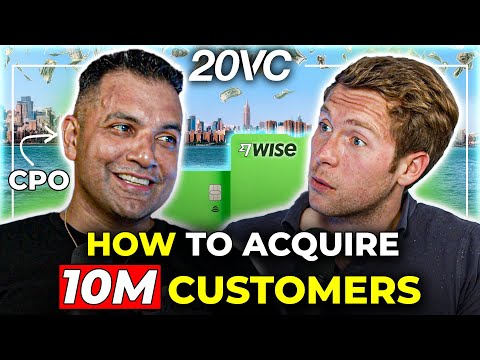
Nilan Peiris: What Growth Hacks Worked and What Did Not, from Wise CPO | E1182
Nilan Peiris (guest), Harry Stebbings (host), Narrator
In this episode of The Twenty Minute VC, featuring Nilan Peiris and Harry Stebbings, Nilan Peiris: What Growth Hacks Worked and What Did Not, from Wise CPO | E1182 explores wise CPO Nilan Peiris Reveals Real Growth Levers Beyond Marketing Hacks Nilan Peiris, CPO of Wise (formerly TransferWise), explains how Wise achieved scalable growth by obsessing over product quality, word of mouth, and rigorous measurement rather than relying on generic growth “playbooks.”
Wise CPO Nilan Peiris Reveals Real Growth Levers Beyond Marketing Hacks
Nilan Peiris, CPO of Wise (formerly TransferWise), explains how Wise achieved scalable growth by obsessing over product quality, word of mouth, and rigorous measurement rather than relying on generic growth “playbooks.”
He contrasts performance channels like paid social and SEO with harder-to-crack brand advertising, arguing that truly exponential growth only comes when the product is an order of magnitude better and customers clearly understand that value.
Peiris dives into Wise’s content and SEO strategy, product marketing experiments, and how visualizing savings and speed dramatically boosted referrals without changing the underlying product.
He also covers unit economics, when to kill or persist with products, organizational design (autonomous teams, squads, tribes), and common founder mistakes such as over-investing in paid marketing before achieving deep product–market fit.
Key Takeaways
You only get strong word of mouth when you’re an order of magnitude better.
Wise saw flat growth when they were only slightly cheaper than banks; real word-of-mouth inflection came when they were dramatically cheaper and faster, offering an experience customers “didn’t know previously existed.”
Get the full analysis with uListen AI
Product marketing’s job is to close the perceived–actual value gap.
Customers often underestimate the value they’re getting; Wise boosted referrals by visually showing exact savings versus banks and animating instant transfers, making hidden benefits obvious and shareable.
Get the full analysis with uListen AI
Content that is genuinely useful can be a durable growth engine.
Wise built best‑on‑the‑internet pages for specific routes (e. ...
Get the full analysis with uListen AI
Paid incentives can drive users, but not necessarily profitable customers.
Referral bonuses and high incentives create spikes in signups, but the incremental users are often low value; Peiris stresses measuring revenue and payback, not just headline growth curves.
Get the full analysis with uListen AI
Regularly “deflating” marketing spend reveals hidden inefficiency.
When Wise halved marketing spend, customers dropped only ~10% and revenue ~1%, exposing waste; repeating this discipline periodically prevents bloated CAC and keeps growth grounded in true ROI.
Get the full analysis with uListen AI
Opportunity cost and upside potential should drive kill‑or‑persist decisions.
Products can be kept alive if costs are marginal and potential is huge, but the real constraint is team time; Wise sets high hurdle rates and focuses on bets that can become truly large businesses.
Get the full analysis with uListen AI
Bottom‑up, autonomous teams can scale if you add layers of accountability.
Wise evolved from fully independent teams to squads and tribes, keeping strategy formation bottom‑up while adding leaders responsible for outcomes, which allows many parallel bets without chaos.
Get the full analysis with uListen AI
Notable Quotes
“You have to be an order of magnitude better than the alternative to get word of mouth.”
— Nilan Peiris
“You need to give customers an experience they did not know previously existed.”
— Nilan Peiris
“I define product marketing as closing this delta between the perceived value a customer has of the product and the actual value that you deliver them.”
— Nilan Peiris
“Every minute you put into product/market fit has such a huge return versus, ‘I’m going to find somebody who’s going to solve the Facebook algorithm.’”
— Nilan Peiris
“The fastest way businesses go bust is when they spend a bunch of money acquiring customers that turn up, but the LTV doesn’t turn up in the way you expected.”
— Nilan Peiris
Questions Answered in This Episode
How can an early‑stage startup practically assess whether its product is truly an order of magnitude better, rather than just marginally improved?
Nilan Peiris, CPO of Wise (formerly TransferWise), explains how Wise achieved scalable growth by obsessing over product quality, word of mouth, and rigorous measurement rather than relying on generic growth “playbooks.”
Get the full analysis with uListen AI
What concrete steps can a product team take to identify and then close the gap between perceived and actual value for their users?
He contrasts performance channels like paid social and SEO with harder-to-crack brand advertising, arguing that truly exponential growth only comes when the product is an order of magnitude better and customers clearly understand that value.
Get the full analysis with uListen AI
How should founders decide the right moment to pull back drastically on marketing spend to test for hidden inefficiencies without stalling growth?
Peiris dives into Wise’s content and SEO strategy, product marketing experiments, and how visualizing savings and speed dramatically boosted referrals without changing the underlying product.
Get the full analysis with uListen AI
In markets where trust is the primary barrier (like fintech), how can teams design product experiences that naturally generate trusted word of mouth instead of relying on expensive brand campaigns?
He also covers unit economics, when to kill or persist with products, organizational design (autonomous teams, squads, tribes), and common founder mistakes such as over-investing in paid marketing before achieving deep product–market fit.
Get the full analysis with uListen AI
What organizational signs indicate that an autonomous team/squad structure is reaching its limits and needs more formal layers (squads, tribes, etc.) for accountability?
Get the full analysis with uListen AI
Transcript Preview
I define product marketing as this, closing this delta between the perceived value a customer has of the products and the actual value that you deliver them. You have to be an order of magnitude better than the alternative to get word of mouth. You need to give customers an experience they did not know previously existed. (camera shutter clicks)
Ready to go? (instrumental music plays) (mouse clicking) Milan, this is such a joy to do. I've been really looking forward to this, so thank you so much for joining me.
Thanks for the invite, Harry. (laughs)
Not at all. But I would love to start with some chronology.
Mm-hmm.
So how did you first make your way into the world of growth and product, and what was that real entry point for you?
Actually, going all the way back, I, uh, I did maths at university, which I advise everybody to do out there. (laughs) Uh, but it was quite formative. I love maths, mainly as, uh ... And like, uh, training for university-level maths was about looking at problems and trying to find a completely different way to look at the problem that no one else had looked at before that enables you to solve it in a way no one had done it before.
Sorry, I, I just have to ask that. Y- you said about kind of doing things differently and in ways that other people hadn't done before, and why, why you like maths in that way. I always wonder, are playbooks good or bad?
In product and in growth where this reaches its fortés, when there is a, like a reproducible model, uh, when the playbook becomes something that feels like a reproducible model, and that f- is in two forms. Uh, usually there's a kind of a market expansion playbook, so we know we ... "This works. I'm gonna keep doing this-"
Mm-hmm.
"... again and again and again." And in my experience, it's usually disappointingly not much. Like, there's, there's very few, like, truly globally scalable products that you build once and they just kind of go everywhere. Uh, every, every country has their nuance usually then. That could be regulatory, could be financial systems, it could be cultural, and these are the things that get stuck in the way of the playbook, uh, (laughs)
Terribly annoying.
of expense.
Much nicer if it was just repeatable.
(laughs)
I actually find playbooks can be more applicable on channels.
Ah.
Like there's a playbook to creating good Twitter content. There's a playbook to creating short-form video hooks.
(laughs)
Do you see what I mean?
Yeah, and that type of, like, growth-hacking marketing side, absolutely. I'm sure you've, you see this, and you're f- quite successful with The Podcast Playbook. But the bit that the edge is, is usually in the creativity.
Yeah.
Install uListen to search the full transcript and get AI-powered insights
Get Full TranscriptGet more from every podcast
AI summaries, searchable transcripts, and fact-checking. Free forever.
Add to Chrome