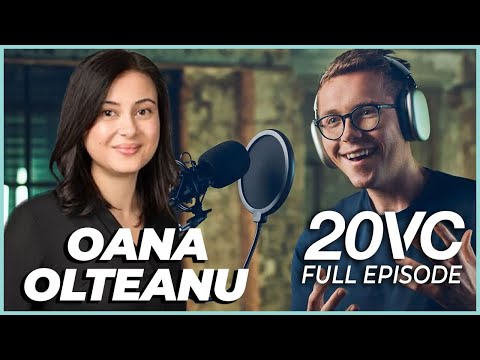
Oana Olteanu: Why Founders Should Expect More From Their VCs | 20VC #950
Harry Stebbings (host), Oana Olteanu (guest)
In this episode of The Twenty Minute VC, featuring Harry Stebbings and Oana Olteanu, Oana Olteanu: Why Founders Should Expect More From Their VCs | 20VC #950 explores raising the Bar: How Founders Should Demand More From VCs Oana Olteanu, partner at SignalFire, shares her journey from a Romanian village to Silicon Valley VC and explains why founders should dramatically raise their expectations of investors. She introduces the idea of the “Schrödinger’s VC” — firms that loudly promise help but add no real value once on the cap table — and outlines how to identify and manage them. A large part of the conversation focuses on what great VC support actually looks like: concrete homework, proactive customer work, board effectiveness, and founder communities. Oana also discusses diversity in hiring, structural misalignments between founders and VCs, and how she’s trying to model a more founder-serving, low-ego approach to venture.
Raising the Bar: How Founders Should Demand More From VCs
Oana Olteanu, partner at SignalFire, shares her journey from a Romanian village to Silicon Valley VC and explains why founders should dramatically raise their expectations of investors. She introduces the idea of the “Schrödinger’s VC” — firms that loudly promise help but add no real value once on the cap table — and outlines how to identify and manage them. A large part of the conversation focuses on what great VC support actually looks like: concrete homework, proactive customer work, board effectiveness, and founder communities. Oana also discusses diversity in hiring, structural misalignments between founders and VCs, and how she’s trying to model a more founder-serving, low-ego approach to venture.
Key Takeaways
Founders must actively screen VCs for real behavior, not promises.
During fundraising, watch what investors *do* in diligence—how they help, reference patterns, and how they talk about tough times in prior companies—rather than relying on marketing or brand alone.
Get the full analysis with uListen AI
Treat your VC like a resource you manage and assign homework to.
To avoid “useless” capital, founders should send materials with clear asks, give investors concrete projects (e. ...
Get the full analysis with uListen AI
Board meetings are only valuable if well-prepared and tightly run.
Great boards start with pre-calls, a focused written update (not a crutch slide deck), clear highlight/lowlight sections, and in-meeting time devoted to the meaty strategic issues—not rehashing what everyone already read.
Get the full analysis with uListen AI
You can and should engineer diversity; it’s not “too hard.”
If your candidate pool isn’t diverse, the problem is upstream: change recruiters if needed, reach out respectfully without reducing people to their gender, leverage dedicated communities (like Oana’s “She’s Ready to Dev”), and implement inclusive policies and benefits.
Get the full analysis with uListen AI
Founder–VC alignment improves when investors genuinely prioritize service over ego.
Misalignments (like VCs selling early for DPI) are real, but can be mitigated by transparent conversations, long-term thinking, and a default stance of optimizing for the company’s and founder’s success.
Get the full analysis with uListen AI
Constructive, data-backed negative feedback is a core part of real value-add.
Instead of ignoring problems, great VCs do the work (customer outreach, benchmarks, peer intros), bring evidence to the founder, and help them see and solve gaps like lagging go-to-market performance.
Get the full analysis with uListen AI
Culture and non-jerk behavior are investment criteria, not afterthoughts.
Oana explicitly avoids working with jerks and favors founders who combine technical rigor with deep care about culture, believing that healthy cultures are central to long-term compounding value.
Get the full analysis with uListen AI
Notable Quotes
“I'm running from unfulfilled potential. I think there is nothing sadder than unfulfilled potential.”
— Oana Olteanu
“Schrödinger's VC is what I call a VC who preaches a lot of help, especially before winning a deal. But then if you ask the founders, they will tell you they added no value.”
— Oana Olteanu
“While a VC cannot play the chess game for you and move the pieces, they have seen a lot more games and therefore they can advise from near the chessboard.”
— Oana Olteanu
“You cannot hire diverse people if they are not even in your candidate pool.”
— Oana Olteanu
“I don't like to work with jerks. You can be amazingly smart, but you also have to actually want to build a healthy culture in your company.”
— Oana Olteanu
Questions Answered in This Episode
What specific questions should a founder ask in references to reliably detect a “Schrödinger’s VC” before taking their money?
Oana Olteanu, partner at SignalFire, shares her journey from a Romanian village to Silicon Valley VC and explains why founders should dramatically raise their expectations of investors. ...
Get the full analysis with uListen AI
How can early-stage founders with limited time and resources practically design and implement inclusive policies from day one?
Get the full analysis with uListen AI
Where is the line between a helpful, hands-on VC and one that becomes overly involved or controlling in operations?
Get the full analysis with uListen AI
In situations where LP liquidity needs clash with a company’s long-term trajectory, what frameworks can founders and VCs use to find fair solutions?
Get the full analysis with uListen AI
How can technical founders train themselves to shift from “write more code” to “talk to more customers” when they’re outside their comfort zone?
Get the full analysis with uListen AI
Transcript Preview
Oana, this is such a joy to do. As I said, I tweeted about the most incredible rising stars to have on the show, and the influx of messages I got on the back saying you, with the most incredible praise, was wonderful. So thank you so much for joining me today.
Thank you for having me. And it wouldn't be without the founders to be on this show or in Venture, so I'm very grateful to you and to them.
That's amazing to hear. But I want to start with a little bit on you. So tell me, from Romania to studying in, in Germany. I heard little bits about driving tanks. Not the usual HBS and, (laughs) you know, living in Menlo Park. So how did you, you know, come to Venture and come to be the rising star, as we said, and, and now obviously a partner at SignalFire?
Um, so I grew up in Romania in a village until the age of 18. At 18, I won this grand prize in a contest organized by NASA, and, uh, that was the first time for me on a plane. I was flying to Mountain View to NASA Ames. And there I was mesmerized by, uh, the amount of intelligent system work they're doing, and I knew I have to be in software. So I get back home and I tell my dad, "I want to go to college," and he got a shock because this was, uh, something new for our family. Um, and I moved to Germany by myself to study computer science, um, actually machine learning, back when MATLAB was the only MLOps tool around. Um, after classes I was working for, um, SAP and two other jobs, but SAP was the one who got me back to the Bay Area. I transferred into their, uh, Palo Alto office. My first experience in the US was finding a room to rent on Craigslist, and I ended up living in the house of the head of microelectronics division at Atari. Um, I was and still am a diehard Atari fan, so I was starstruck when I met Mr. Robert Brown. And that's when I felt like I truly arrived to, to the Valley.
Can I, can I just ask you a blunt question, which is like, it's a massive move, like moving, you know, uh, halfway around the world to the US without knowing people, without having a support network. Were you nervous? And how did it feel as a young person uprooting your life?
It was different, and it... I think maybe because when you're young you take more risks. But I think it's also the fact that many people don't realize that wasn't the first time I moved somewhere. The... It was a lot harder to move to Germany, um, having only known English and French, no German (laughs) and being away from home for the first time, and away to a totally different country and not having a mobile phone, um, not having a laptop, trying to get all the things set up for myself. So coming to the US was easier because I knew the language. I knew I want to come back. Ever since the NASA, the NASA experience, I knew I want to come back. So it was everything I was wishing for. But yes, it was a shock, especially as a European, to arrive at the airport and realize there is no easy public transportation to where you were going (laughs) and you have to rent a car and drive everywhere.
Install uListen to search the full transcript and get AI-powered insights
Get Full TranscriptGet more from every podcast
AI summaries, searchable transcripts, and fact-checking. Free forever.
Add to Chrome