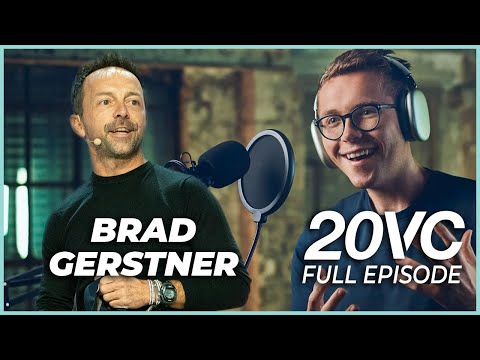
Brad Gerstner: How I Pick Companies; Lessons from Warren Buffet; Chamath vs Gurley | E935
Harry Stebbings (host), Brad Gerstner (guest), Narrator
In this episode of The Twenty Minute VC, featuring Harry Stebbings and Brad Gerstner, Brad Gerstner: How I Pick Companies; Lessons from Warren Buffet; Chamath vs Gurley | E935 explores brad Gerstner on Power Laws, Purposeful Wealth, and Essentialist Investing Brad Gerstner traces his journey from a financially struggling Indiana childhood to founding Altimeter, explaining how early hardship shaped his risk appetite, ethics, and approach to fatherhood and money. He outlines his investing philosophy around power laws and “super cycles,” arguing for concentrated, thesis-driven bets instead of index-like diversification or FOMO-driven deal making. Gerstner emphasizes discipline on valuation, reserves, and liquidity, especially in the context of changing interest rates, inflated private marks, and recent market excesses. Beyond investing, he stresses essentialism, ego control, and intentional living—using wealth to enable impact, maintain grounded relationships, and raise non‑entitled children.
Brad Gerstner on Power Laws, Purposeful Wealth, and Essentialist Investing
Brad Gerstner traces his journey from a financially struggling Indiana childhood to founding Altimeter, explaining how early hardship shaped his risk appetite, ethics, and approach to fatherhood and money. He outlines his investing philosophy around power laws and “super cycles,” arguing for concentrated, thesis-driven bets instead of index-like diversification or FOMO-driven deal making. Gerstner emphasizes discipline on valuation, reserves, and liquidity, especially in the context of changing interest rates, inflated private marks, and recent market excesses. Beyond investing, he stresses essentialism, ego control, and intentional living—using wealth to enable impact, maintain grounded relationships, and raise non‑entitled children.
Key Takeaways
Invest around super cycles, not just current TAM snapshots.
Gerster focuses on massive structural shifts (internet, mobile, cloud/data/AI) and then backs the likely category leaders within those, rather than over-fixating on today’s market size or narrow subsectors.
Get the full analysis with uListen AI
Concentration beats over-diversification if you have real edge.
He argues that owning many names produces index-like returns; instead, Altimeter puts substantial capital behind a few highest‑conviction ideas (e. ...
Get the full analysis with uListen AI
Price of entry and interest rates materially shape outcomes.
Gerster ties valuations to the cost of capital, using sober exit multiples (pre‑COVID averages minus a discount) rather than extrapolating from bubble-era prices, and will pass on pro rata when later-round pricing no longer supports venture returns.
Get the full analysis with uListen AI
Have a clear, quantitative discipline for liquidity and marks.
Altimeter distributes when they no longer see 3–5x over 3–5 years, even in beloved names, and Gerstner advises LPs to haircut recent high-valuation privates heavily to avoid denial about true portfolio value.
Get the full analysis with uListen AI
Essentialism—doing fewer things better—applies to firms and careers.
He resists product proliferation, headcount bloat, and fad vehicles (e. ...
Get the full analysis with uListen AI
Character and ‘plausible alpha’ matter more than pedigrees in hiring.
Gerster looks for people who’ve actually figured out how to make money or create edge in unconventional ways, rather than just collecting elite logos; he views many large organizations’ bottom tiers as dilutive.
Get the full analysis with uListen AI
Use wealth intentionally: to enable purpose, not perform status.
His own choices—modest home, family service trips, clear values around parenting—aim to prevent entitlement, keep ego in check, and ensure that success compounds in impact, relationships, and integrity, not only in net worth.
Get the full analysis with uListen AI
Notable Quotes
“Diversification is a great way to preserve wealth, but a terrible way to create it.”
— Brad Gerstner (channeling Buffett’s philosophy)
“The truth of the matter is most of the people you know, Harry, they're not great. They don't have alpha.”
— Brad Gerstner
“I don't carry the bags for anybody. We do our own work, and we're gonna force ourselves through that screen around valuation.”
— Brad Gerstner
“This can't be the end of our story. We didn't work this hard to have this be the life that our kids are going to live.”
— Brad Gerstner
“We are all just passing through. This life is really, really short, and people tend to meander their way through life because they don't think about mortality.”
— Brad Gerstner
Questions Answered in This Episode
How can early-career investors rigorously assess whether they truly have alpha or are just participating in industry FOMO?
Brad Gerstner traces his journey from a financially struggling Indiana childhood to founding Altimeter, explaining how early hardship shaped his risk appetite, ethics, and approach to fatherhood and money. ...
Get the full analysis with uListen AI
What practical frameworks can founders use to decide when high valuations become more harmful than helpful for their company?
Get the full analysis with uListen AI
How should venture firms redesign fee and ownership structures to better align GP incentives with LP outcomes in an era of mega-funds?
Get the full analysis with uListen AI
What are concrete steps wealthy parents can take to ensure their children develop grit and perspective rather than entitlement?
Get the full analysis with uListen AI
If super cycles are the right lens for investing, what emerging super cycles beyond cloud and AI does Gerstner think are underappreciated today?
Get the full analysis with uListen AI
Transcript Preview
Brad, I don't think I've ever been quite so well prepared for a show as I am for this one.
(laughs)
You introduced me to some incredible people. Ravi Gupta, one of my favorites. I met Bob Pittman, wonderful. I actually have him coming on the show. You didn't know that. I, we hit it off and so he's coming on. Rich Barton, many more. But thank you so much for joining me today, Brad.
I mean, Harry, thanks for having me. You, as you know, I'm a huge fan and I have to say, it's an incredible honor to be pod guest number 3,300.
(laughs)
I mean, I didn't make the first 3,000, but you know, 3,300's not bad.
Well, you know, um, now you know how, uh, I-
(laughs) I left, I left Harry speechless to start off.
Yeah, yeah. Thank you for that. That, that really makes me feel brilliant. Um, the truth is, I wanted to build up to it. I didn't feel ready for you yet, Brad. That's the truth. Um-
Wow. Get on your feet.
The fact that I had Girley on three times already. (laughs) Don't worry about it.
Serious.
It's unbelievable. Uh, listen, I wanna start with some context. So talk to me. We see Altimata today, the incredible institution that you've built. But just in terms of some context, what was the founding aha for you with Altimata and how did that come to be in the first place?
The question is, how far in the way back machine do we wanna go? Um, because I really think it, it, it, it, my, my thinking on this in terms of why I wanted to be an investor started in, in, in childhood. I mean, I grew up in Indiana. I was a poor kid. My, my dad was an engineer. Um, kind of got forced into ent- entrepreneurship. He worked, he was running a factory in Indiana and, um, an acquirer came along. He promised the men they wouldn't get laid off. Of course, the acquirer in 1978 lays everybody off, so my dad heroically tries to hire all these men and compete and, um, mortgages the house, ends up going, uh, bankrupt. Never declares bankruptcy. Um, refuses to. Works his whole life to pay all that money back to the banks who had loaned him the money and, you know, it, I, I was coming of age. I was, this was third grade through probably sixth or seventh grade. Um, and it was really, it was tragic. It was devastating in our family. You know, t- times were tough. Um, we had hostages in Iran. Um, we had double digit interest rates and inflation and so that was my childhood, like seeing kind of us lose the house and, and this guy who was a real hero to me, seeing him struggle. And so I think that-
Install uListen to search the full transcript and get AI-powered insights
Get Full TranscriptGet more from every podcast
AI summaries, searchable transcripts, and fact-checking. Free forever.
Add to Chrome