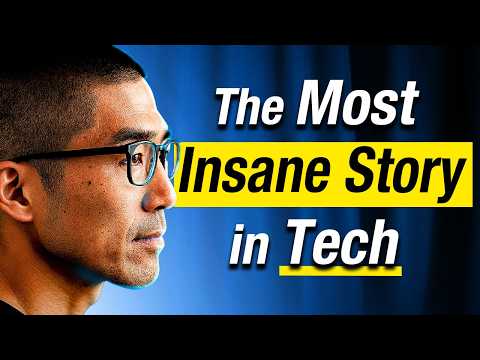
Surge CEO & Co-Founder, Edwin Chen: Scaling to $1BN+ in Revenue with NO Funding
Edwin Chen (guest), Harry Stebbings (host)
In this episode of The Twenty Minute VC, featuring Edwin Chen and Harry Stebbings, Surge CEO & Co-Founder, Edwin Chen: Scaling to $1BN+ in Revenue with NO Funding explores bootstrapped to Billions: Edwin Chen Redefines Data, Funding, and Focus Surge CEO and co‑founder Edwin Chen explains how he built a billion‑dollar, profitable data company in four years with no external funding, by obsessing over quality and running an extremely lean, engineering‑first organization. He contrasts this approach with bloated big tech cultures and “body shop” data vendors that sell warm bodies instead of measurable, improvable data quality. Chen argues that high‑quality human data is the true bottleneck for frontier AI progress, more than compute or algorithms, and that synthetic data is overhyped and often harmful if unmanaged. He intends to keep Surge independent, sees his mission as enabling AGI, and believes the future will hold multiple differentiated AGI providers rather than a single dominant model.
Bootstrapped to Billions: Edwin Chen Redefines Data, Funding, and Focus
Surge CEO and co‑founder Edwin Chen explains how he built a billion‑dollar, profitable data company in four years with no external funding, by obsessing over quality and running an extremely lean, engineering‑first organization. He contrasts this approach with bloated big tech cultures and “body shop” data vendors that sell warm bodies instead of measurable, improvable data quality. Chen argues that high‑quality human data is the true bottleneck for frontier AI progress, more than compute or algorithms, and that synthetic data is overhyped and often harmful if unmanaged. He intends to keep Surge independent, sees his mission as enabling AGI, and believes the future will hold multiple differentiated AGI providers rather than a single dominant model.
Key Takeaways
Radical focus on talent density and small teams outperforms large orgs.
Chen believes 90% of people at big tech work on low‑value internal projects; by stripping away this bloat, a company can move faster, communicate better, and build a far superior product with a fraction of the headcount.
Get the full analysis with uListen AI
Quality as a non‑negotiable principle drives long‑term advantage.
Surge prioritizes data quality over deadlines, revenue, or logo‑chasing, even turning down work when they can’t meet their standard, which differentiates them from competitors who optimize for growth metrics and fundraising optics.
Get the full analysis with uListen AI
Bootstrapping forces clarity of vision and customer alignment.
By refusing to raise capital, Chen avoided status‑driven fundraising cycles, built the MVP himself, and let only deeply aligned customers shape the product, rather than chasing whatever would impress investors.
Get the full analysis with uListen AI
Data quality is a bigger AI bottleneck than compute or algorithms.
He ranks constraints as: (1) high‑quality data, (2) compute, (3) algorithms, citing examples where labs spent months scaling models only to discover their training and eval data were so poor that apparent gains were illusory.
Get the full analysis with uListen AI
Synthetic data is powerful but can silently degrade real‑world performance.
Models trained heavily on synthetic data tend to excel at artificial benchmark tasks but generalize poorly; Chen says customers often find a few thousand top‑tier human datapoints outperform millions of synthetic ones and must purge synthetic data retroactively.
Get the full analysis with uListen AI
Real technology in data labeling is about measuring and improving worker quality at scale.
Surge invests in algorithms to identify the top 1–2% of contributors for complex tasks and aggressively filter out cheaters and low performers, a capability he argues most “body shop” competitors simply don’t have.
Get the full analysis with uListen AI
Founders should pursue problems uniquely suited to them and ignore status games.
Chen insists generational companies come from founders working on deeply believed, idiosyncratic problems—not from serial pivoting to whatever idea will raise money or trend on Twitter—and he models this by rejecting acquisition offers and focusing on AGI impact.
Get the full analysis with uListen AI
Notable Quotes
“You can build a completely different kind of company with 10% of the resources and 10% of the people, but you're still moving ten times faster and building a ten times better product.”
— Edwin Chen
“A lot of the other companies in our space, they're just not technology companies at the end of the day. They are either body shops or they are body shops masquerading as technology companies.”
— Edwin Chen
“One of the things that we simply tell everybody when we first join: quality is the most important thing. It's more important than anything else.”
— Edwin Chen
“I definitely wouldn't sell for 30 billion or even 100 billion. I already have everything I want. We're profitable. I have complete control of our destiny.”
— Edwin Chen
“Synthetic data has made models good at synthetic problems, not real ones.”
— Edwin Chen
Questions Answered in This Episode
How can early‑stage founders practically enforce a ‘quality above all’ principle without slowing growth to a standstill?
Surge CEO and co‑founder Edwin Chen explains how he built a billion‑dollar, profitable data company in four years with no external funding, by obsessing over quality and running an extremely lean, engineering‑first organization. ...
Get the full analysis with uListen AI
What concrete metrics or processes should AI companies use to detect when they’re just ‘benchmark hacking’ rather than truly improving model intelligence?
Get the full analysis with uListen AI
In a world where synthetic data is ubiquitous, how should teams decide what proportion of their training mix must remain human‑labeled?
Get the full analysis with uListen AI
If you refuse to use traditional sales and fundraising engines, what are the most effective ways to systematically find and onboard the right customers?
Get the full analysis with uListen AI
What kinds of ‘only you can do it’ founder insights are actually strong enough to underpin a durable, multi‑billion‑dollar AI business?
Get the full analysis with uListen AI
Transcript Preview
I think a lot of the other companies in our space, they're just not technology companies at the end of the day. They are either body shops or they are body shops masquerading as technology companies. One of the things that we simply tell everybody when we first join: quality is the most important thing. Yeah, it's more important than anything else. (mouse clicks) I definitely wanna sell for 30 billion or even 100 billion. (bell dings) I mean, if you think about us as a company, I already have everything I want. Yeah, we're profitable. (bell dings) I have complete control of our destiny. And so I'm really lucky to have all the resources I want to already do anything that I want. (mouse clicks)
Ready to go? (upbeat music) Edwin, dude, I'm so looking forward to this. I am, like, the biggest fan of your business from afar, which makes me feel incredibly weird because we haven't met before, which means I'm basically a stalker. But thank you for joining me.
Yeah, thanks for having me. It's wonderful being here today.
Now, the... I wanted to break the show into two different parts. The first part being kind of the story of this incredible rise, and then the second part really being assessing the future of data, data labeling, and taking a kind of more analytical approach. If we start on the story itself, and pre actually the founding of Surge, you said to me that 90% of the people while you were working at your Google, your Facebook, your Twitter, 90% of the people there were working on useless problems. I thought that was-
Yeah.
... a very interesting place to start. Why were they working on useless problems, and what did it teach you about efficiency seeing that?
Yeah. So I think the biggest lesson for me was that you can build a completely different kind of company with 10% of the resources and 10% of the people, but you're still moving ten times faster and building a ten times better product. Like, imagine if you could just magically remove the 90% of people who aren't working on, on interesting problems. Wh- wh- what would happen then? Well, if you have a company that's one-tenth this size, you don't need to hire as many people, so you spend less time interviewing, you spend less time in meetings, you spend less time people- giving people updates for the sake of updates. And if it's one-tenth this size, that means everybody has a better view of what's going on around the company because there isn't all this clutter masking the important stuff. And because the talent density is higher and the teams are smaller, that means the communication is a lot higher and the iteration speed is a lot higher, and better ideas just percolate around more quickly.
Can I ask, like, prioritization is slightly ambiguous according to different people.
Install uListen to search the full transcript and get AI-powered insights
Get Full TranscriptGet more from every podcast
AI summaries, searchable transcripts, and fact-checking. Free forever.
Add to Chrome