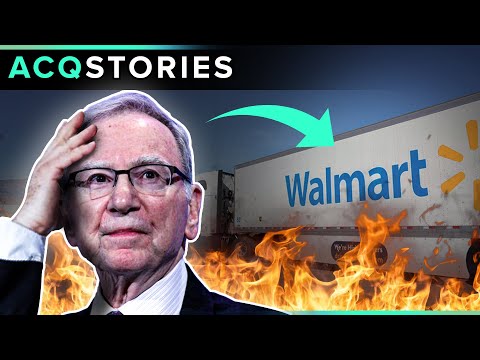
Crazy Story: Qualcomm Had to Sell Half Their Company to Their First Customer!
Ben Gilbert (host), David Rosenthal (host)
In this episode of Acquired, featuring Ben Gilbert and David Rosenthal, Crazy Story: Qualcomm Had to Sell Half Their Company to Their First Customer! explores qualcomm’s lifeline deal: OmniTRACS funded CDMA’s eventual wireless breakthrough Before entering wireless in 1989, Qualcomm took on an unexpected contract to build a mobile satellite network for commercial trucking, which became the OmniTRACS product.
Qualcomm’s lifeline deal: OmniTRACS funded CDMA’s eventual wireless breakthrough
Before entering wireless in 1989, Qualcomm took on an unexpected contract to build a mobile satellite network for commercial trucking, which became the OmniTRACS product.
To fund development and deliver a full-stack “solution” (not just technology), Qualcomm merged with its customer OmniNET—effectively selling about half the company for $3.5M, an unusually dilutive move even given the era.
OmniTRACS launched in late 1988 and generated $32M in 1989 revenue (roughly ~$100M inflation-adjusted), giving Qualcomm cash flow and credibility to pursue its core CDMA patent vision.
A key strategic advantage was Qualcomm’s belief in Moore’s Law: CDMA seemed infeasible in 1986 due to processing constraints, but they correctly forecast it would be feasible by ship time—especially on handsets.
Key Takeaways
A “side business” can become the bridge to the big vision.
Qualcomm’s trucking network work wasn’t the original wireless plan, but OmniTRACS became the interim engine that generated revenue, customer relationships, and financing leverage for pursuing CDMA.
Get the full analysis with uListen AI
Sometimes the only viable financing is strategically painful dilution.
By merging with OmniNET to raise $3. ...
Get the full analysis with uListen AI
Enterprise adoption often requires selling outcomes, not components.
Most customers didn’t want to run dispatch/messaging infrastructure themselves, so Qualcomm shifted to operating the system end-to-end—an early example of “solutions” as a go-to-market unlock.
Get the full analysis with uListen AI
Early revenue scale can hide heavy costs in hardware-and-ops businesses.
Despite $32M in year-one revenue, the hosts emphasize high COGS and operational burden—highlighting that big top-line numbers don’t necessarily mean SaaS-like margins or simplicity.
Get the full analysis with uListen AI
Walmart’s willingness to integrate tech can accelerate vendor validation.
Walmart adopted the system on its proprietary fleet, reinforcing Qualcomm’s credibility and demonstrating real operational value in logistics—while other customers demanded more turnkey delivery.
Get the full analysis with uListen AI
Timing technology bets around compute curves is a durable advantage.
CDMA required sophisticated, real-time signal processing on both base stations and handsets; Qualcomm’s edge was forecasting Moore’s Law progress and building for feasibility at ship time, not at idea time.
Get the full analysis with uListen AI
Patents create a window, not a guarantee.
The discussion flags the CDMA patent’s 1986 filing and 2006 expiry, underscoring that commercialization and standard adoption must happen within a finite timeline to capture outsized returns.
Get the full analysis with uListen AI
Notable Quotes
“We need money so badly... the most attractive option for us is to sell half the equity in our company.”
— David Rosenthal
“We don't sell you a technology, we sell you a solution.”
— Ben Gilbert
“In the first year of business for OmniTRACS, they do $32 million in revenue.”
— Ben Gilbert
“Knowing that something was possible... not today, but when we're gonna ship this... it will be possible then.”
— David Rosenthal
“Nobody believed it could actually work... because you needed such sophisticated processing power.”
— Ben Gilbert
Questions Answered in This Episode
What specific operational components did Qualcomm end up running for customers when OmniTRACS shifted from “technology” to “solution” (dispatch centers, messaging, maintenance, installation)?
Before entering wireless in 1989, Qualcomm took on an unexpected contract to build a mobile satellite network for commercial trucking, which became the OmniTRACS product.
Get the full analysis with uListen AI
Why was a merger-with-the-customer (OmniNET) preferable to other funding options—bank debt, strategic investors, or licensing the tech—given they were close to major revenue?
To fund development and deliver a full-stack “solution” (not just technology), Qualcomm merged with its customer OmniNET—effectively selling about half the company for $3. ...
Get the full analysis with uListen AI
How did Walmart’s integration-first posture shape OmniTRACS’ product design, and what had to change for less technical trucking customers?
OmniTRACS launched in late 1988 and generated $32M in 1989 revenue (roughly ~$100M inflation-adjusted), giving Qualcomm cash flow and credibility to pursue its core CDMA patent vision.
Get the full analysis with uListen AI
What were the biggest cost drivers (COGS) in OmniTRACS—hardware terminals, satellite airtime, network operations, field service—and how did margins evolve as the business doubled?
A key strategic advantage was Qualcomm’s belief in Moore’s Law: CDMA seemed infeasible in 1986 due to processing constraints, but they correctly forecast it would be feasible by ship time—especially on handsets.
Get the full analysis with uListen AI
How did OmniTRACS cash flow and customer traction concretely help Qualcomm finance and de-risk the CDMA push (e.g., fundraising terms, borrowing capacity, talent acquisition)?
Get the full analysis with uListen AI
Transcript Preview
So Qualcomm founded 1985, patent issued 1986, or applied for in 1986.
Which is worth remembering, so it'll expire in 2006.
Uh, that's right. That's right. Looking ahead, foreshadowing. Uh, Qualcomm doesn't enter the wireless industry until 1989. What happens in the interim? [chuckles] This is, this is the next Walmart. Oh, it's so good. You literally just can't make this stuff up. Uh, so they get approached to bid on another contract, the fledgling Qualcomm does, from a company called OmniNET, [lips smack] which has this idea that they think the Qualcomm folks are gonna be perfect to implement. They want to make a mobile satellite network specifically to connect commercial semi-trucks on the roads in America, and, uh, network them up to the distribution centers for retailers [chuckles] and other, uh, people who, uh... companies who ship a lot of things in the US. This is right in their wheelhouse. Qualcomm and, and Irwin are like: "Great, we're gonna bid on this contract." They win it, they start working with OmniNET, [lips smack] and they make it work, and one of the very first customers is, of course, Walmart-
Great idea
... which implements it on their own proprietary fleet of trucks-
Ah.
- building further their technical advantage over just about every other retailer in America.
And at this point, they've walked away from the satellite contract, right? They, they sort of like-
Yeah, they wa-- The, the, the Hughes satellite thing, that, that actually just never happened.
So they developed this technology, they patent it. They were like: "Oh, but there's no money here 'cause the g- the contract got, uh-
Yeah, the FCC was like: "Yeah, satellite, Jurassic Park phone's not gonna be a thing."
Right. So instead, they're focused on this OmniNET-
So they focus-
- deal
... on this, and they also have, like, a lot of the business, you know, relationships already from the previous iteration of what they were doing at Linkabit, including with Walmart and many of the other large companies and retailers. Um, uh, I believe it's Schneider, uh, Trucking-
Yep
... um, becomes one of the-- actually, the first customer, I think, for that. Um, so, uh, they work on building that. It becomes pretty clear, like, this is gonna be the interim main product. Uh, Qualcomm and OmniNET merge in 1988. They raise $3.5 million in funding as part of that. They bring the product to market at the end of 1988 as OmniTRACS. People might have heard of it. [chuckles] Uh, it was part of Qualcomm for a long time before I believe it ended up getting spun out to private equity.
Mm.
Um, and in 1989, in the first year of business for OmniTRACS, they do $32 million in revenue. [chuckles] In 1989. [chuckles]
Which is w- something like- it's like inflation-adjusted $100 million.
It's a lot of money, and there's a lot of demand for this product.
In the first year of the product launch.
Install uListen to search the full transcript and get AI-powered insights
Get Full TranscriptGet more from every podcast
AI summaries, searchable transcripts, and fact-checking. Free forever.
Add to Chrome