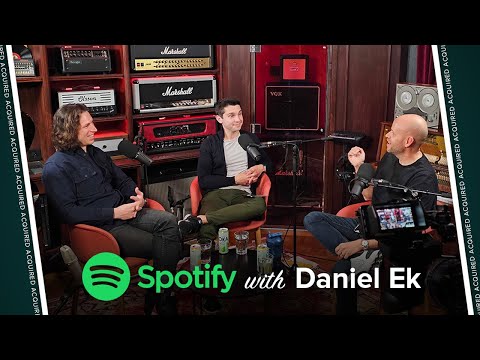
Spotify CEO Daniel Ek
Ben Gilbert (host), David Rosenthal (host), Daniel Ek (guest)
In this episode of Acquired, featuring Ben Gilbert and David Rosenthal, Spotify CEO Daniel Ek explores daniel Ek on Spotify’s growth, podcasts, audiobooks, and culture-building lessons Daniel Ek explains that Spotify’s shift from “music company” to broader “audio company” wasn’t a single master plan but a first-principles response to user behavior, including early signals like audiobook uploads in Germany and internal demand for podcasts in one unified app.
Daniel Ek on Spotify’s growth, podcasts, audiobooks, and culture-building lessons
Daniel Ek explains that Spotify’s shift from “music company” to broader “audio company” wasn’t a single master plan but a first-principles response to user behavior, including early signals like audiobook uploads in Germany and internal demand for podcasts in one unified app.
He argues that podcasting vs. audiobooks is increasingly a blurred format distinction, with business model (ad-supported vs. paid) becoming the clearest differentiator—pushing creators toward freemium, hybrid monetization, and experimentation.
Ek unpacks the misconception that podcasting is automatically a higher-margin business than music, highlighting hidden variable costs at scale (ads infrastructure, moderation, safety, attribution challenges) that resemble social platforms’ realities.
Finally, he reflects on Spotify’s intentional “stacked S-curves” growth strategy and emphasizes culture as the decisive long-term lever—warning against copying other tech companies’ cultural “expressions” and becoming a Frankenstein organization.
Key Takeaways
Spotify’s audio expansion was driven by first principles, not a single ‘genius’ pivot.
Ek describes noticing users already treating Spotify as a general content platform (e. ...
Get the full analysis with uListen AI
Putting podcasts in the same app was the contrarian move that expanded the market.
The “separate podcast app” consensus would have limited adoption to self-identified podcast fans. ...
Get the full analysis with uListen AI
Podcasting vs. audiobooks is increasingly about monetization, not production quality.
Ek frames podcasts as primarily ad-supported audio and audiobooks as paid audio, noting that microphones, editing, and professionalism are converging. ...
Get the full analysis with uListen AI
‘Podcasting is higher-margin than music’ ignores major scaling costs.
While music has heavy revenue sharing with labels, Ek notes podcasting requires building/operating ad systems, handling content moderation, and absorbing safety/compliance burdens that can create large variable costs even at scale.
Get the full analysis with uListen AI
Merchandising/discovery needs differ by time-commitment, so feeds must adapt.
A song is a ~3-minute bet where 10–15 seconds can decide; podcasts require trust and larger time investment. ...
Get the full analysis with uListen AI
Geographic constraint can be an advantage, not a limitation.
Ek argues most companies don’t truly succeed “global day one. ...
Get the full analysis with uListen AI
AI will lower creative barriers, likely hollow out the middle, and raise the premium on the best.
Ek compares AI’s impact to photography: broader participation increases, mid-tier commoditizes, but top-quality becomes more valuable. ...
Get the full analysis with uListen AI
Long-term scaling depends on intentionally designed culture, not borrowed playbooks.
Ek warns against copying Google/Facebook/Amazon “cultural expressions” (e. ...
Get the full analysis with uListen AI
Notable Quotes
““It kind of dawned upon us that podcasters have sort of the same problems that the music creators have.””
— Daniel Ek
““The better way to think about audiobooks and podcasting is… really around a business model… podcasting is ad-supported audio… audiobooks is paid audio.””
— Daniel Ek
““Every really successful entrepreneur… has had at least three near-death experiences with their company.””
— Daniel Ek
““If you really zoom in on that exponential curve, it actually is like a lot of different linear curves stacked on top of each other.””
— Daniel Ek
““We were… a little bit of a Frankenstein monster… we had some of the stuff from everyone, and… some of the bad stuff from everyone, too.””
— Daniel Ek
Questions Answered in This Episode
What specific internal debates or metrics convinced Spotify to keep podcasts inside the main app rather than launching a separate podcast product?
Daniel Ek explains that Spotify’s shift from “music company” to broader “audio company” wasn’t a single master plan but a first-principles response to user behavior, including early signals like audiobook uploads in Germany and internal demand for podcasts in one unified app.
Get the full analysis with uListen AI
Ek frames podcasts vs. audiobooks as ad-supported vs. paid—how does that view handle subscription podcasts, paid bundles, or ‘freemium’ audiobook models?
He argues that podcasting vs. ...
Get the full analysis with uListen AI
Spotify’s biggest hidden costs in podcasting were moderation and ads infrastructure—what operational capabilities did Spotify underestimate at the start, and what would it do differently now?
Ek unpacks the misconception that podcasting is automatically a higher-margin business than music, highlighting hidden variable costs at scale (ads infrastructure, moderation, safety, attribution challenges) that resemble social platforms’ realities.
Get the full analysis with uListen AI
Ek says creators over/under-invest in platforms because attribution is hard—what measurement system would Spotify build (or standardize) to show creators true cross-platform lift?
Finally, he reflects on Spotify’s intentional “stacked S-curves” growth strategy and emphasizes culture as the decisive long-term lever—warning against copying other tech companies’ cultural “expressions” and becoming a Frankenstein organization.
Get the full analysis with uListen AI
Spotify’s ‘density marketing’ insight (8 touches before signup, focus on college cities) worked early—what is the analogous playbook for launching a new audio category like audiobooks today?
Get the full analysis with uListen AI
Transcript Preview
It is impossible to flawlessly execute a podcast of this style.
Yeah.
And that's the beauty of it. You come up with a bunch of stuff you wanna talk about-
Yeah.
-and then you end up having a real organic conversation, and then it turns into a product, and that product is totally different than what you envisioned in your head, but can still be great.
But I think the amazing thing is, unlike you talking to a journalist, et cetera, is it's truly a conversation, one, and the second part is, there's enough time to actually elaborate on the thought and the idea. Whereas you have to be so succinct in how you express your idea and truly get it across in thirty seconds, or, like, you lose the moment, and the journalists wanna move on. Brian Chesky is an example. He's, like, the master on it, and he just switches [snaps] it on, and he's, like, so good. For some reason, he and I always ends up getting on the same panels, and I'm like-
[chuckles]
-it's game over even before it started.
Yeah. [chuckles]
You're gonna have all the great stuff.
"Who got the truth? Is it you? Is it you? Is it you? Who got the truth now? Is it you? Is it you? Is it you? Sit me down, say it straight. Another story on the way. Who got the truth?"
Welcome to this episode of Acquired, the podcast about great technology companies and the stories and playbooks behind them. I'm Ben Gilbert.
I'm David Rosenthal.
And we are your hosts. This episode, we sit down with Daniel Ek, the man who saved the music industry after Napster and the piracy era killed the CD business. Some of the stats are mind-boggling. Spotify has paid forty billion dollars to artists over their lifetime. They're now the single largest source of revenue for the entire music industry.
That's crazy. Spotify also has over five hundred million monthly active listeners, over two hundred million of which are paid subscribers. Both of those numbers are bonkers.
And in today's conversation, we're talking about, one, how Spotify managed to get to this five hundred million number by stacking all these different expansion strategies on top of each other over the years, and two, we're gonna dive into the current moment that Spotify is in. They've entered podcasting in a huge way that has not only changed the experience for consumers, but Spotify's business and their future as a company, which is, of course, very interesting to David and I, as Acquired's growth has really exploded on Spotify.
Totally. As I think we referenced early on in our conversation with Daniel, over sixty percent of Acquired's audience is now on Spotify, which is up from basically zero four years ago.
It's wild. In fact, we were so interested in having this conversation that when Spotify asked if we wanted to fly to Stockholm and record in person with Daniel in the Spotify studio, we jumped at the chance. Daniel also foreshadowed some of what's to come with the cousin of podcasting, audiobooks.
Install uListen to search the full transcript and get AI-powered insights
Get Full TranscriptGet more from every podcast
AI summaries, searchable transcripts, and fact-checking. Free forever.
Add to Chrome