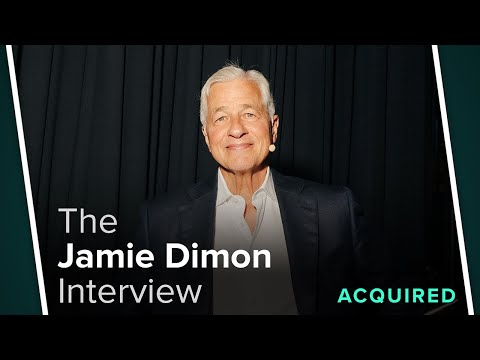
The Jamie Dimon Interview: How JP Morgan Became an $800 Billion Bank
Ben Gilbert (host), David Rosenthal (host), Jamie Dimon (guest), David Rosenthal (host), David Rosenthal (host)
In this episode of Acquired, featuring Ben Gilbert and David Rosenthal, The Jamie Dimon Interview: How JP Morgan Became an $800 Billion Bank explores jamie Dimon on building JPMorgan through risk, culture, acquisitions Ben Gilbert and David Rosenthal interview JPMorgan Chase CEO Jamie Dimon live at Radio City, walking through his path from Citigroup’s president to being fired in 1998, then rebuilding at Bank One and ultimately leading the modern JPMorgan Chase.
Jamie Dimon on building JPMorgan through risk, culture, acquisitions
Ben Gilbert and David Rosenthal interview JPMorgan Chase CEO Jamie Dimon live at Radio City, walking through his path from Citigroup’s president to being fired in 1998, then rebuilding at Bank One and ultimately leading the modern JPMorgan Chase.
Dimon describes how he used conservative risk management, stress testing for “fat tails,” and incentive design to avoid blowups that felled peers—particularly during the 2008 financial crisis.
He details crisis-era acquisitions (Bear Stearns, Washington Mutual) and the importance of rapid, disciplined integration, plus the 2023 First Republic deal and what SVB/FR taught about deposit concentration and interest-rate risk.
Across the story, Dimon emphasizes a “fortress balance sheet,” conservative accounting, cohesive strategy (businesses that feed each other), continuous investment, and culture as the compounding advantage behind JPMorgan’s scale and efficiency.
Key Takeaways
Dimon’s edge is survival-first risk management, not risk avoidance.
He frames risk as something to price and understand, then designs the bank to withstand worst-case scenarios so it can keep serving clients and investing through downturns—when competitors are forced to retreat or fail.
Get the full analysis with uListen AI
Stress test for “worst ever,” because “this time is different” often isn’t.
Dimon rejects narrow or optimistic scenarios (e. ...
Get the full analysis with uListen AI
Conservative accounting and adequate reserves prevent hidden fragility.
At Bank One he found aggressive credit accounting and insufficient capital/reserves; he reviewed and marked down loans, increased reserves, and reduced balance-sheet risk to stop “paper profits” from turning into real losses later.
Get the full analysis with uListen AI
Leverage and misaligned incentives are the fastest path to a bank blowup.
Dimon argues banking returns can be “jacked up” by leverage and deal-by-deal comp, so he reduced leverage, changed comp structures, and removed private “side deals” that reward individuals for risk that harms the firm.
Get the full analysis with uListen AI
A fortress balance sheet is a strategic weapon, not just prudence.
Extra liquidity and capital can look like a drag in good times, but it enables decisive action in crises—raising equity when others can’t, buying assets at attractive prices, and preserving trust among clients and markets.
Get the full analysis with uListen AI
Acquisitions only create value when business logic and integration capability are both real.
He evaluates deals by (1) business fit, (2) ability to execute (systems, culture, consolidation), and (3) price—emphasizing that many mergers fail because integration and operating follow-through collapse.
Get the full analysis with uListen AI
Crisis acquisitions can carry political/regulatory ‘tail risk’ even when they stabilize the system.
Dimon describes Bear Stearns as necessary to prevent uncontrolled failure, yet later costly due to government actions and lawsuits—leading to his stated reluctance to rely on assurances across administrations.
Get the full analysis with uListen AI
Notable Quotes
“It’s your net worth, not my self-worth, that was involved.”
— Jamie Dimon
“You do now.”
— Jamie Dimon
“History does rhyme… Too much leverage, too much risk. Everyone thinks it’s gonna be great.”
— Jamie Dimon
“If you lose money as a financial company… they lose trust.”
— Jamie Dimon
“I wouldn’t really trust the government again.”
— Jamie Dimon
Questions Answered in This Episode
At Citi, you wanted to “skinny it down” while Sandy Weill favored a bigger conglomerate—what specific businesses did you think didn’t belong together, and why?
Ben Gilbert and David Rosenthal interview JPMorgan Chase CEO Jamie Dimon live at Radio City, walking through his path from Citigroup’s president to being fired in 1998, then rebuilding at Bank One and ultimately leading the modern JPMorgan Chase.
Get the full analysis with uListen AI
When you arrived at Bank One, what were the first 3 operational fixes (systems/process/people) you prioritized to stop the bleeding, and what did you deliberately delay?
Dimon describes how he used conservative risk management, stress testing for “fat tails,” and incentive design to avoid blowups that felled peers—particularly during the 2008 financial crisis.
Get the full analysis with uListen AI
You emphasize ‘worst-ever’ stress tests—what are the exact tail scenarios JPMorgan plans for today (rates, unemployment, markets), and which one worries you most?
He details crisis-era acquisitions (Bear Stearns, Washington Mutual) and the importance of rapid, disciplined integration, plus the 2023 First Republic deal and what SVB/FR taught about deposit concentration and interest-rate risk.
Get the full analysis with uListen AI
On incentives: what compensation structures most reliably create ‘blowup behavior’ in banking, and what replacements have worked best at JPMorgan?
Across the story, Dimon emphasizes a “fortress balance sheet,” conservative accounting, cohesive strategy (businesses that feed each other), continuous investment, and culture as the compounding advantage behind JPMorgan’s scale and efficiency.
Get the full analysis with uListen AI
Bear Stearns: what were the most dangerous positions you found during that weekend due diligence, and what did you decide not to keep?
Get the full analysis with uListen AI
Transcript Preview
David, we completely blew it. We went into Jamie Dimon's office, had our little meet and greet. We did not ask about the dual pistols.
Yeah, from the duel, Alexander Hamilton and Aaron Burr, which J.P. Morgan owns and keeps in their headquarters, and we blew it. We didn't ask to see them. We'll just have to come back.
When they finish the new building, I'm sure they will be in the executive floor. We can go get a viewing of the, uh, you know, piece of American history.
All right, speaking of American history, let's do it.
Let's do it. [upbeat music]
Radio City! Are you ready? Who got the truth? Yeah. Is it you, is it you, is it you? Who got the truth now, now? Is it you, is it you, is it you? Take me down, say it straight. I want the story all the way. Who got the truth now, now? Who got the truth?
Welcome to the Summer 2025 season of Acquired, the podcast about great companies and the stories and playbooks behind them. I'm Ben Gilbert.
I'm David Rosenthal.
And we are your hosts. Today's episode is the story of a rising star on Wall Street in the 1980s, who worked with his mentor to merge and acquire their way to the top of the financial world in the '90s, who then got fired unexpectedly by that same mentor, who cast about deciding what to do next, and then in 2000, accepted a job turning around a poorly run Midwestern bank. Then, over the next twenty-five years, he would orchestrate one of the most remarkable runs in banking history, and really, all of corporate history. This is the story of Jamie Dimon, and how he created the modern financial behemoth, JPMorgan Chase, out of the beleaguered component parts of Bank One, JPMorgan Chase, Bear Stearns, Washington Mutual, and First Republic. Jamie is now the longest-serving CEO of any major Wall Street bank and is viewed as kind of the great stabilizer of the American financial system, especially during the 2008 financial crisis. He now sits atop the largest bank in the US with an over eight hundred billion dollar market cap, which is more than twice their nearest competitor. They are the only bank within spitting distance of the sort of big trillion-dollar tech companies that we've covered here on Acquired. And to really put a finer point on the dominance, they are the most valuable company east of the Mississippi in the United States, and the only company east of the Mississippi worth more than half a trillion dollars.
Incredible.
So the question, of course, is: how did he do it? I mean, banks fail. Financial firms often have spectacular blowups, and large organizations, period, financial or not, can often get so bloated that they slow down to a crawl. So what did Jamie Dimon do differently? Well, today's episode, we have Jamie with us, himself, to tell the story. We recorded this live in front of six thousand Acquired fans at Radio City Music Hall in New York City. So you'll notice it's a different format than our usual episode. We're always trying to figure out what version of Acquired works live with an audience, and this is our latest iteration. The Radio City show also had a second act, a late-night talk show, where we had conversations with the CEO of The New York Times, Meredith Kobett Levien, and the chairman of IAC, Barry Diller, plus some cameos from around the Acquired cinematic universe, and we cannot wait to share all of that with you at a later date. Well, if you want to know every time an episode drops, check out our email list, acquired.fm/email. Come join the Slack and talk about this with us afterwards, acquired.fm/slack. If you want more Acquired between each monthly episode, check out ACQ2, our interview show, where we talk with founders and CEOs building businesses in areas we've covered on the show. And before we dive in, we want to briefly thank our presenting partner, J.P. Morgan. [laughing]
Install uListen to search the full transcript and get AI-powered insights
Get Full TranscriptGet more from every podcast
AI summaries, searchable transcripts, and fact-checking. Free forever.
Add to Chrome