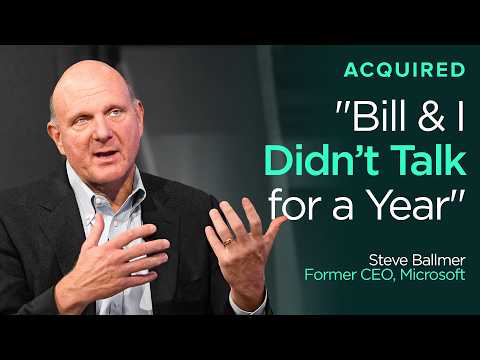
The Steve Ballmer Interview
Ben Gilbert (host), David Rosenthal (host), Steve Ballmer (guest), David Rosenthal (host), David Rosenthal (host), Ben Gilbert (host), David Rosenthal (host)
In this episode of Acquired, featuring Ben Gilbert and David Rosenthal, The Steve Ballmer Interview explores steve Ballmer on Microsoft’s luck, enterprise muscle, and missed waves Ballmer recounts Microsoft’s early dependence on IBM, how the non-exclusive DOS deal and the PC ecosystem’s formation created massive platform leverage, and why “luck” matters in building great companies.
Steve Ballmer on Microsoft’s luck, enterprise muscle, and missed waves
Ballmer recounts Microsoft’s early dependence on IBM, how the non-exclusive DOS deal and the PC ecosystem’s formation created massive platform leverage, and why “luck” matters in building great companies.
He argues he effectively built Microsoft’s enterprise go-to-market muscle—especially licensing innovations like Select and the Enterprise Agreement—while regretting the loss of consumer instinct as the company scaled.
Ballmer revisits iconic moments (e.g., “developers, developers, developers”), clarifies his definition of a “platform” (extensibility), and critiques Microsoft’s later over-attachment to being “just a platform company.”
He details key misses (mobile, search prioritization, spreading bets too thin) and key seeds of later wins (Azure incubation, cloud transition), then connects these lessons to his post-Microsoft investing/loyalty and building the Clippers’ Intuit Dome as a fan-first “product.”
Key Takeaways
Luck is a real input to legendary outcomes—admit it and plan accordingly.
Ballmer frames the IBM/DOS moment as Microsoft’s “big luck,” pushing back on founder mythology that success is purely skill. ...
Get the full analysis with uListen AI
Non-exclusive deals can be more valuable than near-term pricing power.
Microsoft didn’t initially monetize DOS per unit; the long-term value came from being the integration point that developers targeted as clones proliferated. ...
Get the full analysis with uListen AI
Enterprise is less about “back-end” and more about IT-administerable user experiences.
Ballmer’s model separates users, IT, and developers, arguing Microsoft’s advantage came from products that users love, IT can manage, and developers can extend. ...
Get the full analysis with uListen AI
Enterprise customers buy ‘peace of mind’—packaging and support are product features.
He describes enterprise licensing as an insurance policy: predictable compliance, security, admin simplicity, and someone to call. ...
Get the full analysis with uListen AI
A platform is ‘extensibility’—and platforms need great first-party apps.
Ballmer argues Microsoft over-internalized “we’re a platform company,” which sometimes became an excuse not to ship competitive first-party experiences. ...
Get the full analysis with uListen AI
Big-company failures often come from forcing the old model into a new category.
On mobile and Bing-era online services, Ballmer says Microsoft tried to be “too Windowsy” (UI/API/branding) and leaned on Windows integration rather than treating the new product as its own startup-like business requiring new capabilities and economics.
Get the full analysis with uListen AI
Focus beats breadth when entering new markets—‘all wood behind one arrow.’
He critiques Microsoft’s early online strategy for being spread across portal + search + multiple verticals (Expedia, Sidewalk, CarPoint). ...
Get the full analysis with uListen AI
Azure succeeded because Microsoft built cloud capability early and forced culture change.
Azure work began around 2005–06, drawing on prior hosted efforts (e. ...
Get the full analysis with uListen AI
Investor narratives matter; ignoring Wall Street can harm morale and valuation.
Ballmer cites minimizing hype, skipping quarterly calls, refusing guidance, and a “spender” reputation as drivers of a flat stock despite revenue/profit growth. ...
Get the full analysis with uListen AI
Leadership transitions fail when roles are ambiguous or goodbyes are too long.
He recounts a year not speaking with Gates during the CEO handoff and calls the drawn-out Gates departure a mistake. ...
Get the full analysis with uListen AI
Extreme accountability environments (sports) expose what teamwork really means.
Ballmer contrasts business’s slow-feedback loops with sports’ constant scorekeeping and transparency (fans see the same stats). ...
Get the full analysis with uListen AI
Designing a ‘product’ around a single user persona can create durable differentiation.
Intuit Dome is optimized for hardcore basketball fans: The Wall, 4K halo board, frictionless concessions, no hockey compromises, and pricing that incentivizes participation. ...
Get the full analysis with uListen AI
Notable Quotes
““There’s IBM and the bunch.””
— Steve Ballmer
““Luck… is important in the creation of great companies.””
— Steve Ballmer
““Oh, my God, now we have to confront the bear!””
— Steve Ballmer
““When you sell to the enterprise, you have to provide peace of mind, which is kind of like an insurance policy.””
— Steve Ballmer
““You get locked in your model. We’re a platform company. No, we’re an app and platform company.””
— Steve Ballmer
Questions Answered in This Episode
On the DOS/IBM deal: what specific clauses or negotiation moments most enabled the non-exclusive licensing outcome—and who inside IBM championed it?
Ballmer recounts Microsoft’s early dependence on IBM, how the non-exclusive DOS deal and the PC ecosystem’s formation created massive platform leverage, and why “luck” matters in building great companies.
Get the full analysis with uListen AI
Ballmer distinguishes users, IT, and developers; how would he map today’s AI products (Copilot, agents, MCP-style integrations) onto that triad?
He argues he effectively built Microsoft’s enterprise go-to-market muscle—especially licensing innovations like Select and the Enterprise Agreement—while regretting the loss of consumer instinct as the company scaled.
Get the full analysis with uListen AI
He says Microsoft ‘lost the consumer muscle.’ What concrete organizational mechanisms (incentives, talent profiles, shipping cadence) eroded it, and what would he do differently?
Ballmer revisits iconic moments (e. ...
Get the full analysis with uListen AI
Enterprise Agreement as ‘insurance’: where is the ethical line between helpful bundling and anti-competitive tying, especially given the antitrust context?
He details key misses (mobile, search prioritization, spreading bets too thin) and key seeds of later wins (Azure incubation, cloud transition), then connects these lessons to his post-Microsoft investing/loyalty and building the Clippers’ Intuit Dome as a fan-first “product.”
Get the full analysis with uListen AI
He argues Microsoft spread too thin in online services (portal, search, verticals). If he could reallocate 2000–2005 resources, what single arrow would he fund and what would he kill?
Get the full analysis with uListen AI
Transcript Preview
All right, so David, Steve gave us the signed Clippers jersey with the name Acquired on it. There's only one jersey. What are we gonna do about this? [laughing]
[laughing] Should we rock, paper, scissors for it? What-- Well, you know what? No, no, you keep it. There's no Seattle basketball team.
Oh-ho-ho.
Keep it there, up north.
All right, all right. It'll, it'll go in, uh, Acquired Museum North.
Great.
Perfect. All right, let's do it.
Let's do it.
Who got the truth? Is it you, is it you, is it you? Who got the truth now? Is it you, is it you, is it you? Sit me down, say it straight, another story on the way. Who got the truth?
Welcome to episode one of the summer twenty twenty-five season of Acquired, the podcast about great companies and the stories and playbooks behind them. I'm Ben Gilbert.
I'm David Rosenthal.
And we are your hosts. Steve Ballmer is, among other things, arguably the very best investor of the last twenty years. It sounds a little funny to frame it that way, but here are the numbers: In twenty fourteen, when Steve left Microsoft, his net worth was $20B, almost entirely comprised of Microsoft stock. Today, eleven years later, it is a staggering $130B, according to Forbes. It is incredibly rare to reach this stratospheric level when you are, A, not the founder of the company, and B, no longer CEO or even employed by the company, and all of this comes from just one investment decision: just keep holding substantially all of his Microsoft stock.
Incredible. We, uh, chat about it with him in the conversation to come.
Now, as most of you know, we did a big two-part Microsoft series last year on the history of the company up through when Steve transitioned the CEO role to Satya Nadella. Steve listened to those episodes, and, uh, he had some thoughts that he wanted to share with his recollection of how things went down. You know, things like what made Microsoft so fabulously successful, what his missteps were as CEO. We wanted to share that as a recorded conversation with all of you, so we set up our cameras and our mics at his office, his philanthropy office, Ballmer Group, in Bellevue, Washington, and we pressed record. So we'll go into everything from the misses on mobile, search, social, the huge wins in enterprise and cloud. Steve also reflects on his business lessons learned. He goes into why he stepped down as CEO when he did, and he talks about his relationship with Bill Gates over the years. And of course, we had to talk with him a little bit about the Clippers-
Of course
... and the new arena that Steve built and personally owns, too.
Yeah, Intuit Dome. Incredible place. A cathedral of basketball, as Steve would put it.
Listeners, if you wanna know every time an episode drops, check out our email list. It's the only place where we will share a hint of what our next episode will be. We'll share episode corrections, updates, and little tidbits that we learn from all of you about previous episodes. Come and join the Slack to talk about this with us and the whole Acquired community. That is acquired.fm/slack, and the email list is acquired.fm/email. If you want more Acquired between our monthly episodes, check out ACQ2. We just released one with Zach Perret, the co-founder and CEO of Plaid.
Install uListen to search the full transcript and get AI-powered insights
Get Full TranscriptGet more from every podcast
AI summaries, searchable transcripts, and fact-checking. Free forever.
Add to Chrome