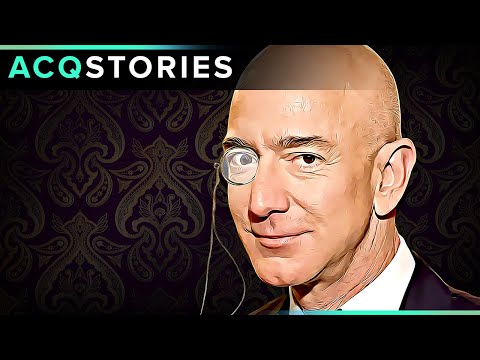
Is Jeff Bezos the Best Investor of All Time?
Ben Gilbert (host), David Rosenthal (host)
In this episode of Acquired, featuring Ben Gilbert and David Rosenthal, Is Jeff Bezos the Best Investor of All Time? explores bezos’s customer obsession and asymmetric bets explain Amazon’s outperformance Amazon’s product strategy is framed as relentlessly customer-use-case driven—building what startups and IT managers actually need, even if it seems “boring.”
Bezos’s customer obsession and asymmetric bets explain Amazon’s outperformance
Amazon’s product strategy is framed as relentlessly customer-use-case driven—building what startups and IT managers actually need, even if it seems “boring.”
The hosts contrast AWS’s pragmatism with competitors’ trend-chasing (e.g., corporate blockchain marketing) to show how Amazon avoids investing without clear customer demand.
Bezos’s 2015 shareholder-letter logic is highlighted: a portfolio of experiments with occasional extreme winners can dominate overall returns.
The conversation positions Bezos as a rare “high beta capital allocator,” arguing Amazon’s internal bets (especially AWS) resemble venture investing with 100% ownership.
A key conceptual lens is “market size unconstrained,” suggesting AWS’s upside wasn’t capped like traditional products or industries.
Key Takeaways
Start with the customer use case before spending engineering dollars.
The hosts argue Amazon’s advantage comes from refusing to build for novelty or trend alignment; if the customer problem isn’t clear (e. ...
Get the full analysis with uListen AI
“Boring” infrastructure wins when it maps directly to real buyer needs.
AWS is described as succeeding by building what startups wanted to build on and what IT managers wanted to “lift and shift,” rather than what technologists found most elegant.
Get the full analysis with uListen AI
The best business bets can have non-truncated upside.
Bezos’s comparison to baseball emphasizes that business outcomes can be orders of magnitude larger than the initial bet, making bold experimentation rational.
Get the full analysis with uListen AI
A high-variance portfolio approach can be optimal inside a company.
Bezos’s view—expect to be wrong most of the time if you’re targeting 100x outcomes—implies you should design organizations to tolerate many misses to capture rare massive wins.
Get the full analysis with uListen AI
Big winners should be expected to fund many failed experiments.
The conversation stresses that outsized successes (like AWS) can pay for a wide experimentation slate, which reframes “waste” as the cost of finding extreme outliers.
Get the full analysis with uListen AI
AWS exemplifies venture-like investing with unusually strong capture of returns.
Because Amazon owns AWS entirely, the hosts suggest it may be one of the greatest “venture” outcomes ever—an internal bet with full upside retained.
Get the full analysis with uListen AI
Notable Quotes
““Make something people want.””
— Ben Gilbert
““We don’t really understand the customer use case yet.””
— Ben Gilbert (quoting Andy Jassy)
““Given a ten percent chance of a hundred times payoff, you should make that bet every time.””
— Ben Gilbert (quoting Jeff Bezos)
““The difference between baseball and business… is that a baseball has a truncated outcome distribution… In business… you can score a thousand runs.””
— Ben Gilbert (quoting Jeff Bezos)
““This long tail distribution of returns is why it’s important to be bold. Big winners pay for so many experiments.””
— Ben Gilbert (quoting Jeff Bezos)
Questions Answered in This Episode
What are concrete examples of AWS features that were built directly from a specific customer “use case” rather than a top-down strategy?
Amazon’s product strategy is framed as relentlessly customer-use-case driven—building what startups and IT managers actually need, even if it seems “boring.”
Get the full analysis with uListen AI
How did Amazon decide it finally understood enough of the blockchain customer use case to ship its “not a blockchain” alternative—and what did it actually solve?
The hosts contrast AWS’s pragmatism with competitors’ trend-chasing (e. ...
Get the full analysis with uListen AI
In Bezos’s 10%-chance-of-100x framework, how should leaders set budgeting and review processes so teams aren’t punished for the nine misses?
Bezos’s 2015 shareholder-letter logic is highlighted: a portfolio of experiments with occasional extreme winners can dominate overall returns.
Get the full analysis with uListen AI
What makes Bezos a better “capital allocator” than top-tier VCs—access to distribution, ability to run experiments at scale, or willingness to wait?
The conversation positions Bezos as a rare “high beta capital allocator,” arguing Amazon’s internal bets (especially AWS) resemble venture investing with 100% ownership.
Get the full analysis with uListen AI
Is “market size unconstrained” always true for cloud infrastructure, or are there hidden constraints (regulation, competition, margin compression) that cap the upside?
A key conceptual lens is “market size unconstrained,” suggesting AWS’s upside wasn’t capped like traditional products or industries.
Get the full analysis with uListen AI
Transcript Preview
Make something people want. This is the YC slogan, but this is exactly what Amazon did. I think Microsoft and Google both wanted to build something that they thought would be an amazing business model and something that was very clever to them as technologists. And what Amazon decided to do is figure out what startups wanted to build on, figure out what IT managers wanted to lift and shift to, and just build that. And it's boring, but it comes through in all these keynotes. I mean, every single thing has a customer use case attached to it, a customer use case that drove them to develop it. And it's funny how they refuse to do things like, for the longest time, people were like, "Why aren't you doing anything in blockchain?" And Andy Jassy's comment on stage is, he's like, "We don't really understand the customer use case yet." And this was in like twenty fifteen or sixteen. This is six years before the recent buzz around Web3 use cases, and I just think they're so focused on that as the very first question you have to ask before investing a single dollar of engineering resources. It's just very impressive.
Whereas in that same timeframe, didn't Microsoft have those ads with Common? "Blockchain in the cloud on Microsoft."
Ugh.
You know, and IBM was doing like a corporate blockchain.
Yeah. So they eventually did roll something out that was like, "This isn't a blockchain, but we think it accomplishes the same thing that you people who are asking for blockchain-based enterprise infrastructure are asking for."
Interesting.
Okay, my next one is about asymmetric upside, and this is another Bezos letter that I'm gonna quote from twenty fifteen where he says, "Given a ten percent chance of a hundred times payoff, you should make that bet every time. But you're still gonna be wrong nine times out of ten. We all know that if you swing for the fences, you're gonna strike out a lot, but you're also gonna hit some home runs. The difference between baseball and business, however, is that a baseball has a truncated outcome distribution. When you swing, no matter how well you connect with the ball, the most runs you can ever get is four. In business, every once in a while, when you step up to the plate, you can score a thousand runs. This long tail distribution of returns is why it's important to be bold. Big winners pay for so many experiments."
Market size unconstrained.
Market size unconstrained.
I think that's gotta be like a catchphrase on Acquired that we should incorporate.
Oh, for sure. Let's print it on some merch. [laughs]
Yeah. [laughs]
But yeah, th-this is the year after he makes the market size unconstrained comment about AWS. I just think it's such a perfect illustration. A lot of people make fun of certain venture capital investments, and I'm kind of only interested in the ones people are making fun of, 'cause that's the whole point of venture capital, is seeking these crazy asymmetric long tail returns. And I think Jeff Bezos got that better than most VCs do. He's a phenomenal high beta capital allocator. And so in running a company, I mean, he was also a very good operational CEO and also like an actual genius. So like all of these things, I mean, there's lots to say about Jeff Bezos. He's absolutely a genius. He's absolutely a brilliant operator. But maybe even more than these things, he just gets capital allocation, and that's why I think Amazon is effectively the highest performing venture returns in history. AWS is a venture bet in their portfolio that they own one hundred percent of.
Install uListen to search the full transcript and get AI-powered insights
Get Full TranscriptGet more from every podcast
AI summaries, searchable transcripts, and fact-checking. Free forever.
Add to Chrome