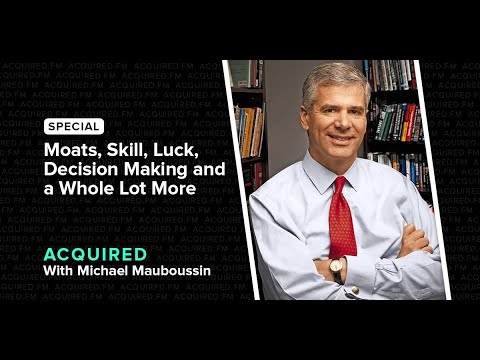
The Legend Michael Mauboussin on Acquired!
Ben Gilbert (host), David Rosenthal (host), Michael Mauboussin (guest), David Rosenthal (host)
In this episode of Acquired, featuring Ben Gilbert and David Rosenthal, The Legend Michael Mauboussin on Acquired! explores michael Mauboussin on expectations, moats, and decision-making in markets Michael Mauboussin explains the core framework of “Expectations Investing”: prices embed market expectations, so investors should reverse-engineer what must be true and then judge whether those expectations are too optimistic or pessimistic.
Michael Mauboussin on expectations, moats, and decision-making in markets
Michael Mauboussin explains the core framework of “Expectations Investing”: prices embed market expectations, so investors should reverse-engineer what must be true and then judge whether those expectations are too optimistic or pessimistic.
He discusses how the shift from tangible to intangible investment (software, R&D, brand, customer acquisition) breaks many traditional accounting-based heuristics and makes cash-flow and unit economics analysis more important than ever.
Mauboussin outlines a structured way to “measure the moat,” connecting strategy to returns on invested capital and clarifying how low-cost vs. differentiation strategies show up in margins and capital velocity.
The conversation broadens to decision-making tools (base rates, pre-mortems, red teams, journaling), complexity and reflexivity (e.g., Tesla), and the skill/luck dynamics that make persistent outperformance increasingly rare in efficient, highly skilled markets.
Key Takeaways
Start with price: reverse-engineer expectations before building conviction.
Mauboussin argues most investors build a valuation from their own assumptions, but the better starting point is asking, “What do I have to believe for today’s price to make sense? ...
Get the full analysis with uListen AI
Think probabilistically, not point-estimate-ically.
Expectations investing is inherently scenario-based: the current price reflects a distribution of outcomes. ...
Get the full analysis with uListen AI
The economy’s shift to intangibles makes earnings less informative.
Because more investment now occurs in items expensed on the income statement (R&D, software, CAC, training, brand), reported profitability can understate value creation. ...
Get the full analysis with uListen AI
Moats should be grounded in ROIC relative to cost of capital and peers.
A true competitive advantage is both absolute (returns above cost of capital) and relative (better economics than competitors). ...
Get the full analysis with uListen AI
Strategy type is often visible in financials via margins and capital velocity.
Low-cost producers tend to show low margins but high capital turnover (sales/invested capital). ...
Get the full analysis with uListen AI
Early-stage investing behaves more like options than discounted cash flows.
For young companies in highly uncertain environments, Mauboussin recommends “real options” thinking: volatility can increase value, managerial option-exercise skill matters hugely, and access to capital can determine whether options can be pursued at all.
Get the full analysis with uListen AI
Reflexivity can temporarily make fundamentals follow price—until it reverses.
In cases like Tesla (and meme-stock dynamics), rising prices can improve fundamentals by enabling cheap capital raises and extending runway. ...
Get the full analysis with uListen AI
Notable Quotes
“A stock price reflects a set of expectations about future financial performance.”
— Michael Mauboussin
“What do I have to believe for this to make sense?”
— Michael Mauboussin
“The ultimate driver value of business is cash, not accounting earnings.”
— Michael Mauboussin
“In activities where both skill and luck contribute to outcomes, as skill increases, luck becomes more important.”
— Michael Mauboussin
“Extraordinary streaks are a combination of skill and luck.”
— Michael Mauboussin
Questions Answered in This Episode
In practice, what’s your preferred “reverse-engineering” method (DCF, unit economics, implied growth/ROIC), and how do you keep it from becoming too assumption-heavy?
Michael Mauboussin explains the core framework of “Expectations Investing”: prices embed market expectations, so investors should reverse-engineer what must be true and then judge whether those expectations are too optimistic or pessimistic.
Get the full analysis with uListen AI
For a modern software company, how would you operationally separate “maintenance” SG&A from “investment” SG&A (e.g., CAC, R&D) when financial statements lump them together?
He discusses how the shift from tangible to intangible investment (software, R&D, brand, customer acquisition) breaks many traditional accounting-based heuristics and makes cash-flow and unit economics analysis more important than ever.
Get the full analysis with uListen AI
When you say a moat requires both above-cost-of-capital returns and outperformance vs. peers, how do you define the peer set in winner-take-most markets?
Mauboussin outlines a structured way to “measure the moat,” connecting strategy to returns on invested capital and clarifying how low-cost vs. ...
Get the full analysis with uListen AI
Tesla: which specific implied expectations (auto volumes, margins, autonomy/energy optionality) have to be true for the valuation to be reasonable, and what would falsify them?
The conversation broadens to decision-making tools (base rates, pre-mortems, red teams, journaling), complexity and reflexivity (e. ...
Get the full analysis with uListen AI
You mentioned industry entry/exit cycles (Klepper). What indicators best reveal when an industry is about to shift from proliferation to shakeout?
Get the full analysis with uListen AI
Transcript Preview
Yeah, dude, we should see if, uh, any listeners wanna create some cool, like, animation for the intro music for the YouTube channel.
Oh, are we gonna open source it to the fans?
[laughing] We gotta do it.
Who got the truth? Is it you? Is it you? Is it you? Who got the truth now? Is it you? Is it you? Is it you? Sit me down, say it straight. Another story on the way. Who got the truth?
Welcome to this special episode of Acquired, the podcast about great technology companies and the stories and playbooks behind them. I'm Ben Gilbert, and I'm the co-founder and managing director of Seattle-based Pioneer Square Labs, and our venture fund, PSL Ventures.
And I'm David Rosenthal, and I am an angel investor based in San Francisco.
And we are your hosts. Well, today, we interview one of our heroes, Michael Mauboussin. We've referenced his work on many episodes before. He's given talks that have been my carve-outs on previous episodes, and as many of you know, Michael is the head of Consilient Research at Counterpoint Global, which is part of Morgan Stanley Investment Management. At, uh, mid-year 2021, earlier this year, Counterpoint Global had assets under management of approximately $180 billion. And for those who don't know Michael's work, boy, are you in for a treat. Uh, [chuckles] David, I think it's fair to say he's your favorite investor's favorite investor.
[laughing] I love that. I love that. He might also... I mean, at this point, we'll have to- somebody have to tally up. He might be, uh, he's certainly in the top five of number of carve-outs, uh, all time in Acquired.
For sure. Yeah, he's done, like, mind-expanding research on a ton of topics that we'll cover today on the show, and today's show, uh, of course, has a lens on how to interpret all of Michael's work over the years in the context of today's unprecedented macroeconomic environment.
I li- I like that, unprecedented.
[laughing]
Good, good phrasing.
Yeah. Well, for the presenting sponsorship on this episode, we have the SoftBank Latin America Fund back again. As many of you know from previous specials, SoftBank LatAm is deploying capital into the Latin America startup ecosystem, and it's absolutely fascinating. They, they just announced they have another $3 billion to invest in addition to their initial $5 billion, so clearly it is working. And when we asked Paulo and Xu, two of the partners in the fund, if we could grab some voices from the founders themselves, they were like, "Of course." So today, we are joined by Gabriel Braga, the co-founder and CEO of QuintoAndar, the $5 billion real estate tech company founded in 2012 in Brazil. Can you explain how the platform works and, and what your journey to start and grow the company has been like?
Definitely. Uh, we enable seamless housing experience from, from searching for a home towards the transaction, and after the transaction, during the leaving, as long as you live in that property. So we started, uh, back in 2012, focused on long-term rentals, and we chose that segment because it was the, the most neglected part of the market. Was particularly painful in Brazil, and in addition to all the ineffici- inefficiencies in, in finding a home, I mean, duplicate listings, poor photos, incomplete info online, tenants were required in Brazil to provide a very cumbersome and expensive rent guarantee, while the landlords were afraid of not receiving the rent on time and having headaches with delinquent tenants and, and evictions. And we fixed the transaction by eliminating the need of those rent guarantees from the tenant side, but guaranteeing the rent on time for the landlord, no matter what happened.
Install uListen to search the full transcript and get AI-powered insights
Get Full TranscriptGet more from every podcast
AI summaries, searchable transcripts, and fact-checking. Free forever.
Add to Chrome