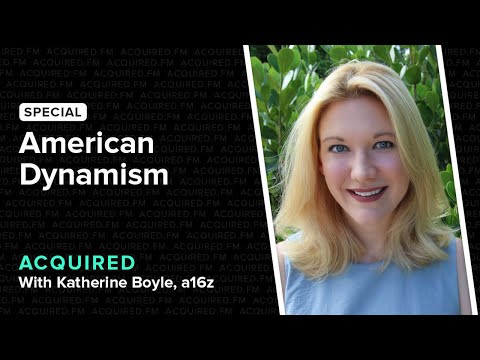
American Dynamism (with Katherine Boyle)
Ben Gilbert (host), David Rosenthal (host), Katherine Boyle (guest)
In this episode of Acquired, featuring Ben Gilbert and David Rosenthal, American Dynamism (with Katherine Boyle) explores a16z’s American Dynamism thesis: rebuilding real-world industries with tech innovation Katherine Boyle (a16z GP) defines “American Dynamism” as investing in companies that support the national interest, spanning defense/aerospace and also core civic domains like housing, education, transportation, and infrastructure.
a16z’s American Dynamism thesis: rebuilding real-world industries with tech innovation
Katherine Boyle (a16z GP) defines “American Dynamism” as investing in companies that support the national interest, spanning defense/aerospace and also core civic domains like housing, education, transportation, and infrastructure.
The thesis argues that the last decades of software innovation largely bypassed these physical, regulated sectors—creating huge opportunities, but also demanding different venture muscles because these companies are harder, slower, and often capital-intensive early on.
Boyle traces why “why now” is driven by COVID-era shifts: renewed urgency to “build,” government’s growing need to buy (not build) modern software, and a geographic decentralization that lets founders build category-defining companies outside Silicon Valley.
The conversation also covers Boyle’s journey from Washington Post reporter to investor, contrasts Washington’s power/attention incentives with Silicon Valley’s equity/creation incentives, and highlights portfolio examples like Anduril, Flock Safety, and Hadrian as emblematic of this next era.
Key Takeaways
American Dynamism is “national-interest tech,” not just defense.
Boyle frames the category as companies that touch core civic life—education, housing, transportation, infrastructure—and often interact with government via sales, regulation, or direct competition.
Get the full analysis with uListen AI
These businesses are harder early and often look “worse” at Series A.
Because they operate in the physical world with entrenched incumbents and regulation, they can require more capital/time and show slower early traction—“deeper down the J-curve”—yet can become massive and strategically important (SpaceX as exemplar).
Get the full analysis with uListen AI
The U.S. government’s “build internally” posture is increasingly untenable.
Boyle argues government lags modern tooling: employees live consumer-internet lives but work with outdated systems, driving cost bloat and poor service outcomes in public goods like education and housing.
Get the full analysis with uListen AI
COVID created a timing window for a rebuild cycle.
The pandemic stress-tested institutions (schools, supply chains, public systems) and accelerated acceptance that the pre-COVID Silicon Valley playbook is changing—creating tailwinds for builders targeting real-world sectors.
Get the full analysis with uListen AI
Founder archetypes are expanding beyond the classic engineer profile.
Because startup-building components can be “taken off the shelf,” people from frontline systems (teachers, DoD procurement, operators) can credibly found startups to modernize the domains they know firsthand.
Get the full analysis with uListen AI
Tech is decoupling from San Francisco—enabling place-based problem selection.
Remote work and online networks reduce the need to relocate for capital and talent; founders can build in (and for) Atlanta, Miami, LA, and smaller cities, addressing local civic problems and retaining regional talent.
Get the full analysis with uListen AI
‘Small tech’ deserves more attention than ‘big tech’ in policy narratives.
Boyle emphasizes that early-stage startups and creator tools (e. ...
Get the full analysis with uListen AI
Notable Quotes
““The most simple definition is it’s companies that support the national interest.””
— Katherine Boyle
““These companies go deeper down the J curve. They often don’t look that good at Series A.””
— Katherine Boyle
““They go into government, and it takes thirty minutes to start their computer. It’s like being back in the 1980s.””
— Katherine Boyle
““Silicon Valley is an idea, not a place.””
— Katherine Boyle
““I think America is the greatest experiment in human history.””
— Katherine Boyle
Questions Answered in This Episode
How does a16z practically define “supports the national interest” when evaluating borderline categories (e.g., fintech, energy, AI tooling)?
Katherine Boyle (a16z GP) defines “American Dynamism” as investing in companies that support the national interest, spanning defense/aerospace and also core civic domains like housing, education, transportation, and infrastructure.
Get the full analysis with uListen AI
What are the specific procurement chokepoints that most often kill gov-adjacent startups, and what has changed (if anything) post-COVID?
The thesis argues that the last decades of software innovation largely bypassed these physical, regulated sectors—creating huge opportunities, but also demanding different venture muscles because these companies are harder, slower, and often capital-intensive early on.
Get the full analysis with uListen AI
You mention these companies become “holding companies earlier”—what organizational and capital-structure patterns do you see (M&A, vertical integration, long private timelines)?
Boyle traces why “why now” is driven by COVID-era shifts: renewed urgency to “build,” government’s growing need to buy (not build) modern software, and a geographic decentralization that lets founders build category-defining companies outside Silicon Valley.
Get the full analysis with uListen AI
In sectors like education and housing, how do you distinguish “regulatory capture as the moat” from “regulatory risk that makes the business uninvestable”?
The conversation also covers Boyle’s journey from Washington Post reporter to investor, contrasts Washington’s power/attention incentives with Silicon Valley’s equity/creation incentives, and highlights portfolio examples like Anduril, Flock Safety, and Hadrian as emblematic of this next era.
Get the full analysis with uListen AI
Flock Safety started selling to HOAs and then pulled in police departments—what are the best ‘non-government wedge’ strategies for ultimately selling to government?
Get the full analysis with uListen AI
Transcript Preview
I think this is our first time doing video in hotel rooms.
I know, I know. It'll be funny. [chuckles]
And the funniest thing is David and I are in hotel rooms down the hall, recording in different rooms so we get better audio quality. [laughing]
Man, doing live in-person events again is awesome, but yields a whole new level of complexity.
A whole new level. All right, let's do it.
All right.
Who got the truth? Is it you? Is it you? Is it you? Who got the truth now? Is it you? Is it you? Is it you? Sit me down, say it straight, another story on the way. Who got the truth?
Welcome to this special episode of Acquired, the podcast about great technology companies and the stories and playbooks behind them. I'm Ben Gilbert, and I am the Co-Founder and Managing Director of Seattle-based Pioneer Square Labs and our venture fund, PSL Ventures.
And I'm David Rosenthal, and I am an angel investor based in San Francisco.
And we are your hosts. David, this should be a very fun- I should... It's funny I say, "should be." We, we recorded this already. I know it was a fascinating conversation.
We are speaking to you from the future. We had a great, great, fun conversation here with my good friend, Katherine Boyle, who is, uh, just a wonderful investor. She's a General Partner at Andreessen Horowitz, where she leads their American Dynamism practice. We dive all into what that means, why this is an important vertical, both for venture investing and technology and the world and for America, but also for Andreessen, why they decided to do this. Her background, her story is fascinating. She was a reporter at The Washington Post in the pre-Bezos era, and then came out to Silicon Valley, went to GSB, that's where we intersected, and then became a venture capitalist. She just has an amazing story, and we were pumped to get to do it with her. Now, before we dive in, for our presenting sponsor for this special episode, we have, as always, the Solana Foundation. And Solana, as you all know by now, is a global state machine and the world's most performant blockchain. That means that developers can build applications on it with super, super low transaction fees compared to other Web3 infrastructure, and all with very low latency and without compromising composability.
It's like a real modern computer, but distributed.
It's amazing. It is indeed a technical marvel. And today, we are talking with Stephen Hess, the CEO of Metaplex. Stephen, welcome to Acquired.
GM, David.
GM, indeed. Well, that is the perfect greeting to lead into my first question, which is, can you tell us all a little bit about what Metaplex is?
Absolutely. Metaplex is a protocol and framework for building NFT applications, games, and experiences on the Solana protocol. Less than a year ago, there were no Solana NFTs, and now we have an exploding ecosystem of over, actually, this morning, one point nine million collectors that are holding a Solana NFT that uses the Metaplex standard. That's twelve million NFTs minted to date, and there is no slowing down. I know there's a lot of talk of bear markets, but I can tell you that the NFT creators are not stopping, and there's a lot of green field in front of us for sure.
Install uListen to search the full transcript and get AI-powered insights
Get Full TranscriptGet more from every podcast
AI summaries, searchable transcripts, and fact-checking. Free forever.
Add to Chrome