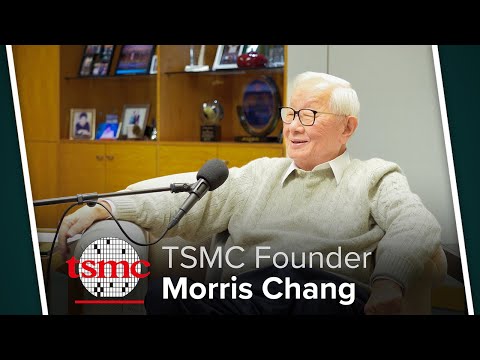
TSMC founder Morris Chang
Ben Gilbert (host), David Rosenthal (host), Dr. Morris Chang (guest), Ben Gilbert (host), David Rosenthal (host), Ben Gilbert (host)
In this episode of Acquired, featuring Ben Gilbert and David Rosenthal, TSMC founder Morris Chang explores morris Chang on TSMC’s customer trust, nodes, and compounding scale Acquired interviews 93-year-old TSMC founder Morris Chang, focusing on pivotal episodes that shaped TSMC’s leadership: the early NVIDIA partnership, the 2009 40nm crisis, and the strategic “all-in” commitment to 28nm.
Morris Chang on TSMC’s customer trust, nodes, and compounding scale
Acquired interviews 93-year-old TSMC founder Morris Chang, focusing on pivotal episodes that shaped TSMC’s leadership: the early NVIDIA partnership, the 2009 40nm crisis, and the strategic “all-in” commitment to 28nm.
Chang describes how he resolved a major NVIDIA dispute through direct executive engagement, a time-boxed settlement, and a long-term partnership mindset—turning a painful yield/quality period into enduring trust.
He explains TSMC’s deliberate decision to institutionalize R&D at 8% of revenue and dramatically increase capital spending to capture the smartphone-era “sweet spot” at 28nm, despite board resistance.
The conversation then traces how Apple became a customer (via Foxconn’s Terry Gou introducing Jeff Williams), why Intel failed to win Apple’s foundry business, and how node roadmaps (20nm detour, 16nm catch-up) created real strategic trade-offs.
Key Takeaways
Customer trust is a strategic asset that can be “bought back” decisively.
In the 40nm dispute, Chang personally re-engaged Jensen Huang, quantified harm, and offered a >$100M settlement with no bargaining and a 48-hour deadline—avoiding arbitration and preserving a relationship that later produced many billions in business.
Get the full analysis with uListen AI
Operational crises compound when leadership avoids accountability.
Chang recounts that the prior CEO leaned on internal quality claims to deny fault (“zero”), prolonging conflict with NVIDIA; Chang’s fix began by re-opening facts, aligning incentives, and treating restitution as a trust reset, not a legal fight.
Get the full analysis with uListen AI
Avoid layoffs if you’ll need the talent back within a year.
Chang argues performance-based layoffs lack credibility due to supervisor subjectivity and destroy value when severance plus retraining roughly equals a year; in Moore’s Law businesses, capacity to execute future nodes depends on retaining trained teams.
Get the full analysis with uListen AI
Make R&D non-negotiable to sustain a Moore’s Law cadence.
After being denied incremental R&D at TI, Chang set TSMC’s R&D at a fixed 8% of revenue “regardless of recession,” removing annual bargaining and enabling teams to plan aggressively for successive nodes like 28nm (and later “sweet spots”).
Get the full analysis with uListen AI
Winning a node often requires synchronized R&D conviction and capex courage.
TSMC tripled capex (≈$2–2. ...
Get the full analysis with uListen AI
Big customers can force roadmap detours with real competitive consequences.
Apple demanded 20nm—an intermediate node that delayed TSMC’s 16nm and allowed Samsung to get ahead temporarily, illustrating how even “pleasant surprise” demand can reshape sequencing and shift competitive timing.
Get the full analysis with uListen AI
Capacity commitments need guardrails—deposits, partial acceptance, and financing discipline.
Chang describes requiring customer deposits (and the threat of ‘confiscation’) to prevent over-ordering, and later limiting Apple to roughly half its requested volume while funding expansion via borrowing (not dividends cuts or equity), based on shareholder realities.
Get the full analysis with uListen AI
Notable Quotes
“Quiet! Morris Chang is calling me.”
— Dr. Morris Chang (recounting Jensen Huang’s reaction, 1997)
“Our offer is effective forty-eight hours… We are not going to argue. We are not gonna bargain.”
— Dr. Morris Chang
“Intel just does not know how to be a foundry.”
— Tim Cook (as relayed by Dr. Morris Chang)
“There’s a tide in the affairs of man, which taken at its flood, leads on to fortune.”
— Dr. Morris Chang (quoting Shakespeare on the 28nm bet)
“China ruined it. They subsidized the hell out of it.”
— Dr. Morris Chang (on TSMC’s solar expansion)
Questions Answered in This Episode
On the 40nm crisis, what specific technical/operational changes did TSMC implement to prevent a repeat at 28nm and beyond (process control, QA ownership, customer communication cadence)?
Acquired interviews 93-year-old TSMC founder Morris Chang, focusing on pivotal episodes that shaped TSMC’s leadership: the early NVIDIA partnership, the 2009 40nm crisis, and the strategic “all-in” commitment to 28nm.
Get the full analysis with uListen AI
How did you calculate the >$100M NVIDIA settlement—what variables mattered most (wafer scrap, delay penalties, customer damages, future volume assumptions)?
Chang describes how he resolved a major NVIDIA dispute through direct executive engagement, a time-boxed settlement, and a long-term partnership mindset—turning a painful yield/quality period into enduring trust.
Get the full analysis with uListen AI
You set R&D at 8% of revenue ‘regardless of recession.’ How did you protect that rule during downturns without overextending capex or harming margins?
He explains TSMC’s deliberate decision to institutionalize R&D at 8% of revenue and dramatically increase capital spending to capture the smartphone-era “sweet spot” at 28nm, despite board resistance.
Get the full analysis with uListen AI
Apple requested 20nm, which delayed 16nm and opened the door for Samsung. In hindsight, would you still accept the 20nm detour, or would you negotiate roadmap alignment differently?
The conversation then traces how Apple became a customer (via Foxconn’s Terry Gou introducing Jeff Williams), why Intel failed to win Apple’s foundry business, and how node roadmaps (20nm detour, 16nm catch-up) created real strategic trade-offs.
Get the full analysis with uListen AI
Tim Cook said Intel ‘does not know how to be a foundry.’ What are the top 3 behaviors/processes that define ‘knowing how’—and which are hardest for an IDM culture to learn?
Get the full analysis with uListen AI
Transcript Preview
the podcast about great technology companies and the stories and playbooks.
Oh, no, you said technology! [laughing] Now we definitely have a cold opening.
All right. [chuckles] I guess, uh, I really want us to be about technology companies again.
Well, this is a technology company.
It's a sign. All right, here we go.
Who got the truth? Is it you? Is it you? Is it you? Who got the truth now? Is it you? Is it you? Is it you? Sit me down, say it straight. Another story on the way. Who got the truth?
Welcome to the Spring 2025 season of Acquired, the podcast about great companies and the stories and playbooks behind them. I'm Ben Gilbert.
I'm David Rosenthal.
And we are your hosts. Today, we have something very special to share with you. After becoming obsessed with semiconductors from our TSMC episode four years ago, David and I wound our way through the rest of the industry, studying fabless companies like NVIDIA and Qualcomm, architecture companies like Arm, and chip design software companies like Synopsys. And as we were thinking, "What's next in the world of chips on Acquired?" We threw the Hail Mary. We asked friend of the show, Jensen Huang, if he would ask Dr. Morris Chang, the ninety-three-year-old founder of TSMC, if he would be open to an interview with us.
Yeah, it is, uh, kind of insane and super cool that Jensen made time to help us with this. Uh, it's, uh, it's not like he doesn't have a lot of other things going on. [chuckles]
Yes. Well, listeners, it happened. So today's episode is a conversation that we recorded in Taipei last week at Dr. Chang's office. We flew to Taiwan for a forty-eight-hour whirlwind, where we spent some time at TSMC's headquarters in Hsinchu Science Park, uh, where many of TSMC's fabs are located.
Super cool to see.
Totally. So conveniently, Dr. Chang just published Volume Two of his autobiography a couple months ago after a twenty-six-year hiatus from Volume One. But inconveniently, it is written in traditional Chinese and not published in the Western world. We managed to get our hands on an unpublished translation of the book to prepare, and what you are about to hear focuses on a few crucial stories from TSMC's history that Dr. Chang shares in his memoir about Apple, NVIDIA, and the birth of the fabless industry.
Yes, and big thank you to Karina Bao, who we were lucky to connect with after we set this up, and who has been translating Morris's memoirs with funding from Tyler Cowen and Emergent Ventures. Right now, the memoirs are not published in English, and we will let you know if and when that happens.
Yep. All right, listeners, you can join our email list at acquired.fm/email. You'll get an email every time a new episode drops, once a month, and this is also where we announce past episode corrections, plus a fun little game where we give hints at, uh, what the next episode will be.
Install uListen to search the full transcript and get AI-powered insights
Get Full TranscriptGet more from every podcast
AI summaries, searchable transcripts, and fact-checking. Free forever.
Add to Chrome