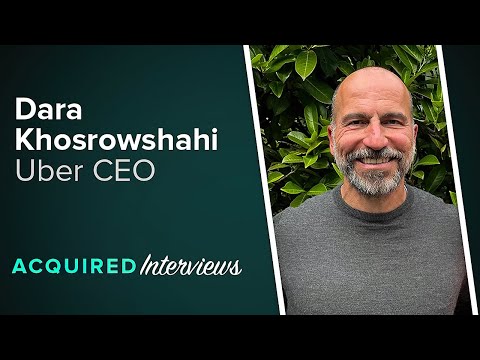
Uber CEO Dara Khosrowshahi
David Rosenthal (host), Ben Gilbert (host), Dara Khosrowshahi (guest), Ben Gilbert (host), David Rosenthal (host), David Rosenthal (host), David Rosenthal (host)
In this episode of Acquired, featuring David Rosenthal and Ben Gilbert, Uber CEO Dara Khosrowshahi explores dara Khosrowshahi on turning Uber into a disciplined platform company Dara Khosrowshahi recounts formative career moments—from Allen & Company and Barry Diller to leading Expedia through intense competitive lessons against Booking.com—and how those experiences shaped his operating style at Uber.
Dara Khosrowshahi on turning Uber into a disciplined platform company
Dara Khosrowshahi recounts formative career moments—from Allen & Company and Barry Diller to leading Expedia through intense competitive lessons against Booking.com—and how those experiences shaped his operating style at Uber.
He explains Uber’s evolution since IPO day: divesting speculative bets, integrating Mobility and Eats teams, building compounding cross-side flywheels, and pushing the company toward sustained profitability rather than growth-at-all-costs.
The conversation details underappreciated mechanics of Uber’s turnaround, including the CEO recruitment process, the painful post-IPO shareholder-base reset, and the high-stakes SoftBank governance deal that eliminated super-voting control.
Dara closes by emphasizing Uber’s future depends on being the best platform for earners (drivers/couriers), raising the “duty of care” for people who spend hours daily on the app, and keeping take rates low through operational efficiency.
Key Takeaways
Decisive conviction during crises can create long-term advantage.
Dara describes IAC keeping the Expedia deal intact after 9/11 despite a material-adverse-change option; the decision stabilized the business and proved prescient as travel demand normalized.
Get the full analysis with uListen AI
Great leaders seek the source of truth, not filtered summaries.
Barry Diller’s habit of pulling junior analysts into the room reflects a bias toward “unvarnished reality,” a pattern Dara credits for better decisions and stronger organizations.
Get the full analysis with uListen AI
Marketplace winners often win through supply-side focus and execution discipline.
Booking. ...
Get the full analysis with uListen AI
Cross-business flywheels take years to become visible externally—then compound.
Uber’s rides→Eats demand flow and Eats→rides supply recruitment required significant “machinery” (surfaces, targeting, internal pricing), but after multiple years the benefits show up as margin outperformance.
Get the full analysis with uListen AI
Uber’s prices aren’t simply ‘because profitability’—they largely reflect labor supply-demand and inflation.
Dara argues the marketplace sets a spot price for labor; when driver supply lags, prices rise, and when supply catches up, year-on-year prices can decline.
Get the full analysis with uListen AI
Turning Uber profitable was an operational pitch, not a grand strategy pitch.
Dara says his CEO-candidate presentation focused on execution, discipline, and getting to breakeven—strategy evolved later into a tighter focus on Mobility, Delivery, and Freight plus new bets like taxis and grocery.
Get the full analysis with uListen AI
Keeping take rates low is a durability strategy, not altruism.
High take rates invite competition and ecosystem backlash; Dara frames the job as ‘torturing the organization’ to remove waste/fraud and automate so Uber can scale profitably while leaving more dollars with earners.
Get the full analysis with uListen AI
Governance fixes can be existential in high-stakes tech battles.
Uber’s SoftBank deal required every super-voting holder to agree to collapse high-vote shares—an all-or-nothing prisoner’s dilemma that both enabled the investment and defused founder/board control conflict.
Get the full analysis with uListen AI
Earner experience requires a higher duty of care than typical consumer A/B testing.
Dara highlights that drivers spend 4–6 hours/day on the app, so ‘P95’ bad experiences happen frequently; Uber is shifting culture to slow down, listen more, and design with greater humility and responsibility.
Get the full analysis with uListen AI
Notable Quotes
““If there isn’t travel, there isn’t life.””
— Dara Khosrowshahi (recounting Barry Diller during the post-9/11 Expedia decision)
““Dara, since when is life about having fun? It’s about having impact.””
— Daniel Ek (recounted by Dara Khosrowshahi)
““The middle is where you go to die.””
— Dara Khosrowshahi (on media/publishing strategy between niche and scale quality)
““We’re not setting prices. The marketplace is setting its own price.””
— Dara Khosrowshahi (citing Uber’s economist perspective)
““You don’t come to Uber for easy… It ain’t fun, but people love being at the company.””
— Dara Khosrowshahi
Questions Answered in This Episode
On the Expedia 9/11 moment: what concrete indicators convinced you travel would normalize, and what would have made you walk away?
Dara Khosrowshahi recounts formative career moments—from Allen & Company and Barry Diller to leading Expedia through intense competitive lessons against Booking. ...
Get the full analysis with uListen AI
What specific ‘machinery’ changes (teams, incentives, internal transfer pricing) mattered most to make the Mobility↔Eats flywheel real instead of theoretical?
He explains Uber’s evolution since IPO day: divesting speculative bets, integrating Mobility and Eats teams, building compounding cross-side flywheels, and pushing the company toward sustained profitability rather than growth-at-all-costs.
Get the full analysis with uListen AI
You said Uber is supply-led and supply acquisition cost dominates—what are the top 2–3 levers that reduce supply acquisition cost without degrading safety or quality?
The conversation details underappreciated mechanics of Uber’s turnaround, including the CEO recruitment process, the painful post-IPO shareholder-base reset, and the high-stakes SoftBank governance deal that eliminated super-voting control.
Get the full analysis with uListen AI
When you say the marketplace sets price, what role do Uber’s algorithms play in shaping outcomes (e.g., surge rules, dispatch priority, incentives), and where is the line between ‘setting’ vs ‘discovering’ price?
Dara closes by emphasizing Uber’s future depends on being the best platform for earners (drivers/couriers), raising the “duty of care” for people who spend hours daily on the app, and keeping take rates low through operational efficiency.
Get the full analysis with uListen AI
What were the hardest internal tradeoffs when merging Eats and Mobility teams—what got worse before it got better?
Get the full analysis with uListen AI
Transcript Preview
So, uh, I came up here, we scheduled this time to record. What are, what are we talking about today?
[exhales] I mean, we haven't talked about Uber in a while.
Hmm, that's right. A lot has happened since we did the IPO episode.
It's been, what, four years? That is crazy. All right. Yeah, let's do it. I ordered some food. I hope that's okay if, uh-
Oh, yeah, yeah.
Um, maybe we can eat [knocking] while we, uh, while we... [door opens] Oh, dear. Hey, did someone order Uber Eats? Oh, yeah, that's me. All right, cool. Um, got some wine in here. Oh, great. That's perfect. So can I join you guys?
Sure.
Actually, yeah, that'd be great.
Yeah.
Come on in.
Come on in.
Who got the truth? [singing] Is it you? Is it you? Is it you? Who got the truth now? Hmm. Is it you? Is it you? Is it you? Sit me down, say it straight, another story on the way. Who got the truth?
Welcome to this episode of Acquired, the podcast about great technology companies and the stories and playbooks behind them. I'm Ben Gilbert.
I'm David Rosenthal.
And we are your hosts. Today's episode is an interview with Uber CEO, Dara Khosrowshahi, where he joins us from the Acquired home studio in Seattle. And it's been a while since we checked in on Uber. They've gone through quite the transformation since our 2019 episode on IPO day. In the past 12 months, they've done over $30 billion in revenue, up from just $10 billion two years ago.
And that's not GMV, that's revenue.
That is revenue. And they have two businesses, as many of you know, that complement each other nicely in Eats and Mobility, and they've divested anything hardware, international, or that's too far in the future or speculative. They're even doing something we couldn't imagine at IPO time, which is profitability. Now, it's very modest at this point, but we wouldn't have dreamed Uber could even get to break even back when they burned... David, what was it? $3 billion the year before the IPO.
Yeah, I think it was the most capital burned before an IPO by any company in history up to that point.
Well, today's discussion, of course, is partly about Uber, as we're alluding to here. But as David and I evolve the interview format, we're putting more of a focus on Dara as a person and sharing some of his craziest stories from throughout his whole career. So this is a candid conversation that dives into moments like buying Expedia right when 9/11 happened, how he first met Barry Diller at Allen & Company, and what the financial mechanics are actually like of replacing Uber's entire shareholder base, or close to it anyway, almost in its entirety, since joining the company.
Yeah, not to mention the Uber CEO recruitment process, which I don't think Dara's talked about anywhere else before.
No, I don't think so either. Well, if you are not already in the Slack, you totally should join. So many smart folks commenting on episodes and bringing new information after we record that we didn't find in the research, because many of you work in the fields that we're actually covering on episodes. So you can join at acquired.fm/slack. Listen to our other episodes on our second show, ACQ2, like a great episode we just did with Jake saper from Emergence on AI moats in B2B SaaS. And without further ado, this show is not investment advice. David and I may have investments in the companies we discuss, and this show is for informational and entertainment purposes only. Onto our conversation with Dara. [glass clinking] Cheers. Dara.
Install uListen to search the full transcript and get AI-powered insights
Get Full TranscriptGet more from every podcast
AI summaries, searchable transcripts, and fact-checking. Free forever.
Add to Chrome