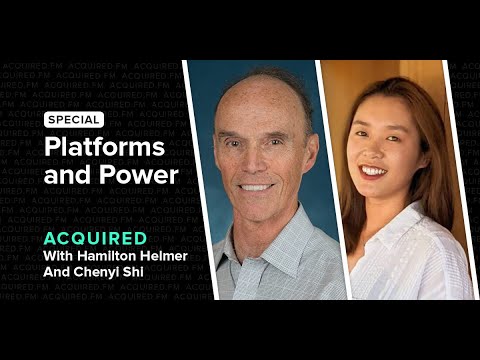
Platforms and Power (with Hamilton Helmer and Chenyi Shi)
Ben Gilbert (host), David Rosenthal (host), Ben Gilbert (host), Hamilton Helmer (guest), Chenyi Shi (guest)
In this episode of Acquired, featuring Ben Gilbert and David Rosenthal, Platforms and Power (with Hamilton Helmer and Chenyi Shi) explores how to analyze platform power beyond product-market fit flywheels The episode introduces an in-progress framework for diagnosing whether a platform can achieve durable power, distinct from merely achieving product-market fit and rapid growth.
How to analyze platform power beyond product-market fit flywheels
The episode introduces an in-progress framework for diagnosing whether a platform can achieve durable power, distinct from merely achieving product-market fit and rapid growth.
Helmer and Shi define platforms broadly as intermediaries that facilitate transactions (not just digital), and argue technology’s key role is lowering transaction costs enough to create new markets.
They propose three core questions: (1) how value is created and how it scales, (2) how each participant segment perceives that value as the platform scales, and (3) what blocks competitors from achieving equivalent value (the “barrier” side of power).
Examples like Uber/Lyft, YouTube, Airbnb, and stock exchanges illustrate how heterogeneity, diminishing returns to scale, and multi-homing determine whether network effects translate into real, defensible power and value capture.
Key Takeaways
Power is a second invention after product-market fit.
Helmer frames company value as two independent step-changes: first create value (PMF), then keep a defensible share of it (power). ...
Get the full analysis with uListen AI
Define platforms by transactions, not technology.
Shi defines a platform as an intermediary for transactions, spanning everything from ancient village matchmakers to Uber. ...
Get the full analysis with uListen AI
Use three questions to diagnose platform power.
(1) Map how economic value is created and how it changes with more participants; (2) model how each side/segment perceives that value as scale grows; (3) identify what prevents competitors from matching the value proposition. ...
Get the full analysis with uListen AI
Heterogeneity determines how quickly scale advantages flatten.
In low-heterogeneity markets (ride-sharing), “good enough” density is reached quickly, so returns to scale flatten early. ...
Get the full analysis with uListen AI
Multi-homing is the central threat to platform power.
If riders/drivers (or buyers/sellers) can easily use multiple platforms, any relative scale advantage can be arbitraged away—customers draw value from the combined pool rather than one platform’s pool. ...
Get the full analysis with uListen AI
Network effects don’t automatically imply power; flywheels can mislead.
Helmer argues flywheels are evidence of PMF, not defensibility—often you can swap a competitor’s logo into a flywheel and it still “works. ...
Get the full analysis with uListen AI
Value capture timing is guided by “surplus leader margin.”
Shi points to surplus leader margin—the maximum premium a leader can charge over the best alternative while still staying the leader. ...
Get the full analysis with uListen AI
Pricing ‘generosity’ can be strategic, not benevolent.
In discussing TSMC vs Apple, Helmer argues lower current extraction can rationally buy future demand certainty, enabling massive lumpy capex and preferential access to scarce suppliers (e. ...
Get the full analysis with uListen AI
Notable Quotes
“There are really two major step changes in the value of a company. The first is product-market fit, and the second is getting power.”
— Hamilton Helmer
“We think of [a platform] as an intermediary for transactions, and that’s it.”
— Chenyi Shi
“Platforms… you don’t own your customers… This is a scenario that we call multi-homing, and… a lot of the differential value… gets arbitraged.”
— Chenyi Shi
“When you see a flywheel, run for the hills.”
— Hamilton Helmer
“Network effects describes only the value creation… without consideration about competition, which… is all power is about.”
— Chenyi Shi
Questions Answered in This Episode
For a given platform, how do you practically measure whether the value-vs-scale curve has already entered the “flat part” (diminishing returns) in each geography or segment?
The episode introduces an in-progress framework for diagnosing whether a platform can achieve durable power, distinct from merely achieving product-market fit and rapid growth.
Get the full analysis with uListen AI
In the Uber/Lyft case, what specific mechanisms (contracts, bundling, memberships, regulation, exclusivity) have historically been effective at reducing multi-homing, and why haven’t they created durable power yet?
Helmer and Shi define platforms broadly as intermediaries that facilitate transactions (not just digital), and argue technology’s key role is lowering transaction costs enough to create new markets.
Get the full analysis with uListen AI
In the YouTube debate—search-cost reduction vs expectation that ‘everything is there’—what data would you collect to determine which driver is more causal for retention and power?
They propose three core questions: (1) how value is created and how it scales, (2) how each participant segment perceives that value as the platform scales, and (3) what blocks competitors from achieving equivalent value (the “barrier” side of power).
Get the full analysis with uListen AI
How should a platform operator decide which side to subsidize versus charge (e.g., users, creators, advertisers), and what are the failure modes when that choice is wrong?
Examples like Uber/Lyft, YouTube, Airbnb, and stock exchanges illustrate how heterogeneity, diminishing returns to scale, and multi-homing determine whether network effects translate into real, defensible power and value capture.
Get the full analysis with uListen AI
Can you give an example where a platform had strong network effects but still failed to achieve “network economies” (power), and what specifically was missing on the barrier side?
Get the full analysis with uListen AI
Transcript Preview
Hey, Acquired listeners, we have some fun news for you. Following hot on the news that we are doing a freaking arena show-
Arena show!
[laughing] At Climate Pledge Arena in Seattle. We are here tonight to announce the very first guest that will be joining us for that show.
Ben, who is it?
It is fresh off his full-page profile in The New York Times this weekend, Jim Weber, the CEO of Brooks Running. We wanted to have a really fun, local Seattle success story, but I think most people have no idea the magnitude of the success story here, or Jim's personal story. It's just fascinating.
We want everything we do for this event to, like, literally check all the Acquired boxes. This checks all the Acquired boxes.
Berkshire Hathaway.
Berkshire Hathaway. Uh, people who don't know, Brooks Running is a very successful, now standalone, division of Berkshire Hathaway. Local Seattle story, amazing, amazing journey. What they went from... Under Jim, they went from, like, de minimis small number of millions of revenue to over a billion in revenue a year, competing with Nike and Adidas.
They were, like, accidentally bought by Berkshire as part of a Fruit of the Loom roll-up, and they were sort of this bland nothing brand, and by-
Yes
... unbelievable, maniacal focus on making fantastic running products, that is how they became the billion-dollar business that they are today.
Not to mention, Jim battled cancer, uh, along the way. Like, so great.
And when you say billion, by the way, we should say billion in revenue. Well, like, this is a profitable, over billion-dollar [chuckles] revenue growing company.
This isn't a billion-dollar valuation. [laughing] That's, that's a billion in, in cash every year. [chuckles] Not cash flow, but revenue.
Yes. So we're very excited to have a conversation with Jim at the event. You should totally come join us. It's May 4th. Doors open at five, with plenty of time for drinks and mingling throughout the event. You can go to acquired.fm/arenashow, or click the link in the show notes to RSVP. We've got a few more details in the previous little mini episode that we released to announce the Arena Show. All proceeds will go to Climate Pledge Arena's philanthropy, the One Roof Foundation. It's twenty dollars to attend, and, uh, we hope to see you there. Acquired.fm/arenashow, or click the link in the show notes.
We're gonna have some more announcements coming over the next couple of weeks, and, uh, it's amazing. People are DM-ing us, saying they're flying in from all over.
[chuckles]
If you live in Seattle, definitely come. If you don't live in Seattle, Alaska Air has great flights-
Great flights
... to SeaTac. This is gonna be a huge party. We're so excited.
[upbeat music] Awesome. Listeners, acquired.fm/arenashow, we'll see you there.
Who got the truth? Is it you? Is it you? Is it you? Who got the truth now? Is it you? Is it you? Is it you? Sit me down, say it straight, another story on the way. Who got the truth?
Install uListen to search the full transcript and get AI-powered insights
Get Full TranscriptGet more from every podcast
AI summaries, searchable transcripts, and fact-checking. Free forever.
Add to Chrome