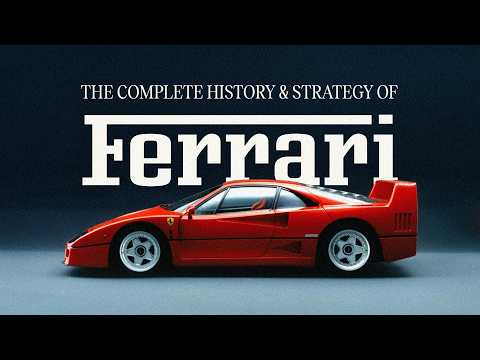
Ferrari: What happens when you staple a luxury brand to a sports team? (Audio)
Ben Gilbert (host), David Rosenthal (host)
In this episode of Acquired, featuring Ben Gilbert and David Rosenthal, Ferrari: What happens when you staple a luxury brand to a sports team? (Audio) explores ferrari’s paradox: ultra-rare cars powering a global cultural obsession Ferrari’s business is built on engineered scarcity—~14,000 cars/year, most allocated to existing owners—to maximize exclusivity while sustaining enormous global awareness.
Ferrari’s paradox: ultra-rare cars powering a global cultural obsession
Ferrari’s business is built on engineered scarcity—~14,000 cars/year, most allocated to existing owners—to maximize exclusivity while sustaining enormous global awareness.
Enzo Ferrari was not merely a racer but a master marketer and entrepreneur who used racing victories, tragedy-laden mystique, and symbolism (prancing horse, rosso corsa) to create desire.
Ferrari’s defining structural advantage was combining under one roof a factory team, customer race cars, and the service ecosystem to support both—turning buyers into participants in the myth.
Ownership transitions (Fiat stake, Luca di Montezemolo’s turnaround, and the post-IPO era) show constant tension between luxury discipline and industrial temptations like volume growth and brand licensing.
Today Ferrari operates like an apex luxury house with automotive engineering: extreme margins, a tiered product pyramid (range → special series → Icona → supercars), and a fanbase (Tifosi) that functions like a sports-team network effect.
Ferrari’s next strategic question is whether the first EV (Ferrari “Luce,” with Jony Ive/Mark Newson) can deliver ‘Ferrari emotion’ in a post-engine world without alienating core devotees.
Key Takeaways
Ferrari sells dreams, not transportation.
The company’s value proposition is emotion, identity, and myth—enabled by racing heritage and cultural symbolism—so conventional auto metrics (units, utility, reliability) are secondary.
Get the full analysis with uListen
Scarcity is a managed system, not a byproduct of low volume.
Ferrari intentionally limits supply (“one car less than demand”), allocates most production to existing owners, and controls waitlists centrally to preserve ‘seeing a Ferrari’ as a rare event.
Get the full analysis with uListen
Racing is Ferrari’s marketing engine and authenticity moat.
Continuous presence in F1 since 1950 and a deep customer-racing ecosystem makes the brand’s performance claims credible—and creates a narrative competitors struggle to replicate.
Get the full analysis with uListen
The under-one-roof model (team + cars + services) created early differentiation.
Ferrari pioneered a bundled product/service proposition where owners could buy a race-capable machine plus the tuning and support to compete, amplifying both results and desirability.
Get the full analysis with uListen
Tragedy and danger were historically baked into the brand’s allure.
Deaths of drivers and spectators—and even condemnation by the Vatican—reinforced Ferrari as ‘forbidden fruit,’ deepening the romance of speed, risk, and transcending death.
Get the full analysis with uListen
Luca di Montezemolo’s turnaround combined luxury discipline with F1 dominance.
He cut production sharply, fixed product quality (e. ...
Get the full analysis with uListen
Ferrari’s profits are disproportionately driven by top-of-pyramid cars.
Limited-run supercars and Icona models (often sold out pre-reveal) likely contribute far more profit than their unit share, smoothing earnings and reinforcing the aspirational ladder.
Get the full analysis with uListen
Ferrari is ‘Hermès + sports team’—inclusive fandom, exclusive ownership.
Unlike most luxury houses, Ferrari can monetize a massive fanbase via sponsorships and controlled merch while owners welcome broad admiration because it raises the status of the asset they hold.
Get the full analysis with uListen
Brand licensing is powerful but dangerous; Ferrari’s history shows both.
Licensing can fund survival (near-100% margin) and serve fans, but missteps (e. ...
Get the full analysis with uListen
The EV transition is a strategic identity test, not just a powertrain shift.
With speed becoming commoditized (e. ...
Get the full analysis with uListen
Notable Quotes
“Today’s episode…is about selling dreams.”
— Ben Gilbert
“I sell engines, and the car I throw in for free.”
— Enzo Ferrari (quoted)
“Aerodynamics are for people who can’t build engines.”
— Enzo Ferrari (quoted)
“An agitator of men.”
— Enzo Ferrari (quoted, self-description)
“Ferrari will always deliver one car less than the market demand.”
— Enzo Ferrari (quoted)
Questions Answered in This Episode
How exactly does Ferrari’s modern allocation system work (central vs. dealer), and what behaviors does it reward or penalize among buyers?
Ferrari’s business is built on engineered scarcity—~14,000 cars/year, most allocated to existing owners—to maximize exclusivity while sustaining enormous global awareness.
Get the full analysis with uListen AI
What specific operational practices keep Ferrari’s ‘one roof’ racing-to-road feedback loop real today, versus mostly symbolic branding?
Enzo Ferrari was not merely a racer but a master marketer and entrepreneur who used racing victories, tragedy-laden mystique, and symbolism (prancing horse, rosso corsa) to create desire.
Get the full analysis with uListen AI
How did Luca di Montezemolo translate luxury-house playbooks (Hermès/LVMH) into an automotive context without breaking the racing myth?
Ferrari’s defining structural advantage was combining under one roof a factory team, customer race cars, and the service ecosystem to support both—turning buyers into participants in the myth.
Get the full analysis with uListen AI
Was the Ford acquisition attempt primarily a genuine exit plan or a deliberate PR/negotiation tactic to raise Ferrari’s leverage with future Italian buyers?
Ownership transitions (Fiat stake, Luca di Montezemolo’s turnaround, and the post-IPO era) show constant tension between luxury discipline and industrial temptations like volume growth and brand licensing.
Get the full analysis with uListen AI
How much of Ferrari’s current profitability is structurally dependent on supercars/Icona launches, and what happens in years without a halo cycle?
Today Ferrari operates like an apex luxury house with automotive engineering: extreme margins, a tiered product pyramid (range → special series → Icona → supercars), and a fanbase (Tifosi) that functions like a sports-team network effect.
Get the full analysis with uListen AI
Transcript Preview
Okay, David, so the question, do you have a favorite Ferrari?
Ooh, that's a tough one. I would never actually wanna get behind the wheel of it, but I think I gotta go with the F40.
Of course.
I remember just being like a kid in elementary school and getting a model of one and thinking like, "Oh my God, this is the most incredible machine that mankind has ever created."
Yeah, it's the defining supercar.
Yes, yes. How about you?
I actually have two. One is the car from Charles Leclerc's wedding.
Ooh.
It's the 1957 250 Testarossa.
Mm.
And the car from Ford v Ferrari, that 1966 330 P3 is just beautiful. It's got these curves. It looks like a spaceship. It's gorgeous.
Ah. Beauty and power, the story of Ferrari.
Yes. All right. Should we do it?
Let's do it.
Who got the truth? Is it you? Is it you? Is it you? Who got the truth now? Hm. Is it you? Is it you? Is it you? Sit me down. Say it straight. Another story on the way. Who got the truth?
Welcome to the Spring 2026 season of Acquired, the podcast about great companies and the stories and playbooks behind them. I'm Ben Gilbert.
I'm David Rosenthal.
And we are your hosts. Almost everyone needs transportation. It is a giant market serving a huge human need, and it is one of the top three things that households spend money on, along with their housing and their food. And the automobile has become the default way that humans move around the world.
And that is not what we're talking about today.
[laughs] And this episode has absolutely nothing to do with any of that. Today's episode, listeners, is about selling dreams.
Ooh, yes.
We are talking about Ferrari, one of the most paradoxical companies that we have ever studied here on Acquired. Ferrari ships very, very few cars, around 14,000 per year. That is approximately the number of Toyotas that are sold every 10 hours.
[laughs]
But of course, we know Toyota and Ferrari are a silly comparison, so what about a company that we have covered in the past? Porsche.
Yeah.
Even Porsche ships 22 times the number of cars that Ferrari does. And yet, even though almost nobody owns a Ferrari, only about 180,000 people globally, they have among the highest brand recognition. I would argue that over a billion people know what a Ferrari is.
Easily.
Which means, David, that Ferrari has the highest ratio of people who know about their products to people who actually own their products of any company in human history.
[laughs] Uh, I, I think we gotta scope it to companies that make products that are nominally available for purchase by consumers, but-
Yes.
But yes. [laughs]
Yes, like the space shuttle is a product, but you can't go, go buy a, a space shuttle.
[laughs] Yeah.
So I would say Ferrari is the only ultra-luxury brand that has reached mass cultural awareness.
Install uListen to search the full transcript and get AI-powered insights
Get Full TranscriptGet more from every podcast
AI summaries, searchable transcripts, and fact-checking. Free forever.
Add to Chrome