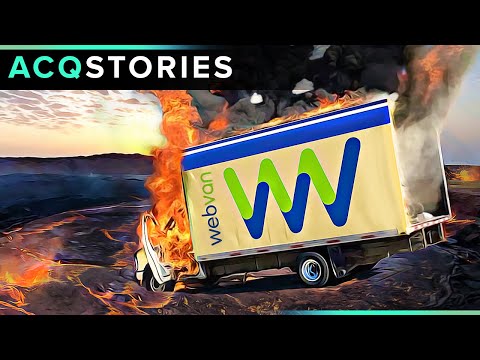
The Downfall of Webvan: Oasis to Smoking Crater
Ben Gilbert (host), David Rosenthal (host)
In this episode of Acquired, featuring Ben Gilbert and David Rosenthal, The Downfall of Webvan: Oasis to Smoking Crater explores webvan’s venture bet, bold timing, and Benchmark’s swagger reboot story Benchmark partner David Byrne championed the ambitious “Oasis” plan (Webvan) as the kind of high-upside, high-risk swing venture firms are supposed to take.
Webvan’s venture bet, bold timing, and Benchmark’s swagger reboot story
Benchmark partner David Byrne championed the ambitious “Oasis” plan (Webvan) as the kind of high-upside, high-risk swing venture firms are supposed to take.
Webvan aimed to be an “everything store” delivered to your door, using groceries as the wedge but aspiring to compete broadly—an ambition even its investors tried to narrow.
The hosts argue Webvan’s initial financing was disciplined in VC terms: a $7M early round split with Sequoia, with Benchmark/Sequoia not repeatedly propping the company up pre-IPO.
They contend Webvan’s reputational “smoking crater” obscures that it briefly reached an $8B market cap, making it a potentially enormous outcome that mostly failed due to timing and market collapse.
Webvan also symbolizes Benchmark regaining “swagger,” later exemplified by letting author Randall Stross deeply embed to write an inside account of the firm (eBoys).
Key Takeaways
Webvan was a VC-appropriate bet, not pure dot-com insanity.
The hosts frame it as exactly the kind of “swagger” investment with asymmetric upside that an early-stage firm should make, especially when sized small relative to the fund.
Get the full analysis with uListen AI
Ambition was both the product thesis and the central tension.
Louis Borders wanted “food and everything” with fast delivery from day one, while Benchmark partners repeatedly pushed to focus on groceries to reduce scope and competitive surface area.
Get the full analysis with uListen AI
Early checks can create massive paper outcomes even if the company later collapses.
Benchmark and Sequoia’s ~$3. ...
Get the full analysis with uListen AI
Not doubling down can be disciplined venture behavior.
The transcript emphasizes that Benchmark/Sequoia did not keep funding Webvan through later mezzanine rounds, suggesting their exposure was bounded rather than an endless capital sink.
Get the full analysis with uListen AI
“Too early” can be indistinguishable from “wrong” in execution-heavy businesses.
They argue the vision resembled today’s Amazon-like convenience but was a decade or two early, implying infrastructure, consumer readiness, and capital markets timing mattered as much as idea quality.
Get the full analysis with uListen AI
Firm culture can pivot around signature swings.
Backing Webvan helped restore Benchmark’s appetite for bold moves, later echoed by allowing unprecedented access to an author-in-residence to document the partnership in eBoys.
Get the full analysis with uListen AI
Notable Quotes
““Well, shit… Have I got the plan for you.””
— Bruce Dunlevie (quoted by Ben Gilbert)
“This is exactly the type of bet you should be making in venture capital.”
— David Rosenthal
“Everyone goes, ‘Webvan, ball of flames… emblematic of dot-com insanity’… [but it’s] a great risk-adjusted bet.”
— David Rosenthal
“You wanna back someone who's got a missionary-focused dream… Go get all the risk you can.”
— David Rosenthal
“You gotta play like there's nothing to lose here.”
— Ben Gilbert
Questions Answered in This Episode
What specific operational constraints made Webvan’s “groceries first, everything next” strategy harder than Amazon’s slower initial delivery model?
Benchmark partner David Byrne championed the ambitious “Oasis” plan (Webvan) as the kind of high-upside, high-risk swing venture firms are supposed to take.
Get the full analysis with uListen AI
If Benchmark partners wanted “just food,” what would a scoped-down Webvan have looked like—different warehouses, delivery promises, or geographic rollout?
Webvan aimed to be an “everything store” delivered to your door, using groceries as the wedge but aspiring to compete broadly—an ambition even its investors tried to narrow.
Get the full analysis with uListen AI
The hosts call Webvan a disciplined bet because Benchmark/Sequoia didn’t follow on—how should VCs decide when *not* to protect an early position?
The hosts argue Webvan’s initial financing was disciplined in VC terms: a $7M early round split with Sequoia, with Benchmark/Sequoia not repeatedly propping the company up pre-IPO.
Get the full analysis with uListen AI
How much of Webvan’s failure was timing (consumer behavior, logistics tech, capital markets) versus avoidable execution mistakes?
They contend Webvan’s reputational “smoking crater” obscures that it briefly reached an $8B market cap, making it a potentially enormous outcome that mostly failed due to timing and market collapse.
Get the full analysis with uListen AI
What does the Webvan story suggest about interpreting ‘paper gains’ (e.g., $8B market cap) when liquidity is constrained by lockups and crashes?
Webvan also symbolizes Benchmark regaining “swagger,” later exemplified by letting author Randall Stross deeply embed to write an inside account of the firm (eBoys).
Get the full analysis with uListen AI
Transcript Preview
So David Byrne arrived at Benchmark with ambitions to contribute to the partnership fast in any way he could, and he had some ideas for new businesses for which he hoped he could find entrepreneurs. One of the concepts that kept nagging him was an e-commerce business that he called MyStore, which would sell online everything for everyday needs. Start with groceries and move toward an online Walmart. We've got some less family-friendly language here, but I'm quoting from the book, so fast-forward if you have little ones listening. "Well, shit," Bruce Dunlevie said when Dave told him his idea as the two sat in Dunlevie's office. "Have I got the plan for you." Dunlevie reached into a stack of papers and pulled out a business plan called Oasis. He tossed it to Byrne, explaining that he and the other partners lacked the balls to do it. Would Byrne be willing to be the guy? And Oasis, of course, is Webvan, which I remember Webvan as a crater, a cautionary tale of what could go wrong in the dot-com excesses. But going back and doing the research here and, and looking at it, this was actually a great bet to make.
Oh, this is exactly the type of bet you should be making in venture capital.
Totally. This is the exact kind of swagger bet with the right aligned asymmetric upside and downside that if you wanna be taking the right kind of risks to establish yourself as one of the premier early-stage venture capital firms, you should be doing.
All right, so what was Webvan?
[laughing] What was the company or what was the deal?
What was the company, and why was it so swagger-filled to do it?
Have we talked about Webvan on every season episode so far in season eleven, I think? [laughing]
[laughing] That might be true.
Yeah, I feel like everybody knows.
The theme of season eleven is Webvan. [laughs]
There we go. There we go.
That's so true. We probably hit it on Walmart and Amazon.
So of course, as we've talked about, it was Louis Borders, the founder of Borders Books, which had then gotten absorbed by Kmart and then spun out, and he had left as part of all that, and he felt like Borders didn't realize his vision. He wanted another big swing, bite at the apple. He knew about Kmart, Walmart. He wanted to build Amazon, what Amazon is today. He wanted to build amazon.com, uh, the modern amazon.com. He was just a couple decades too early. And so that's what Webvan was. It was anything you want, starting with groceries, that was their wedge, but it was anything you want from the web on a van delivered to your doorstep.
And importantly now, Webvan did have the sort of last mile component as the initial founding wedge. Whereas Amazon, they're like, "Yeah, we'll get it to you, and it might take two weeks." And of course, then they get to Prime, and then they get to Prime Now, and now they're trying to do one-day Prime, and all sorts of things can happen the same day if you're spoiled like me and live in Seattle. And Webvan had that from the start, and it was equally ambitious. Louis Borders did want to do food and everything. It was the everything store at the edge, sort of close to your house whenever you want it. And it was so ambitious that even the Benchmark partners, after they invested, kept trying to talk him into, "Could we just do food? Do we have to compete with everything Amazon is doing right away?"
Install uListen to search the full transcript and get AI-powered insights
Get Full TranscriptGet more from every podcast
AI summaries, searchable transcripts, and fact-checking. Free forever.
Add to Chrome