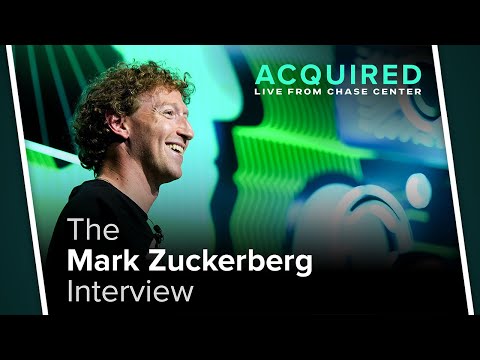
The Mark Zuckerberg Interview
David Rosenthal (host), Ben Gilbert (host), Mark Zuckerberg (guest), Mark Zuckerberg (guest), David Rosenthal (host), David Rosenthal (host), Ben Gilbert (host), Mark Zuckerberg (guest)
In this episode of Acquired, featuring David Rosenthal and Ben Gilbert, The Mark Zuckerberg Interview explores zuckerberg on Meta’s evolution: AI glasses, open platforms, resilience strategy Mark Zuckerberg frames Meta as a “human connection” technology company—not a set of social apps—whose advantage comes from strong engineering, rapid iteration, and learning faster than competitors across tech waves.
Zuckerberg on Meta’s evolution: AI glasses, open platforms, resilience strategy
Mark Zuckerberg frames Meta as a “human connection” technology company—not a set of social apps—whose advantage comes from strong engineering, rapid iteration, and learning faster than competitors across tech waves.
He explains why smart glasses are the next major computing platform: they provide contextual AI assistance (seeing/hearing what you do) and eventually enable holographic “presence,” expanding social interaction beyond phone screens.
Zuckerberg discusses pivotal historical decisions (mobile HTML5 and the IPO-era rewrite, governance after the Yahoo acquisition attempt) and shares his biggest long-term regret: misreading the post-2016 political dynamic and accepting blame too broadly.
He defends major long-horizon bets (Reality Labs, AI infrastructure, Llama/open-source) as both strategic “control our destiny” moves against platform taxes—especially Apple—and as a personal/company shift toward building not just “good,” but “awesome,” inspiring products.
Key Takeaways
Meta’s continuity comes from mission-level identity, not app-level identity.
Zuckerberg argues Meta is built to pursue “human connection” across form factors (web, mobile, glasses), enabling platform shifts without redefining the company each cycle.
Get the full analysis with uListen AI
Iteration speed is a core cultural weapon—distinct from “great engineering.”
He separates technical excellence from the willingness to ship early, collect feedback, and optimize quickly, even at the cost of occasional embarrassment or imperfect first versions.
Get the full analysis with uListen AI
Future social computing is “presence,” and glasses are the enabling form factor.
Glasses can act as always-available AI assistants with real-world context and eventually project holograms, making digital interaction feel physically co-present rather than phone-bound.
Get the full analysis with uListen AI
Open source is not ideology; it’s a market-position strategy.
Meta open-sourced infrastructure (e. ...
Get the full analysis with uListen AI
The mobile HTML5 bet failed, but the response showcased Meta’s execution discipline.
The company paused feature development to rewrite native apps and invent feed ads, accepting near-term pain while mobile usage surged and desktop monetization shrank.
Get the full analysis with uListen AI
Founder control was shaped by early trauma: the Yahoo offer nearly ended Facebook’s independence.
Zuckerberg says the board tried to fire him during the 2006 acquisition push; the governance structure was designed to prevent losing the company’s long-term direction.
Get the full analysis with uListen AI
The deepest mistake wasn’t technical—it was political diagnosis and narrative management.
He believes Meta treated post-2016 attacks like a corporate crisis (own everything) rather than a political arena where some actors sought a scapegoat, and says recovery will take a decade-plus.
Get the full analysis with uListen AI
Notable Quotes
“I don’t apologize anymore.”
— Mark Zuckerberg
“Pathemathos — learning through suffering.”
— Mark Zuckerberg
“Values are not what you write down on the wall. It’s your lived behaviors.”
— Mark Zuckerberg
“When you’re losing, it’s usually pretty clear what you have to do… it’s: do you have the pain tolerance to go do it?”
— Mark Zuckerberg
“We run towards something, we don’t run away from things.”
— Mark Zuckerberg
Questions Answered in This Episode
On glasses: What specific “killer” use case do you expect first—contextual AI assistant, capture/creation, messaging, or holographic presence—and what adoption milestone would confirm it?
Mark Zuckerberg frames Meta as a “human connection” technology company—not a set of social apps—whose advantage comes from strong engineering, rapid iteration, and learning faster than competitors across tech waves.
Get the full analysis with uListen AI
On iteration: How do you decide the boundary between “early enough to learn” and “too unpolished to generate valid user data”? What internal metrics serve as those guardrails?
He explains why smart glasses are the next major computing platform: they provide contextual AI assistance (seeing/hearing what you do) and eventually enable holographic “presence,” expanding social interaction beyond phone screens.
Get the full analysis with uListen AI
On open platforms: For Llama, what’s the concrete mechanism by which openness translates into advantage for Meta (talent, tooling, distribution, safety research, enterprise adoption)?
Zuckerberg discusses pivotal historical decisions (mobile HTML5 and the IPO-era rewrite, governance after the Yahoo acquisition attempt) and shares his biggest long-term regret: misreading the post-2016 political dynamic and accepting blame too broadly.
Get the full analysis with uListen AI
On Apple rivalry: Which “platform taxes” matter most—policy restrictions, economic take rates, ATT-style data limits—and how does owning the next platform change Meta’s business model?
He defends major long-horizon bets (Reality Labs, AI infrastructure, Llama/open-source) as both strategic “control our destiny” moves against platform taxes—especially Apple—and as a personal/company shift toward building not just “good,” but “awesome,” inspiring products.
Get the full analysis with uListen AI
On the 2012 HTML5 mistake: What organizational practices today prevent a similar platform misread in AI (e.g., betting on the wrong deployment model, wrong privacy posture, or wrong hardware form factor)?
Get the full analysis with uListen AI
Transcript Preview
So how many interviews with Mark do you think you watched before tonight?
[chuckles] Oh, to prepare?
Yeah.
[chuckles] Uh, th- thirty to forty? Uh, the, the best ones are the '04 to '06 vintage, but they're all so different. It's almost like every three to four years is a new era that is markedly different from all the previous eras.
Totally. And, uh, I think we might have witnessed the beginning of a new era right in front of us on stage.
[chuckles] Oh, yes, absolutely.
All right, should we do this?
Let's do it.
Who Got the Truth? [upbeat music] Is it you? Is it you? Is it you? Who got the truth now? Is it you? Is it you? Is it you? Sit me down, say it straight. Another story on the way. Who got the truth?
Welcome to the Fall 2024 season of Acquired, the podcast about great companies and the stories and playbooks behind them. I'm Ben Gilbert.
I'm David Rosenthal.
And we are your hosts. Listeners, we have something very special for you today: our interview with Mark Zuckerberg from Acquired live at Chase Center.
Ooh!
Mark is the iconic founder CEO of our time, and this conversation was just too good to hold onto any longer, so we are getting it out quickly before we release the full video of the entire show.
Which, speaking of the full show, [chuckles] was utterly amazing. We had surprise appearances from Jensen Huang, Daniel Ek, Emily Chang, and of course, we had the one and only Mike Taylor, the artist who sings Who Got the Truth, performing live. It was incredible. We've got basically a whole film production that's now happening behind the scenes, with another ninety minutes of content beyond just this Mark interview. We should have that out in the next couple weeks, so stay tuned for that.
First, though, a huge thank you to our partners this season. You know our presenting partner, J.P. Morgan Payments.
And we are also pumped to have two more great returning sponsors this season: Statsig, the world's first product acceleration platform that thousands of companies, from OpenAI to Series A startups, rely on to ship fast, learn more, and make smart decisions. You can find out more about them at statsig.com/acquired.
Sounds a lot like Meta.
[chuckles]
And Crusoe, which is the world's best climate-aligned AI cloud and data center operator that is leading the industrial build-out of AI. Find out more about them at crusoe.ai/acquired. As always, come discuss this afterwards with us in the Slack, acquired.fm/slack. And if you wanna be notified when every new episode drops, sign up at acquired.fm/email.
All right, one more thing before the interview. We need to say a huge, huge thank you to the entire J.P. Morgan Payments team for securing the Chase Center [chuckles] for this, for orchestrating the entire evening. Our partnership this year has been absolutely incredible and gone, I think, way beyond what either of us ever could have imagined.
Install uListen to search the full transcript and get AI-powered insights
Get Full TranscriptGet more from every podcast
AI summaries, searchable transcripts, and fact-checking. Free forever.
Add to Chrome