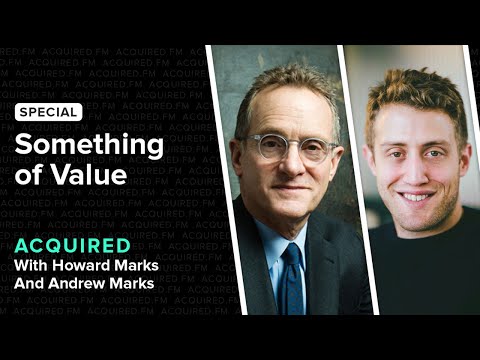
Howard Marks & Andrew Marks: Something of Value
David Rosenthal (host), Ben Gilbert (host), David Rosenthal (host), Howard Marks (guest), Ben Gilbert (host)
In this episode of Acquired, featuring David Rosenthal and Ben Gilbert, Howard Marks & Andrew Marks: Something of Value explores value vs growth investing: open-mindedness, judgment, and selling discipline discussed Howard Marks (Oaktree) and his son Andrew Marks (TQ Ventures) discuss their co-authored memo “Something of Value,” using a father–son dialogue to bridge classic value/credit frameworks with modern tech and venture realities.
Value vs growth investing: open-mindedness, judgment, and selling discipline discussed
Howard Marks (Oaktree) and his son Andrew Marks (TQ Ventures) discuss their co-authored memo “Something of Value,” using a father–son dialogue to bridge classic value/credit frameworks with modern tech and venture realities.
A central theme is avoiding rigid labels (“value” vs “growth”) and instead grounding decisions in discounted future cash flows, price vs intrinsic value, and the need for second-level thinking amid increasingly efficient, information-rich markets.
They explore why disruption and accelerating technology change both increase uncertainty and expand upside through global and adjacent-market scale, making qualitative judgment about the future more important than ever.
The conversation culminates in a nuanced debate on selling: when taking profits is rational (capped upside) versus when it destroys returns (rare compounding machines), and how firm-building choices should match temperament and strengths.
Key Takeaways
Don’t hardwire “value” vs “growth”—all equities are DCFs.
They argue every stock’s value is the discounted sum of future cash flows; the difference is how far out the cash flows are and how uncertain they are. ...
Get the full analysis with uListen AI
Open-mindedness is a core edge; rigidity is a profit killer.
Marks credits early high-yield success to going where others had rules and prejudices (“we don’t do that”). ...
Get the full analysis with uListen AI
Price matters as much as quality—great companies can be terrible investments.
The Nifty Fifty illustrates how “no price too high” thinking can lead to massive losses despite strong underlying businesses. ...
Get the full analysis with uListen AI
Complex modern companies require deeper, less “knee-jerk” analysis.
Amazon is used to show how superficial income-statement conclusions missed favorable cash dynamics and strategic optionality (e. ...
Get the full analysis with uListen AI
Disruption makes durability harder—but makes scale-based compounding more powerful.
They describe faster “Darwinism” (winners/losers faster) alongside increasing returns to scale (global distribution, adjacency expansion). ...
Get the full analysis with uListen AI
Selling should be reframed as “unbuying,” not reacting to price moves.
Both criticize selling merely because something is up or down (regret avoidance). ...
Get the full analysis with uListen AI
Know which assets are capped-upside vs compounding machines.
Howard’s credit/value roots fit “buy $1 for $0. ...
Get the full analysis with uListen AI
Firm-building strategy must match the nature of the investing game—and your temperament.
Oaktree scaled with culture, process, and complementary partner roles (client-facing vs investing), while TQ stays narrow to maximize time spent on investing and founder relationships. ...
Get the full analysis with uListen AI
Notable Quotes
“When you go to an auction and you sit down, take your seat, and you see there are no other bidders… that’s usually a good thing.”
— Howard Marks
“Moody said, “These bonds are not proper for investment regardless of price.” How can that be?”
— Howard Marks
“If you see a chart of a stock that’s been up for twenty-five years… think of all the days you would’ve had to talk yourself out of selling.”
— Andrew Marks
“The path to exceptionality cannot come through doing what everybody else does.”
— Howard Marks
“Most people sell because they’re up or because they’re down.”
— Howard Marks
Questions Answered in This Episode
In “Something of Value,” what specific indicators help you distinguish “good losses” (smart reinvestment) from “bad losses” (value destruction) in growth companies?
Howard Marks (Oaktree) and his son Andrew Marks (TQ Ventures) discuss their co-authored memo “Something of Value,” using a father–son dialogue to bridge classic value/credit frameworks with modern tech and venture realities.
Get the full analysis with uListen AI
How would you operationalize “optional profitability” in analysis—what evidence proves a company can choose profitability later rather than merely hoping?
A central theme is avoiding rigid labels (“value” vs “growth”) and instead grounding decisions in discounted future cash flows, price vs intrinsic value, and the need for second-level thinking amid increasingly efficient, information-rich markets.
Get the full analysis with uListen AI
Andrew: when you model a venture outcome, what are your core inputs for probability-of-success and eventual market structure (competition, moats, adjacency)?
They explore why disruption and accelerating technology change both increase uncertainty and expand upside through global and adjacent-market scale, making qualitative judgment about the future more important than ever.
Get the full analysis with uListen AI
Howard: in today’s market where disruption is faster, how has Oaktree’s definition of “predictability” evolved, especially in credit underwriting?
The conversation culminates in a nuanced debate on selling: when taking profits is rational (capped upside) versus when it destroys returns (rare compounding machines), and how firm-building choices should match temperament and strengths.
Get the full analysis with uListen AI
Can you share an example where a widely held qualitative narrative (great team, great market) was fully reflected in price—how did you decide to pass?
Get the full analysis with uListen AI
Transcript Preview
All right, I think we figured it out.
Andrew, I think you have a bright future in technology.
I appreciate it. [laughing]
Especially Windows technology.
Yeah, you should invest in some tech startups.
[laughing]
[laughing]
Who got the truth? Is it you? Is it you? Is it you? Who got the truth now? Is it you? Is it you? Is it you? Sit me down. Say it straight. Another story on the way. Who got the truth?
Welcome to this special episode of Acquired, the podcast about great technology companies and the stories and playbooks behind them. I'm Ben Gilbert. I am the co-founder and managing director of Seattle-based Pioneer Square Labs, and our venture fund, PSL Ventures.
And I'm David Rosenthal, and I am an angel investor based in San Francisco.
And we are your hosts. Today, we have two guests with very different investment styles: a value investor and a growth-oriented tech investor, head-to-head! But not just any investors. We are joined today by the legendary value investor, Howard Marks, the co-founder of Oaktree Capital Management, and his son, Andrew Marks, the co-founder of TQ Ventures. Oaktree, for those who don't know, is one of the leading investment management firms in the world, specializing in alternative investments, with a hundred and fifty-nine billion dollars in assets under management as of the end of June 2022.
Probably far fewer of you know Andrew and his firm, TQ Ventures, but what they've accomplished so far is pretty equally impressive in a very different field. So as we'll talk about, TQ is an early-stage venture firm that Andrew and his partners started about five years ago. They have a billion dollars under management now, including, I think, a five hundred million dollar third fund that they just closed just a couple months ago. I can say I do know that their returns so far have been top decile across all venture funds raised during that time period in all of those vintages. We got to know Andrew over the years as a Acquired community member and listener, and then I've gotten to know him in the context of Kindergarten Ventures, my angel list fund that I manage with Nat Manning. And a little over a year ago, Andrew and Howard co-authored one of Howard's famous memos together in a departure for Howard, where they were debating over COVID together as a family, as father and son, value investing versus growth investing and tech investing, and what was going on in the markets, and they turned it into a memo, and it ended up becoming... we'll talk about it on the episode, Howard's most popular memo ever, which is incredible in a career spanning many, many decades as one of the most popular authors of investment memos.
Oh, Howard's memos and books are among the most coveted in the entire investing landscape. Even Warren Buffett is quoted in saying, "When I see memos from Howard Marks in my mail, they're the first thing I open and read. I always learn something." Well, if you wanna discuss these topics with us after you listen, you should come join the Acquired community at acquired.fm/slack. Our new merch store is available at acquired.fm/store. You can listen to The LP Show by searching Acquired LP Show in the podcast player of your choice, or get new episodes two weeks early at acquired.fm/lp. Now, we are very excited to welcome back to Acquired our presenting sponsor, Vanta, the leader in automated security and compliance. We are enormous fans of Vanta, and now investors, and their approach to the whole compliance process, SOC 2, HIPAA, GDPR, and more. And we've got CEO and co-founder Christina Cacioppo back with us today.
Install uListen to search the full transcript and get AI-powered insights
Get Full TranscriptGet more from every podcast
AI summaries, searchable transcripts, and fact-checking. Free forever.
Add to Chrome