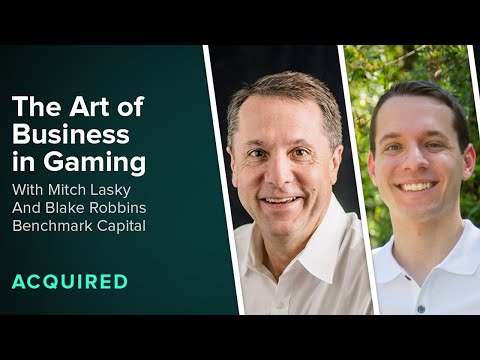
Benchmark’s Mitch Lasky and Blake Robbins on The Art of Business in Gaming
Mitch Lasky (guest), David Rosenthal (host), Ben Gilbert (host), Blake Robbins (guest), Ben Gilbert (host)
In this episode of Acquired, featuring Mitch Lasky and David Rosenthal, Benchmark’s Mitch Lasky and Blake Robbins on The Art of Business in Gaming explores gaming’s business models shape creativity, distribution, and enduring platform power. Mitch Lasky and Blake Robbins explain that the history of gaming is best understood through business-model shifts that constrain and enable creative output, from packaged goods to free-to-play and from retail to digital platforms.
Gaming’s business models shape creativity, distribution, and enduring platform power.
Mitch Lasky and Blake Robbins explain that the history of gaming is best understood through business-model shifts that constrain and enable creative output, from packaged goods to free-to-play and from retail to digital platforms.
They break down why “forever games” and platform-based publishing create today’s durability, why distribution leverage beats “great content” alone, and how platforms like Steam and Tencent accrued power.
The conversation also covers cloud gaming’s demand moment, esports as game marketing (and why many team businesses struggle), and why Web3 gaming only becomes promising when real game makers use it to enhance—not replace—traditional models.
They close with practical perspectives on reinvestment in live ops, why paid acquisition can become addictive, and where AI may meaningfully reduce costs and expand capabilities (art pipeline, QA/balancing, live ops, and AI-assisted dungeon mastering).
Key Takeaways
Creative “genius” is real, but business models set the boundaries.
Lasky argues designers are constrained by monetization and distribution: packaged goods required planned obsolescence and repeat purchases, shaping what could be put “on the disc” and how franchises like FIFA iterated annually.
Get the full analysis with uListen AI
Free-to-play didn’t just change pricing—it changed what games must be.
Free-to-play demands different design: retention loops, social play, economies, and ongoing content. ...
Get the full analysis with uListen AI
Durability now comes from two distinct forces: forever games and platform-based publishing.
Forever games extend play patterns through live ops; platform-based publishers aggregate demand and use it to reduce CAC and launch new products. ...
Get the full analysis with uListen AI
Distribution is king; “great game” is table stakes, not a plan.
They stress most venture-backed games must assume quality is expected; without a credible distribution wedge (community, platform leverage, pre-qualified audience), “launch on Steam and pray” rarely yields venture-scale outcomes.
Get the full analysis with uListen AI
Steam won by starting as an updater, then compounding features into a platform.
Built to patch/validate/piracy-proof Valve games, Steam gradually added community, storefront, mods, and network effects—becoming the default PC distribution channel even for companies with their own launchers.
Get the full analysis with uListen AI
Cloud gaming’s timing is demand-driven: new audiences want AAA without owning hardware.
Earlier streaming attempts faced a mismatch—people who wanted AAA already had consoles/PCs. ...
Get the full analysis with uListen AI
Cross-play materially increases monetization, making console worth it once PMF is proven.
Lasky notes Fortnite disclosures suggested cross-play users monetized like “new whales. ...
Get the full analysis with uListen AI
Live ops is as capital-intensive as building the original game—and often more strategic.
Keeping a forever game fresh (events, cosmetics, balancing, safety/toxicity tooling) can cost as much annually as pre-launch development. ...
Get the full analysis with uListen AI
Esports is mostly a marketing engine for the game, not a standalone goldmine for teams.
Top orgs can build real brands via content and merch, but many teams remain financially strained. ...
Get the full analysis with uListen AI
Web3 in games only works when it adds to existing models and avoids speculation traps.
They’re skeptical of “NFT-first” games; the hopeful path is game-native use (e. ...
Get the full analysis with uListen AI
AI’s near-term impact is production leverage, not fully AI-generated hit games.
They expect early wins in art pipelines (asset variations), QA/balancing (AI playtesting and arbitrage detection), live ops personalization (dynamic quests), and AI-assisted “dungeon mastering” for emergent narrative play.
Get the full analysis with uListen AI
Nintendo’s next hardware decision could define whether it becomes a modern platform.
They argue backward compatibility + more open third-party economics would unlock an “app store” opportunity and stop re-aggregating users every cycle; non-compatibility would signal a return to a toy/hardware-first posture.
Get the full analysis with uListen AI
Notable Quotes
“In the packaged goods era… it’s gotta have a degree of planned obsolescence to it.”
— Mitch Lasky
“Distribution is king… today, in 2023, distribution is king.”
— Mitch Lasky
“You fish where the fish are.”
— Mitch Lasky
“You should just assume every venture-backed studio is an amazing game.”
— Blake Robbins
“Most of [esports]… is accruing benefit to the League of Legends… because that’s really what it’s functioning as.”
— Mitch Lasky
Questions Answered in This Episode
Forever games: What are Mitch’s “rules” or diagnostic signals that a game can truly endure 5–10+ years?
Mitch Lasky and Blake Robbins explain that the history of gaming is best understood through business-model shifts that constrain and enable creative output, from packaged goods to free-to-play and from retail to digital platforms.
Get the full analysis with uListen AI
Steam vs Epic: What specific product/market structure advantages keep Epic from denting Steam despite Fortnite scale and subsidies?
They break down why “forever games” and platform-based publishing create today’s durability, why distribution leverage beats “great content” alone, and how platforms like Steam and Tencent accrued power.
Get the full analysis with uListen AI
Nintendo thesis: What concrete signs would confirm Nintendo is moving toward backward compatibility + a more open marketplace (and what would falsify it)?
The conversation also covers cloud gaming’s demand moment, esports as game marketing (and why many team businesses struggle), and why Web3 gaming only becomes promising when real game makers use it to enhance—not replace—traditional models.
Get the full analysis with uListen AI
Distribution wedges: For a new studio today, what are the top 3 credible distribution advantages you’d actually underwrite as venture investors?
They close with practical perspectives on reinvestment in live ops, why paid acquisition can become addictive, and where AI may meaningfully reduce costs and expand capabilities (art pipeline, QA/balancing, live ops, and AI-assisted dungeon mastering).
Get the full analysis with uListen AI
Paid UA addiction: Where’s the line between “smart paid acquisition” and the slippery slope Mitch warns about—what metrics or behaviors signal danger?
Get the full analysis with uListen AI
Transcript Preview
I will say, I wanna give you guys just a, a pre-recording compliment. I forget what it's called, I- there's a name for it, but basically, it's where you're reading something in the newspaper about something that you were a part of, right? And you go, "People don't know anything," right? "This is so damn stupid." And then you turn the page, and there's something about foreign affairs, and you're like, "Wow, super interesting." Like, the thing you know about, you don't apply that same logic to the second thing. And I have to say, I have so much trust in your podcast because the stuff that you do that I was a part of, and there are many things you've done that you don't know that I was a part of, that I was a part of. [laughing]
[laughing] Oh.
You guys are so good. Like, it's so accurate. It is really remarkable. Somehow you're able to tell a story that is actually as close to true as, as true exists.
Well, the secret is, we don't have people on the show, so-
Right. [laughing]
... this is not gonna be that, but- [laughing]
Who got the truth? Is it you, is it you, is it you? Who got the truth now? Is it you, is it you, is it you? Sit me down, say it straight, another story on the way. Who got the truth?
Welcome to this special episode of Acquired, the podcast about great technology companies and the stories and playbooks behind them. I'm Ben Gilbert.
I'm David Rosenthal.
And we are your hosts. After our deep dives into Nintendo and Sega, we wanted to do something special to cap off our gaming extravaganza, and we wanted that something to be a special with guests who are actually in the belly of the beast of the gaming industry. Fortunately, we knew just the people. So today, our conversation is with Mitch Lasky and Blake Robbins. Mitch is perhaps the best games investor of all time, generating literally billions of dollars of returns from early investments in Riot Games, Discord, and That Game Company, not to mention Snapchat. Mitch was also an executive vice president at both EA and Activision, and took his own gaming company, Jamdat, public in 2004. Mitch, of course, was a partner at Benchmark in the Fab Five era that we chronicled on our Benchmark episode.
Which actually, we stole that line from Mitch when we were talking to him- [laughing]
[laughing]
... in the research, and that's how he referred to it.
So we are joined by Mitch and Blake Robbins, Benchmark's current principal, who has also come up on previous episodes. Blake is one of the best thinkers in the world on the gaming landscape today, and Mitch and Blake just launched an incredible podcast called Gamecraft, that chronicles the history of the gaming industry from the business perspective.
And one other thing, if you are listening to this on the audio feed, we did a full video on this. It's up on YouTube. You can find it on our website or there. Uh, we did it at Benchmark's Woodside office, at, it turns out, they have another triangle table. [laughing]
Install uListen to search the full transcript and get AI-powered insights
Get Full TranscriptGet more from every podcast
AI summaries, searchable transcripts, and fact-checking. Free forever.
Add to Chrome