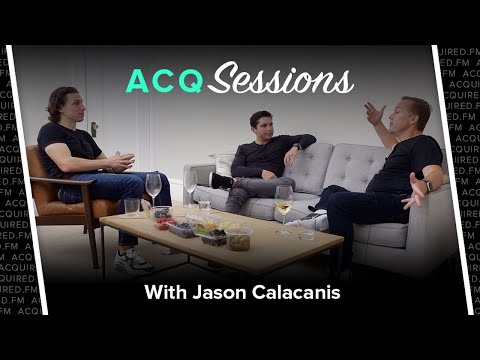
ACQ Sessions: Jason Calacanis
David Rosenthal (host), Ben Gilbert (host), Jason Calacanis (guest), Ben Gilbert (host), Jason Calacanis (guest), David Rosenthal (host)
In this episode of Acquired, featuring David Rosenthal and Ben Gilbert, ACQ Sessions: Jason Calacanis explores jason Calacanis on podcasting, venture, motivation, and San Francisco’s future In this first “Acquired Sessions,” Ben Gilbert and David Rosenthal go off-script with Jason Calacanis to explore his path from early tech media to podcasting power (This Week in Startups, All-In) and high-velocity angel/venture investing.
Jason Calacanis on podcasting, venture, motivation, and San Francisco’s future
In this first “Acquired Sessions,” Ben Gilbert and David Rosenthal go off-script with Jason Calacanis to explore his path from early tech media to podcasting power (This Week in Startups, All-In) and high-velocity angel/venture investing.
Calacanis explains why All-In broke out: genuine chemistry and conflict, intentional “character” framing, and a moderation style inspired by Howard Stern and The McLaughlin Group—plus an information edge from being “inside” tech.
He describes a post-pandemic life realignment driven partly by Tony Hsieh’s death: eliminate draining work (legal/ops), focus on energizing work (daily podcasting, helping builders), and adopt a guiding rule—“not for me”—by delegating everything that doesn’t fit his strengths.
The discussion spans “democratizing” venture through syndicates and public fundraises, the merits/limits of meritocracy narratives, Bay Area political dysfunction, and how media presence compounds into deal flow, brand, and long-term impact.
Key Takeaways
All-In scaled because it packaged real debate into a repeatable, character-driven format.
Calacanis says the conflicts aren’t scripted, but he intentionally shaped roles (e. ...
Get the full analysis with uListen AI
Great moderation is about serving the audience, not winning arguments.
He pauses guests to unpack jargon and reframes comments so non-insiders (his “dentist in Reno” example) can follow along. ...
Get the full analysis with uListen AI
Being ‘inside the flow’ yields a structural information advantage over traditional journalism.
Calacanis contrasts founder/investor networks—where you can hear the full context—with journalism’s partial access (“5–35% of a story”). ...
Get the full analysis with uListen AI
Sustained output becomes easier when you remove energy-draining work via delegation.
After reflecting on mortality (Tony Hsieh’s death), Calacanis cut out tasks he hates (legal, HR, accounting) and built a 22-person org so the hardest work is often “not for me. ...
Get the full analysis with uListen AI
Publicly raising a venture fund can be a distribution hack—if you already have attention.
He explains 506(c) fundraising, why he’s leaning into webinars and audience-driven LP sourcing, and how podcast reach expands capital access. ...
Get the full analysis with uListen AI
Early-stage ‘legendary’ wins often hinge on qualitative signals like design and velocity.
Using Calm as a formative example, he describes a heuristic approach (a “nine factors” list plus an anti-list of red flags). ...
Get the full analysis with uListen AI
Media properties can be hugely valuable even when you don’t monetize them directly.
Calacanis estimates All-In as a standalone asset at ~$50–100M, but argues the true value is indirect: brand, access, and deal flow that could create nine- or ten-figure outcomes from a single great investment sourced through the show.
Get the full analysis with uListen AI
California’s risk is not just taxes—it’s political hostility toward builders.
He argues the Bay Area’s narrative and policy choices (e. ...
Get the full analysis with uListen AI
Notable Quotes
“The pod’s gotten very big… It has nothing to do with tech anymore.”
— Jason Calacanis
“I did craft with All-In. I was very premeditated in creating some character… arcs.”
— Jason Calacanis
“People are like, ‘That’s a lot of work.’ But… not for me.”
— Jason Calacanis
“I literally do not care about more money.”
— Jason Calacanis
“If you haven’t secured the bag yet… there’s nothing like getting home with the bag.”
— Jason Calacanis
Questions Answered in This Episode
You mentioned you intentionally created character arcs (e.g., “Sultan of Science”). What other specific ‘show mechanics’ did you design for All-In that listeners might not notice?
In this first “Acquired Sessions,” Ben Gilbert and David Rosenthal go off-script with Jason Calacanis to explore his path from early tech media to podcasting power (This Week in Startups, All-In) and high-velocity angel/venture investing.
Get the full analysis with uListen AI
You cited The McLaughlin Group as an influence. What moderation techniques did you borrow—and which did you later decide were mistakes because they push the show toward debate over conversation?
Calacanis explains why All-In broke out: genuine chemistry and conflict, intentional “character” framing, and a moderation style inspired by Howard Stern and The McLaughlin Group—plus an information edge from being “inside” tech.
Get the full analysis with uListen AI
You reject being the real-time fact-checker for Sacks. Where do you draw the line between letting ideas compete and preventing misinformation from taking hold?
He describes a post-pandemic life realignment driven partly by Tony Hsieh’s death: eliminate draining work (legal/ops), focus on energizing work (daily podcasting, helping builders), and adopt a guiding rule—“not for me”—by delegating everything that doesn’t fit his strengths.
Get the full analysis with uListen AI
You said journalism often has only “5–35% of a story.” What practices should podcasts adopt to avoid overconfidence from being ‘inside’ and still validate claims?
The discussion spans “democratizing” venture through syndicates and public fundraises, the merits/limits of meritocracy narratives, Bay Area political dysfunction, and how media presence compounds into deal flow, brand, and long-term impact.
Get the full analysis with uListen AI
On fundraising in public (506(c)): what are the operational risks (compliance, LP management load, adverse selection) that first-time public fundraisers underestimate?
Get the full analysis with uListen AI
Transcript Preview
[upbeat music] So wait, it was a magazine when you started?
Magazine, yeah.
Magazine, that's how I started, yeah.
You said-
Magazines was, like, the original platform for-
Wait, are we star- have we started?
... Silicon Alley.
I guess we've started.
This is, this is the trick, we've just been recording the whole time.
We just started, yeah, the whole time. [chuckles]
Yeah, but that, I don't know-
Welcome to Acquired Sessions.
All that stuff that you said beforehand-
Yeah
... that, like, was really juicy, I don't think we should put that in.
No, definitely not.
[laughs]
Definitely not. No, we don't wanna tell people where the bodies are buried. Well, cheers, boys.
Cheers!
Here we go. We're... This is the... Is this the first one, or- [glasses clink]
This is the first-
First one
... in real life.
Wow, IRL.
But I think this is our ninth, tenth together, something like that?
A lot between the two pods, yeah, for sure. Great to know you, boys. [sighs]
So this is the first Acquired Sessions.
Acquired Sessions. I feel like I should get out a guitar here and just play some Dylan. [laughs]
[laughs] This is, this is your baby. What is Acquired Sessions?
Acquired Sessions is, normally on the show, we are, like, so scripted-
Yeah, you are
... and we have a great time, we do four-hour episodes. You know, it's awesome. But, uh, really, for folks like you, who we know really well-
Yeah
... what happens if we throw out the script?
And just chop it up?
And we just chop it up.
David Rosenthal unplugged. [laughs]
Wow, love it.
[laughs]
Love it. This is the literally MTV Unplugged.
Literally.
That's great.
So... Well, we, the, we, we have no agenda, obviously, but, um-
No agenda.
Wait, where do you wanna start? We gotta thank Vanta.
Oh, yes.
Oh, Vanta! I'm an investor.
We're investors, too.
Well, great. They're an awesome company. Big, uh, supporter of podcasts, so yeah, go Vanta.
We are huge fans of Vanta and their approach to the whole compliance process, SOC 2, HIPAA, GDPR, and more, and we've got CEO and co-founder Christina Cacioppo back with us today.
Vanta was already the best place to check the box and get security compliance certified, but now you've just launched Vanta Trust Reports, which take things even further. Tell us about that, and how they can help companies deepen their relationships and trust with their customers and partners over time.
Really excited about these. So actually, a bit of, uh, not yet told Vanta history, but something like Vanta Trust Reports, honestly, a much worse, much more poorly designed version by yours truly, uh, which I can say that, uh, were launched in the very early days of Vanta, when we wanted to help companies get secure and prove that security, but weren't yet convinced we wanted to or had to go all through the nuances of what a SOC 2 was. So we figured, "Hey, let's just make this report of the best security practices. Let's check companies against those practices all the time, and make this live and updating, visible and transparent. This should help these companies prove their security and grow their business, and it should also help them be more secure, because they've got this report, like, this kind of security status page out in the wild." So 2017, Vanta tried this and found out that no one really knew what a Vanta report was, and everyone wanted a SOC 2. So flash forward to 2022 [laughs] and it's actually really exciting. [laughs]
Install uListen to search the full transcript and get AI-powered insights
Get Full TranscriptGet more from every podcast
AI summaries, searchable transcripts, and fact-checking. Free forever.
Add to Chrome