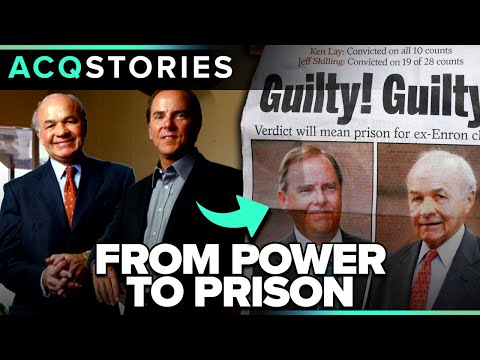
Enron: From power to prison
David Rosenthal (host), Ben Gilbert (host)
In this episode of Acquired, featuring David Rosenthal and Ben Gilbert, Enron: From power to prison explores enron’s reinvention: branding, trading innovation, and early seeds of fraud The episode traces Enron’s early Ken Lay era, beginning with a corporate refounding: a new name, a new Houston-centered identity, and an ambition to modernize energy markets.
Enron’s reinvention: branding, trading innovation, and early seeds of fraud
The episode traces Enron’s early Ken Lay era, beginning with a corporate refounding: a new name, a new Houston-centered identity, and an ambition to modernize energy markets.
It then describes Enron’s first major trading scandal—embezzlement and massive losses—highlighting Lay’s tendency to protect “productive” traders and tolerate unethical behavior.
From there, the hosts explain Enron’s shift from pipelines into a proto-financial institution: spot markets evolving into energy derivatives and a strategy Skilling dubbed a “bank for gas.”
The segment ends with the crucial enabling mechanism: Jeff Skilling’s insistence on mark-to-market accounting, a powerful but easily abused approach that Enron would become the first non-financial company to adopt.
Key Takeaways
Enron’s rebrand wasn’t cosmetic—it signaled a strategic reset.
The name change to “Enron” and the move to Houston reinforced Ken Lay’s break from the legacy pipeline identity and supported a forward-looking story meant to attract talent, capital, and political goodwill.
Get the full analysis with uListen AI
The first trading scandal revealed a permissive ethics culture early.
When traders were caught falsifying trades and funneling money to personal accounts, Lay initially resisted firing them because they were profitable—implicitly teaching the organization that results could outweigh integrity.
Get the full analysis with uListen AI
A near-fatal loss was survived partly by timing, not discipline.
After being spared, the traders went “risk-on” and created nearly $1B in losses; Enron survived largely because the quarter’s timing allowed partial recovery and limited reported damage—reducing pressure for deep reform.
Get the full analysis with uListen AI
Trading started as market-making for logistics, then became the business.
Traders originally helped match supply and demand and quoted spreads in a still-immature market; this “interface” function became a wedge that turned Enron into a proto-financial institution.
Get the full analysis with uListen AI
Skilling’s “bank for gas” reframed energy as a securitizable product.
Instead of just facilitating spot trades, Enron aimed to buy rights to future production, slice and repackage it, and sell structured contracts—effectively importing investment-banking logic into commodities.
Get the full analysis with uListen AI
Derivatives had legitimate hedging value before speculation took over.
The hosts emphasize the early, “innocent” use case: utilities locking in prices to reduce uncertainty—while warning that markets can shift toward trading the instrument itself rather than the underlying commodity.
Get the full analysis with uListen AI
Mark-to-market accounting was the critical enabler—and a liability.
Skilling made mark-to-market a condition of joining, because it allowed Enron to book projected future profits as current earnings; as the first non-financial firm to do this, Enron gained flexibility that also created massive room for subjective valuation and manipulation.
Get the full analysis with uListen AI
Notable Quotes
“They want to name it Enteron.”
— Ben Gilbert
“Enteron is actually a medical term… the intestinal digestive tract… particularly used for embryos.”
— Ben Gilbert
“They were funneling money to their own bank accounts.”
— David Rosenthal
“What if Enron… [became] a ‘bank for gas.’”
— Ben Gilbert (quoting Jeff Skilling’s phrase)
“Mark-to-market accounting… is the epitome of ‘With great power comes great responsibility.’”
— David Rosenthal
Questions Answered in This Episode
In the first trading scandal, what concrete controls did Enron “set up,” and why weren’t they sufficient to prevent the subsequent $1B loss?
The episode traces Enron’s early Ken Lay era, beginning with a corporate refounding: a new name, a new Houston-centered identity, and an ambition to modernize energy markets.
Get the full analysis with uListen AI
How much of Enron’s early success came from genuine market innovation (spot + derivatives) versus regulatory arbitrage and narrative-driven investor confidence?
It then describes Enron’s first major trading scandal—embezzlement and massive losses—highlighting Lay’s tendency to protect “productive” traders and tolerate unethical behavior.
Get the full analysis with uListen AI
What specific incentives did Lay face that made him reluctant to fire profitable-but-unethical traders—and how common is this pattern in trading cultures?
From there, the hosts explain Enron’s shift from pipelines into a proto-financial institution: spot markets evolving into energy derivatives and a strategy Skilling dubbed a “bank for gas.”
Get the full analysis with uListen AI
When does a derivative market cross the line from hedging utility to pure speculation, and what early signals were visible at Enron?
The segment ends with the crucial enabling mechanism: Jeff Skilling’s insistence on mark-to-market accounting, a powerful but easily abused approach that Enron would become the first non-financial company to adopt.
Get the full analysis with uListen AI
How exactly did Enron’s producer-financing deals work (rights, covenants, profit split), and what risks did Enron take on by acting like a lender?
Get the full analysis with uListen AI
Transcript Preview
They were funneling money to their own bank accounts.
[laughing] Yeah. If the story were to stop there, this probably would be a great company.
This shows how unbelievably savvy he is. He, he sort of realized he couldn't build a business.
Well, he is effing smart, according to him.
Yeah. Could not build the business that he wanted to without doing this.
So Lay's now settled in, he's in charge, he's the chairman, he's the CEO, and he decides that he wants to get a new name for this company. You know, HNG, InterNorth, that, you know, it sounds too old, and, you know, it's reeking of his predecessor.
And it is true that a- all these energy companies had, like, just the worst names. I mean, it's all these, like, completely meaningless prefixes and suffixes, like Co. and Corp. and Inter-, and it's like in Office Space, Intertek. They're all named something like that.
Yes. Well, [chuckles] maybe this is the beginning of the modern era of that because they go and they hire very expensive naming and branding consultants. The logo would actually come a little later, but including, uh, a few years later, Paul Rand would design-
Unbelievable
... the Enron logo. This would be the last logo that the legendary-
Oh, really?
-Paul Rand designed before he died.
He, of course, designed the IBM logo, the, uh-
NeXT.
NeXT logo, the UPS logo, maybe?
And he very much has his style. Like, you think the IBM logo, or if you know the NeXT logo, you know, Steve Jobs' NeXT, like, uh, the Enron logo, like, they're all kind of in the same style.
ABC, Yale Press, Westinghouse.
Oh, Westinghouse.
Yeah.
My grandfather worked for Westinghouse.
Really?
Yeah. Ah, legendary. Enron would be the last logo he designed before he died. Oof, what a legacy.
[chuckles]
So the naming consultants, separate from Paul, they come up with a brilliant new idea for the company. They want to name it Enteron.
Almost, almost.
Lay loves it! The board loves it, Lay loves it, everybody's so excited. They announce the name. And the name comes from, it's a portmanteau, N-E-N for energy, T-E-R as a nod to InterNorth, get that, you know, legacy back in there, and then On at the end because it sounds cool and modern. Enteron. [laughing] So they announce it. Um, they didn't check, though, that, uh, in the dictionary, because enteron is actually a medical term. It is a word, it is a medical term, it comes from a Greek word, and it means the intestinal digestive tract of a living creature and is particularly used for embryos. So, like, the digestive tract of embryos is an enteron. So, uh, they kind of get pilloried in the press for this. Lay, you know, he's so concerned about appearances and, you know, political, like, he goes nuts. Like, L- Lay never loses his cool, as we'll see throughout this story. Like, he loses his cool here.
Install uListen to search the full transcript and get AI-powered insights
Get Full TranscriptGet more from every podcast
AI summaries, searchable transcripts, and fact-checking. Free forever.
Add to Chrome