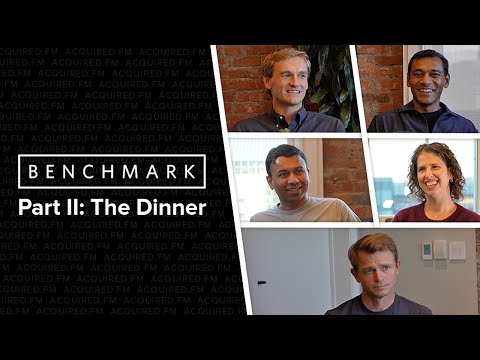
Benchmark Part II: The Dinner
David Rosenthal (host), Ben Gilbert (host), Ben Gilbert (host), David Rosenthal (host), Ben Gilbert (host)
In this episode of Acquired, featuring David Rosenthal and Ben Gilbert, Benchmark Part II: The Dinner explores inside Benchmark’s no-agenda dinner: culture, focus, and commitment playbook Acquired is invited to record Benchmark’s storied “dinner” tradition: an open-ended, no-agenda forum designed to build social cohesion, surface curiosity, and reinforce non-hierarchical truth-seeking.
Inside Benchmark’s no-agenda dinner: culture, focus, and commitment playbook
Acquired is invited to record Benchmark’s storied “dinner” tradition: an open-ended, no-agenda forum designed to build social cohesion, surface curiosity, and reinforce non-hierarchical truth-seeking.
Benchmark partners explain how habits—not strategies—compound into firm character, and why avoiding memos, pre-selling, and rigid meeting agendas protects authenticity and collective judgment.
They unpack the firm’s defining trade-offs: staying small, remaining early-stage, rejecting a growth fund to avoid conflicted incentives, and measuring success by fund multiples and asymmetric outcomes rather than AUM.
The group shares concrete examples of founder support in crises, lessons from high-profile failures (e.g., Docker), sourcing challenges of a tiny team, and how new partners are selected through long, lived working relationships.
Key Takeaways
Benchmark treats culture as a compounding set of habits, not a written strategy.
They argue venture firms become “collections of habits,” so they deliberately institutionalize curiosity and cohesion (e. ...
Get the full analysis with uListen AI
The dinner format is engineered to produce one conversation and deconstruct power.
The custom table eliminates a “head,” prevents sidebars, and forces shared context—mirroring Benchmark’s Monday meeting norm of collective engagement and reducing internal politics.
Get the full analysis with uListen AI
They remove internal persuasion mechanisms to protect truth-seeking.
No memos and “no pre-selling” aim to prevent ego, bias, and hallway lobbying; partners want to react to the founder directly and discuss what was actually learned rather than what was “authored.”
Get the full analysis with uListen AI
Benchmark frames investments as rare, high-intensity commitments, not portfolio ‘bets.’
Partners describe making only 1–2 commitments per year each, which creates deeper relationships and a higher expectation of showing up—emotionally and operationally—at key moments.
Get the full analysis with uListen AI
Being small is a deliberate anti-conflict design choice, not just nostalgia.
They argue a growth fund would adulterate the founder relationship by reintroducing pricing incentives, round preemption motives, and internal time sinks (pipeline management, staffing, LP marketing).
Get the full analysis with uListen AI
Their model aims to help founders raise better later rounds while taking less dilution.
By not needing to “go long” with follow-on capital, Benchmark believes founders can optimize market pricing without pressure for insider preemption; the brand plus process expertise improves round quality and investor fit.
Get the full analysis with uListen AI
They value ‘good failures’ as evidence of still taking real venture risk.
Webvan is cited as a “perfect venture failure,” and they emphasize judging themselves partly by the quality of their misses—contrarian, worthwhile shots—rather than avoiding embarrassment.
Get the full analysis with uListen AI
Notable Quotes
“Social connection is not something that's transaction. It's fluid, it's fun, it's playful. There is no agenda.”
— Benchmark partner (unnamed in transcript segment)
“Job number one, don't fuck it up.”
— Eric Vishria
“We want no part of this firm to become the incumbent.”
— Benchmark partner (likely Peter Fenton)
“Each of us make one or two of these commitments a year… they’re not bets.”
— Sarah Tavel
“One measure of quality for the firm will be how good our failures are. Webvan was… the perfect venture failure.”
— Benchmark partner (likely Peter Fenton)
Questions Answered in This Episode
How do you decide, in real time, that a conversation has enough “truth” to commit without the forcing function of a memo?
Acquired is invited to record Benchmark’s storied “dinner” tradition: an open-ended, no-agenda forum designed to build social cohesion, surface curiosity, and reinforce non-hierarchical truth-seeking.
Get the full analysis with uListen AI
What specific prompts or facilitation techniques keep the no-agenda Monday meeting from drifting into shallow roaming conversation?
Benchmark partners explain how habits—not strategies—compound into firm character, and why avoiding memos, pre-selling, and rigid meeting agendas protects authenticity and collective judgment.
Get the full analysis with uListen AI
You say removing a growth fund reduces conflicts—are there any conflicts it creates (e.g., less ability to defend ownership, signaling to markets)?
They unpack the firm’s defining trade-offs: staying small, remaining early-stage, rejecting a growth fund to avoid conflicted incentives, and measuring success by fund multiples and asymmetric outcomes rather than AUM.
Get the full analysis with uListen AI
Can you share an anonymized example where “vulnerability” broke down with a founder and how you repaired it one-on-one?
The group shares concrete examples of founder support in crises, lessons from high-profile failures (e. ...
Get the full analysis with uListen AI
On Docker, what were the 2–3 key strategic mistakes that led to value destruction despite massive product adoption?
Get the full analysis with uListen AI
Transcript Preview
I've spent a lot of time in, in, in, in, in Europe, and the dinners are about three hours, maybe three and a half hours long. So unlike the-
That's an Acquired episode. [laughing]
Yeah. [laughing]
There you go. And that's the whole point, is that social connection is not something that's transaction. It's fluid, it, it's fun, it's playful. And, and so the idea is people are coming out beaming, smiling after a dinner, as opposed to, um, you know, this sort of rigid structure of a typical dinner with an agenda. There is no agenda.
No agenda.
Yeah.
No agenda.
I don't have an agenda today.
The agenda is to come together. [laughing]
[upbeat music] Who got the truth? Is it you? Is it you? Is it you? Who got the truth now? Hm. Is it you? Is it you? Is it you? Sit me down, say it straight, another story on the way. Who got the truth?
Welcome to Season 11, Episode 5 of Acquired, the podcast about great technology companies and the stories and playbooks behind them. I'm Ben Gilbert, and I am the co-founder and managing director of Seattle-based Pioneer Square Labs, and our venture fund, PSL Ventures.
And I'm David Rosenthal, and I'm an angel investor based in San Francisco, where we were for this very episode.
Indeed, and we are your hosts. Last episode, we told the four-hour story of Benchmark, the legendary venture capital firm that stayed small while all their competitors ballooned in size. At the end of the episode, we mentioned that their partner meeting had this dinner at the end of it, where the five equal partners of Benchmark sit down for an open-ended discussion, sometimes with a special guest. Well, we were talking with the Benchmark partners about that last episode, and they invited us to be their guest for one of these dinners, and for the first time ever, record it, even on video. So we are so pumped to share this with all of you. We got to ask them about a lot of the open questions we had about the future of balancing those out-there consumer investments with their B2B portfolio, how they think about making sure that they see that next world-changing company, the pressure of inheriting a top venture firm and trying desperately not to mess it up, and of course, there's some good war stories from the portfolio companies in there, too, David.
Indeed, indeed. Bet, this was such a special episode on so many fronts. This is, by far, is a record on an Acquired episode for number of guests that we have concurrently.
Oh, we had seven microphones running.
We had to buy, like, $5,000 worth of gear just for this episode. [chuckles] I think it was worth it, though.
Next time, I need to account for the fact that there will be, uh, violent laughter when I'm setting the audio levels, 'cause we had a blast, and you'll definitely hear it when you listen. Well, for our presenting sponsor on this episode, we have a company that you know very well at this point, Fundrise, and this very interesting thing they've been sharing with us this whole season called the Fundrise Innovation Fund, that enables their customers not just to invest in real estate, but also private, late-stage growth tech companies. So we are back today with Ben Miller, the CEO and co-founder, to dive a little deeper into the model.
Install uListen to search the full transcript and get AI-powered insights
Get Full TranscriptGet more from every podcast
AI summaries, searchable transcripts, and fact-checking. Free forever.
Add to Chrome