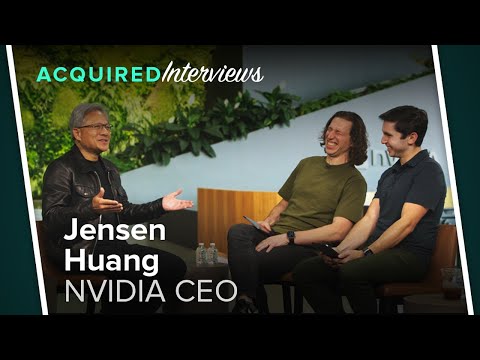
NVIDIA CEO Jensen Huang
Ben Gilbert (host), David Rosenthal (host), Jensen Huang (guest), David Rosenthal (host), Ben Gilbert (host), David Rosenthal (host)
In this episode of Acquired, featuring Ben Gilbert and David Rosenthal, NVIDIA CEO Jensen Huang explores jensen Huang on NVIDIA’s bets, platforms, and AI’s future economy Jensen Huang explains how NVIDIA survived early existential risk with the Riva 128 by “pulling risk forward” through emulation, full-stack software readiness, and a one-shot production mindset.
Jensen Huang on NVIDIA’s bets, platforms, and AI’s future economy
Jensen Huang explains how NVIDIA survived early existential risk with the Riva 128 by “pulling risk forward” through emulation, full-stack software readiness, and a one-shot production mindset.
He traces the company’s long arc from graphics to a developer-first platform strategy (UDA → CUDA), emphasizing architectural compatibility and ecosystem building as the core of durable advantage.
Huang details NVIDIA’s intentional pivot toward the data center (starting with GeForce Now and remote graphics) and why high-performance networking (Mellanox/InfiniBand) became essential for distributed AI training.
He closes with pragmatic views on AI: prioritize safety and human-in-the-loop deployment, expect job shifts but likely net job creation via prosperity, and underscores how psychologically hard company-building is without deep support systems.
Key Takeaways
When you “bet the company,” pre-validate as much as physics allows.
Huang frames big bets as pulling future risk into the present: emulate hardware, build the full software stack, run QA early, and only then commit to production/scale-up.
Get the full analysis with uListen AI
Desperation can reveal the right operating system—then keep it.
NVIDIA’s Riva 128 “one shot” forced process innovations (simulation, parallel software development, aggressive go-to-market timing) that became enduring best practice.
Get the full analysis with uListen AI
Platforms start with developers, not moats.
NVIDIA’s earliest strategy (DirectNV/UDA) was developer-oriented; CUDA later extended that by leveraging the GPU install base to create a durable platform ecosystem.
Get the full analysis with uListen AI
Architectural compatibility is a non-negotiable platform rule.
Huang argues a compute platform can’t exist if each generation breaks compatibility; NVIDIA treats “every chip runs CUDA” as the company’s only unbreakable rule.
Get the full analysis with uListen AI
AlexNet wasn’t just a product moment—it was a first-principles unlock.
Huang recognized deep learning as a scalable ‘universal function approximator’ and reasoned that if it scales, it can reprogram most software and reshape computer architecture.
Get the full analysis with uListen AI
NVIDIA’s data center dominance was paved by earlier ‘small’ data center products.
GeForce Now and remote graphics built operational muscle (systems, deployment, reliability) that later made DGX and AI infrastructure execution possible at scale.
Get the full analysis with uListen AI
AI training is distributed computing; networking becomes the computer.
Huang distinguishes hyperscale virtualization from AI’s single-job-across-many-processors reality, making InfiniBand-class networking and Mellanox-like capabilities strategic, not optional.
Get the full analysis with uListen AI
Organize around the product architecture and shared information, not hierarchy.
He describes NVIDIA as a ‘computing stack’ where teams are wired like a neural network; information dissemination reduces power gradients, increasing pressure on leaders to reason well.
Get the full analysis with uListen AI
Win by building ‘zero-billion-dollar markets’ a decade early.
NVIDIA repeatedly enters markets before they exist (gaming, workstations, accelerated computing, automotive, Omniverse) so that when demand arrives, competitors aren’t shaped correctly yet.
Get the full analysis with uListen AI
AI’s labor impact is likely job reshuffling before net job loss.
Huang predicts productivity drives prosperity, which funds expansion into new initiatives; individuals are still at risk, so the actionable advice is to learn AI to stay competitive.
Get the full analysis with uListen AI
Notable Quotes
“If you only had six months and you get to tape out just one time, then obviously you're gonna tape out a perfect chip.”
— Jensen Huang
“When you bet the farm, you're saying, 'I'm gonna take everything in the future, all the risky things, and I'm gonna pull it in advance.'”
— Jensen Huang
“Mission is the boss.”
— Jensen Huang
“We are the only accelerator on the planet where every single accelerator is architecturally compatible with the others… That's the only unnegotiable rule in our company.”
— Jensen Huang
“I wouldn't do it… building NVIDIA turned out to have been a million times harder than I expected it to be.”
— Jensen Huang
Questions Answered in This Episode
On Riva 128: what specific tests or acceptance criteria did you require in emulation before you were willing to go straight to production?
Jensen Huang explains how NVIDIA survived early existential risk with the Riva 128 by “pulling risk forward” through emulation, full-stack software readiness, and a one-shot production mindset.
Get the full analysis with uListen AI
You describe ‘prefetching’ the future via simulation—what are NVIDIA’s modern equivalents (digital twins, workload replay, synthetic data) for today’s systems?
He traces the company’s long arc from graphics to a developer-first platform strategy (UDA → CUDA), emphasizing architectural compatibility and ecosystem building as the core of durable advantage.
Get the full analysis with uListen AI
CUDA as an extension riding on a paid-for graphics install base is a powerful strategy—what are the best and worst-case scenarios for that model as AI shifts toward custom silicon?
Huang details NVIDIA’s intentional pivot toward the data center (starting with GeForce Now and remote graphics) and why high-performance networking (Mellanox/InfiniBand) became essential for distributed AI training.
Get the full analysis with uListen AI
You say architectural compatibility is non-negotiable—what technical compromises or opportunity costs has that forced over 30 years?
He closes with pragmatic views on AI: prioritize safety and human-in-the-loop deployment, expect job shifts but likely net job creation via prosperity, and underscores how psychologically hard company-building is without deep support systems.
Get the full analysis with uListen AI
On language models: which capabilities did you find genuinely surprising versus ‘predictable’ from first principles (compression of text + scale)?
Get the full analysis with uListen AI
Transcript Preview
I will say, David, I would love to have NVIDIA's full production team every episode. It was nice not having to worry about turning the cameras on and off and making sure that nothing bad happened to myself while we were recording this.
Yeah, just the gear. I mean, the drives that came out of the camera.
All right, uh, Red cameras for the home studio starting next episode.
Yeah, great.
All right, let's do it.
Who got the truth? Is it you? Is it you? Is it you? Who got the truth now? Is it you? Is it you? Is it you? Sit me down, say it straight. Another story on the way. Who got the truth?
Welcome to this episode of Acquired, the podcast about great technology companies and the stories and playbooks behind them. I'm Ben Gilbert.
I'm David Rosenthal.
And we are your hosts. Listeners, just so we don't bury the lead, this episode was insanely cool for David and I.
Yeah.
After researching NVIDIA for something like five hundred hours over the last two years, we flew down to NVIDIA headquarters to sit down with Jensen himself. And Jensen, of course, is the founder and CEO of NVIDIA, the company powering this whole AI explosion. At the time of recording, NVIDIA is worth one point one trillion dollars and is the sixth most valuable company in the entire world. And right now is a crucible moment for the company. Expectations are set high. I mean, sky-high. They have about the most impressive strategic position and lead against their competitors of any company that we've ever studied. But here's the question that everyone is wondering: Will NVIDIA's insane prosperity continue for years to come? Is AI going to be the next trillion-dollar technology wave? How sure are we of that? And if so, can NVIDIA actually maintain their ridiculous dominance as this market comes to take shape? So Jensen takes us down memory lane with stories of how they went from graphics to the data center to AI, how they survived multiple near-death experiences. He also has plenty of advice for founders, and he shared an emotional side to the founder journey toward the end of the episode.
Yeah, I got new perspective on the company and on him as a founder and a leader just from doing this, despite, [chuckles] you know, we thought we knew everything before we came in advance, and, uh, it turned out we didn't.
Turns out the protagonist actually knows more. [chuckles]
Yes. [chuckles]
All right, well, listeners, join the Slack. There is incredible discussion of everything about this company, AI, the whole ecosystem, and a bunch of other episodes that we've done recently going on in there right now. So that is acquired.fm/slack. We would love to see you. And without further ado, this show is not investment advice. David and I may have investments in the companies we discuss, and this show is for informational and entertainment purposes only. On to Jensen. So, Jensen, this is Acquired, so we want to start with story time. So we want to wind the clock all the way back to, I believe it was nineteen ninety-seven. You're getting ready to ship the Riva 128, which is one of the largest graphics chips ever created in the history of computing. It is the first fully 3D-accelerated graphics pipeline for a computer.
Install uListen to search the full transcript and get AI-powered insights
Get Full TranscriptGet more from every podcast
AI summaries, searchable transcripts, and fact-checking. Free forever.
Add to Chrome